



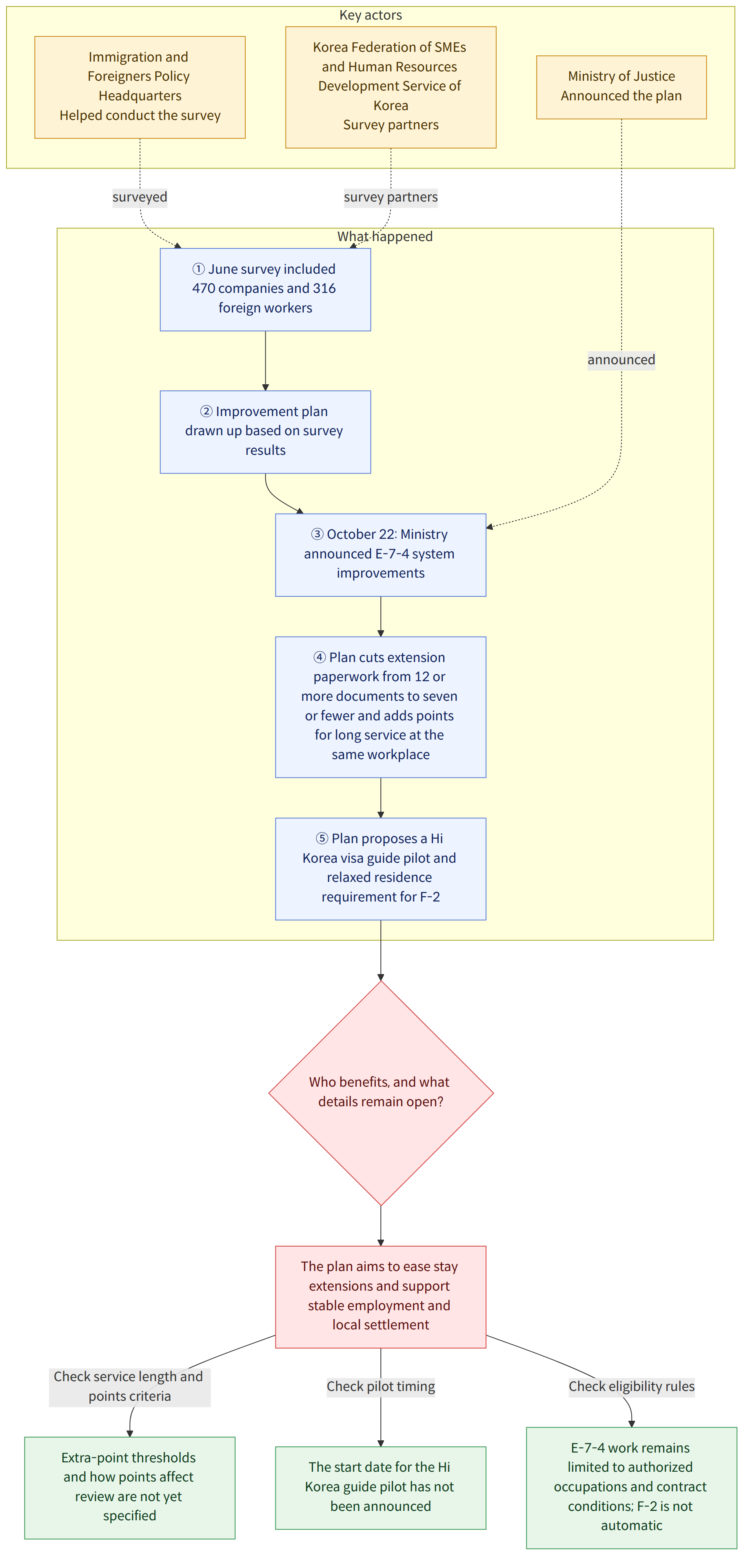
On October 22, the Ministry of Justice announced plans to improve the Skilled Worker (숙련기능인력, E-7-4) system. The goal is to help foreign workers who have worked in Korea for a long time maintain stable employment and settle in local communities. The plan includes reducing the paperwork required to extend a period of stay from 12 or more documents to seven or fewer, and awarding additional points based on length of service to people who have worked for a long time at the same workplace.
Background and context
The improvement plan was drawn up based on the results of a survey conducted in June by the Ministry of Justice’s Immigration and Foreigners Policy Headquarters (출입국·외국인정책본부), the Korea Federation of SMEs (중소기업중앙회), and the Human Resources Development Service of Korea (한국산업인력공단). The survey included 470 companies and 316 foreign workers. The Ministry of Justice said the changes are not intended to bring in more foreign workers, but to help those who have contributed to Korean industry over a long period continue working stably and settle in local communities.
As a procedural improvement, the plan proposes a pilot of an “Employment Visa Guide” (고용비자 가이드) on Hi Korea (하이코리아), the government’s portal for services for foreign residents and visas. Companies and foreign workers will be able to use the guide to check the required documents and application procedures. However, the information made public does not say when the pilot will begin.
The plan is notable because it aims to address long-term employment and stability of stay alongside paperwork simplification. It plans to award additional points based on length of service to workers who have spent a long time at the same workplace and to relax the residence requirement for switching to a long-term F-2 visa. However, it has not yet specified the length of service or number of points required to receive the additional points, or the precise criteria for the relaxed residence requirement.
What this news means
Reducing the paperwork burden for foreign workers could ease the effort involved in preparing to extend a period of stay. In particular, awarding points based on length of service to long-serving workers could give people an institutional advantage for choosing to stay at the same workplace. Companies, too, may find it easier to prepare applications if they have a source of guidance on the required documents and application procedures.
For example, a worker who has been at the same workplace for a long time and is preparing to extend a period of stay may be able to check the shorter document list and whether additional points based on length of service apply. However, the information released so far does not make clear how long a person must have worked to receive points or how those points will factor into the E-7-4 review. Until detailed criteria for actual applications are established, it is difficult to treat the benefits as confirmed.
Relaxing the residence requirement for switching to F-2 status could be a significant change for workers considering a long-term stay. The article describes F-2 as a visa regarded as a pathway to obtaining permanent residency. Even so, this announcement alone does not mean that E-7-4 workers will automatically qualify for F-2 status or obtain permanent residency. The scope of the relaxed residence requirement and other review conditions will need to be checked separately.
Related systems and support information
According to the in-house visa guide, E-7 is a status of stay for foreign nationals who have a contract with a public or private institution in Korea, among others, and intend to work in an occupation designated by the Ministry of Justice. E-7-4 is a points-based category for skilled workers, and having E-7 status does not mean a person can work in any occupation. They must work in an authorized occupation and under an employment contract, and must also check the qualification requirements for that occupation and the requirements for the employer.
The documents listed in the in-house guide for extending a period of stay include an application form, passport and alien registration card; an employment contract; proof of personal income; a copy of the business registration certificate or a corporate registry extract; proof of residence; and records of the employer’s payments and certificates related to national and local taxes. This is the existing guidance listed in the guide; the announcement that extension paperwork will be reduced to seven or fewer documents does not mean that the list will be reduced to precisely these items. The types of documents that will actually be eliminated and the submission process should be checked when new guidance is released.
Changing or adding a workplace may also require prior approval or a subsequent report, depending on the occupation. The in-house guide says that, if a subsequent report is required, it must be filed within 15 days of the event giving rise to the obligation. Therefore, anyone planning to change workplaces should first check whether their occupation requires approval or a report.
F-2 is a status of stay that includes people seeking to reside in Korea long term in order to obtain permanent resident status, and the application route and required documents vary by applicant category. The in-house guide describes several categories, including points-based applicants with outstanding qualifications, as well as separate review procedures. However, it does not specify which categories will be covered by the relaxed residence requirement in the E-7-4 improvement plan or how it will apply. Therefore, do not mistake general F-2 guidance for confirmed eligibility or requirements under these changes; once the specific criteria for switching status are announced, compare them with the route and documents applicable to your situation.
The E-7-4 points system and the F-2 status-change system may have separate reviews and requirements. Additional points for long service should not be interpreted as guaranteeing a change to F-2 status or the acquisition of permanent resident status.
What is confirmed and what is not yet known
Confirmed
- The Ministry of Justice announced plans to improve the E-7-4 system on October 22.
- The improvement plan was drawn up based on the results of a June survey involving 470 companies and 316 foreign workers.
- Paperwork for extending a period of stay is set to be reduced from 12 or more documents to seven or fewer.
- The plan is to award additional points to long-serving workers based on their length of service and relax the residence requirement for switching to F-2 status.
- The plan is to pilot an Employment Visa Guide on Hi Korea, where companies and foreign workers can check documents and application procedures.
Not yet known
- When will the improvement plan actually take effect, and when will the Employment Visa Guide pilot begin?
- What length of service will be required to receive additional points, and how will the points be calculated?
- By how much, and for which applicants, will the residence requirement for switching to F-2 status be relaxed?
- Which extension documents will be eliminated, and which applications will the simplified process apply to first?
What readers should check
- If you are preparing to extend your period of stay, check whether the plan has taken effect and review the new document list. Keep in mind that guidance may differ before and after the changes, and check which criteria apply when you submit your application.
- If you are planning to change or add a workplace, check whether your occupation requires prior approval and, if a subsequent report is required, whether it must be filed within 15 days of the event giving rise to the obligation.
- If you are considering switching to F-2 status, check whether the detailed criteria for relaxing the residence requirement have been released, then compare the application route and documents with those applicable to your status and applicant category.
If you are dealing with a similar issue, attorney Ji-sun Ahn of Ijun Law Firm can review your employment and stay history, any recommendation, and documents supporting a visa change or points application with you. These details can help clarify which options apply to your situation.

















