The Broken Promise: Jisoo Kim's Legal Deadlock
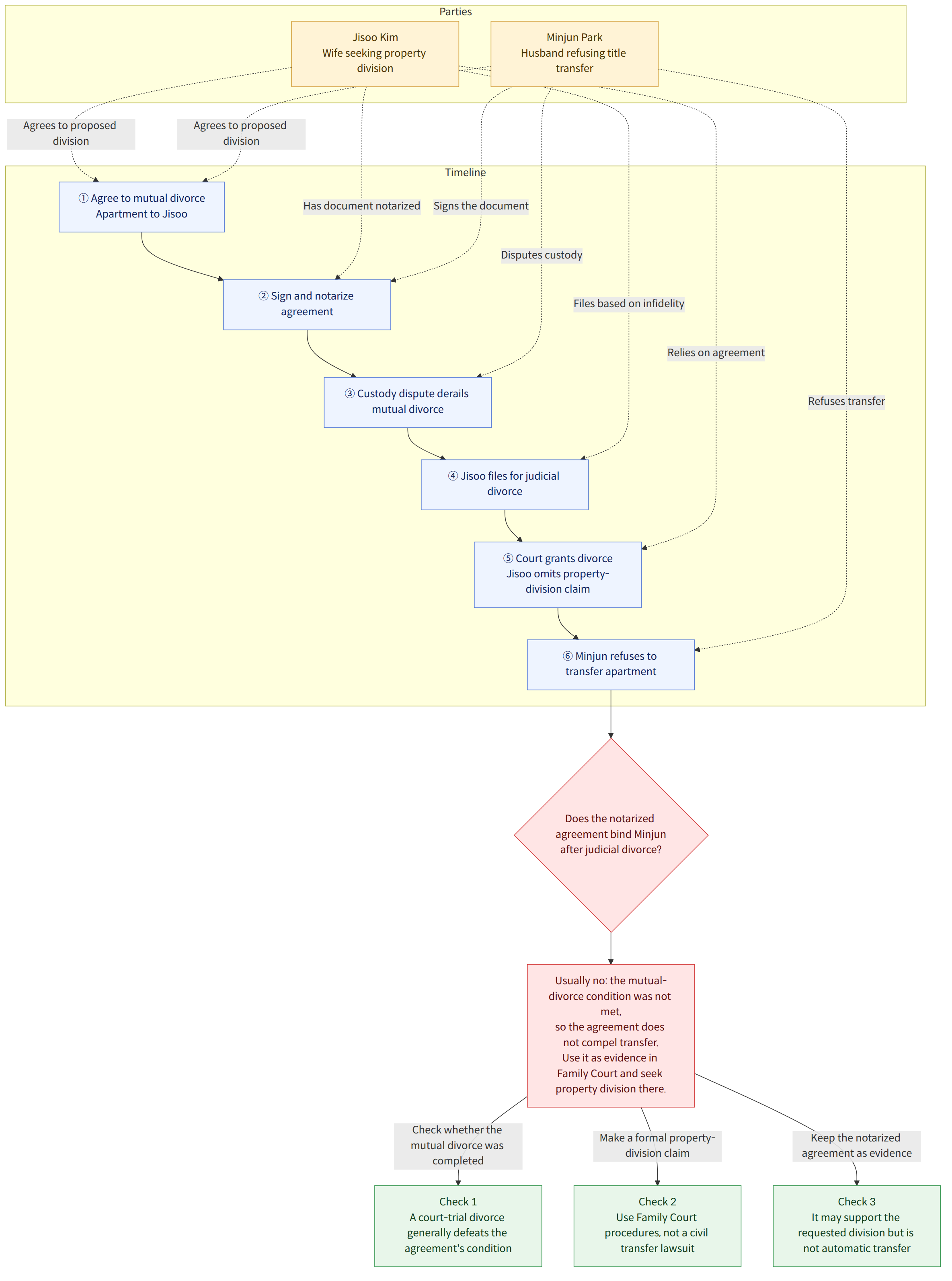
Jisoo Kim decided to end her 15-year marriage with her husband, Minjun Park, after discovering his infidelity. Despite the betrayal, Jisoo wanted to keep things quiet for the sake of their children. The couple initially agreed on a 'Mutual Agreement Divorce.' They even signed a formal document stating that the apartment, currently under Minjun’s name, would be transferred to Jisoo. To be safe, Jisoo had the document notarized by a public notary.
However, their cooperative spirit evaporated when they began fighting over the custody of their son. The mutual divorce fell through. Left with no choice, Jisoo filed for a judicial divorce (litigation) based on Minjun's infidelity and eventually won the case. Relying on the notarized agreement, she didn't specifically ask the court for property division during the trial, assuming the house was already legally hers. But after the divorce, Minjun's tone changed. "That agreement was only if we divorced peacefully," he claimed, refusing to sign the title transfer. "Now that you sued me, that paper is garbage."
The Legal Question: Does a Pre-Divorce Agreement Survive a Court Trial?
The core of this dispute lies in whether a property division agreement made in anticipation of a mutual divorce maintains its legal binding power if the marriage is eventually dissolved through a court judgment (judicial divorce) rather than the intended mutual agreement.
What Korean Law Says: The Doctrine of Conditional Effectiveness
Korean courts interpret property division agreements made before a mutual divorce as a 'conditional declaration of intent.' This means the agreement is legally valid only if the specific condition—finalizing the divorce through mutual agreement—is met.
Supreme Court Principle:"An agreement on property division made while the parties are still married but planning to divorce by mutual agreement is, in principle, a conditional agreement. Unless special circumstances exist, its effectiveness is contingent upon the completion of the mutual divorce. If that divorce does not happen and the marriage is dissolved by a court trial, the agreement becomes void due to the 'non-fulfillment of the condition.'"
Therefore, the agreement usually loses its effect if:
- One party files for litigation instead of pursuing the mutual agreement process.
- The mutual agreement process is initiated but withdrawn before completion.
- The divorce is finalized via mediation or reconciliation in court (unless a new agreement is made during that process).
How Korean Courts Approach This
Judges view mutual divorce agreements as a package of compromises. When a couple moves to a courtroom battle, the court assumes that the previous spirit of compromise is gone. Since litigation involves a full review of assets, contributions, and faults, the law prevents one party from cherry-picking a previous agreement that was made under different circumstances.
Furthermore, this is a matter of Family Law, not general Civil Law. You cannot simply file a civil lawsuit for 'transfer of ownership' based on a voided agreement; you must resolve the asset distribution through the Family Court's specialized procedures.
Applying the Law to Jisoo’s Case
In Jisoo’s situation, the notarized agreement she holds is technically void because the condition (mutual divorce) was never fulfilled. Minjun is legally correct in claiming that the document no longer binds him to transfer the house automatically. Jisoo's attempt to file a civil lawsuit for the transfer would likely be dismissed.
However, Jisoo is not entirely without hope. While the agreement isn't a binding contract anymore, it serves as powerful evidence in a Family Court trial. Under Article 839-2 of the Civil Act, the court considers 'all circumstances' when dividing assets. The fact that Minjun once agreed to give her the house can be used as a significant factor in her favor to prove her contribution or the intended distribution of wealth.
Conclusion: What Happened, and What Should You Do?
Jisoo must stop trying to enforce the agreement through civil channels and instead file a request for property division in the Family Court immediately. She should present the notarized document as evidence of their original intent to secure a favorable court order for the apartment transfer.
For readers in similar situations, keep these two tips in mind:
- First, never assume a pre-divorce agreement is self-executing. If your mutual divorce turns into a lawsuit, ensure your lawyer includes a formal claim for 'Property Division' in the divorce complaint. Do not rely on old notarized papers to do the work for you.
- Second, understand the limits of notarization. A notary's seal proves the document was signed by the parties, but it does not magically override the legal requirement that the 'condition' (the mutual divorce) must be fulfilled for the contract to be valid.