On September 29, 2026, the U.S. Supreme Court (미국 연방대법원) allowed deportation flights to continue while it reviews the legality of the third-country deportation policy. As a result, flights to Liberia could resume. At least 20 people deported from the United States have reportedly been transferred to Liberia so far.
Transfers to Liberia are not just a matter of current U.S. deportation policy. Because they are connected to the country’s past efforts to send people of African descent whom the United States considered “undesirable” to West Africa, the policy’s human rights and constitutional questions should be considered alongside its historical context.
Background and context
Liberia is a country in West Africa, about the size of Ohio. It was described as one of 35 countries to which the Trump administration pays for accommodation and meals for Latin Americans and others living in the United States without appropriate legal status. However, the reports say only that some of the receiving countries are known for corruption and human rights abuses; they do not apply the same assessment to Liberia itself.
According to the article, most deportees have no ties to the host country. One Colombian national who arrived in Liberia on August 20 told PBS that they had never heard of the country. This shows that the destination was unfamiliar to that person, at least. However, the experience of this one person cannot be generalized to all those transferred.
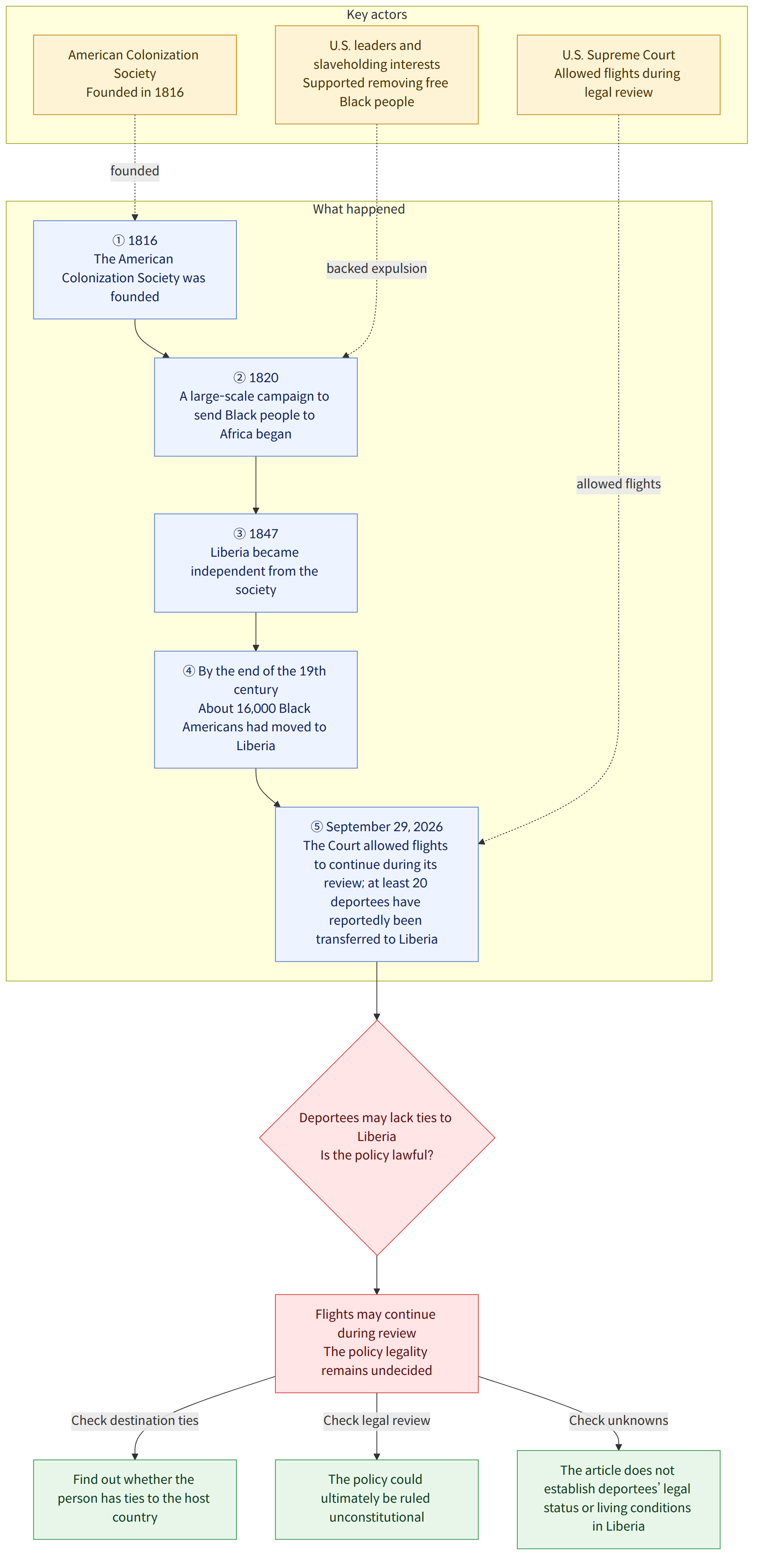
The history linking Liberia and U.S. migration policy dates back to the early 1800s. At the time, U.S. leaders looked to the West African coast as a place to send free people of African descent whom they considered unwanted residents of the United States. The American Colonization Society (미국식민협회) was founded in 1816, and a large-scale campaign to have Black people “return to Africa” began in 1820.
The early migrants included African American intellectuals, church leaders and merchants. The article explains that violence and inhumane treatment by white Americans drove them to leave. At the same time, slaveholding interests held a majority in Congress and called for the expulsion of free Black people, whose presence they viewed as giving hope to those held in slavery.
The early American settlers named their new home “Liberia,” meaning freedom. In 1847, the settlement declared independence from the society’s control and became Africa’s first independent republic. The settlers established towns and farms along the coast, but the region was already home to Indigenous communities estimated to number in the hundreds of thousands.
By the end of the 19th century, about 16,000 Black Americans had moved to Liberia. According to the article, many of them left against their will after being promised a better life. Thousands of migrants also came from the Caribbean, and at least 6,000 people rescued from slave-trading ships were sent to Liberia by the U.S. Navy.
What this news means
The decision allowed deportation flights to continue; it did not definitively establish that the third-country deportation policy is lawful. The article also notes that the policy could ultimately be ruled unconstitutional. What is clear for now is not the policy’s ultimate legal status, but that the Supreme Court has allowed flights to continue while it reviews the policy’s legality.
For people affected by the policy, the nature of their connection to the destination country may become an important issue. Reports that most deportees have no ties to the host country, along with the case of one Colombian national who had never heard of Liberia, show that a transfer may involve more than simply moving from one country to another. The original article does not establish what legal status or living conditions these people will have in Liberia.
The historical context is not meant to claim that today’s policy is the same as the past. However, the fact that the United States once campaigned to remove Black people from American society and send them to Africa—and that the effort had political motives, including the view that free Black people posed a threat—broadens the discussion of today’s third-country transfers. The issue draws attention to the importance of asking who is sent to another country, and for what reasons and through what process.
For example, if a deportee has no ties to the host country, being transferred there could cut them off from familiar social relationships and connections. This is a hypothetical explanation; the article alone does not show what consequences people transferred to Liberia have actually experienced.
What is confirmed and what remains unknown
Confirmed facts
- On September 29, 2026, the Supreme Court allowed deportation flights to continue while it reviews the policy’s legality.
- The decision could allow flights to Liberia to resume, and at least 20 people have been transferred there so far.
- Liberia is among the 35 countries for which the Trump administration pays accommodation and meal costs.
- Liberia has a history connected to 19th-century U.S. campaigns to resettle Black people.
What remains unknown
- How the Supreme Court will ultimately rule on whether the third-country deportation policy is unconstitutional.
- The specific payments the U.S. government makes to Liberia and the details of the agreement between the two countries.
- The legal status and living conditions in Liberia of the people transferred there.
What readers should watch for
- It will be important to see whether the Supreme Court issues a final ruling and what effect that ruling has on deportation flights.
- Readers can watch for the release of information about payments and the agreement between the United States and Liberia. The current article does not provide specific details.
- Readers should look for further information about the legal status and living conditions of the people transferred. The current reports are not enough to draw conclusions about their situation in Liberia.