
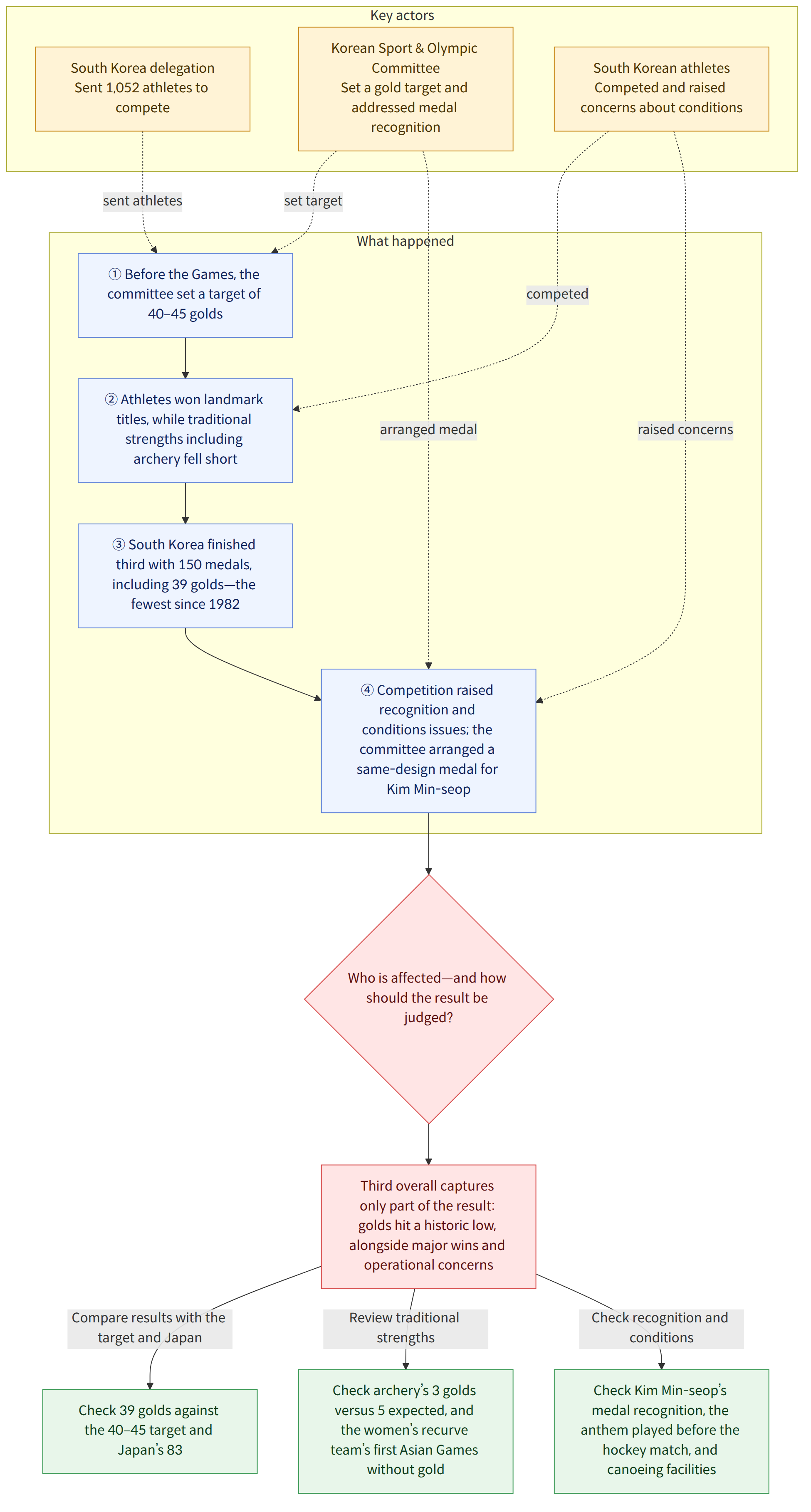
South Korea sent 1,052 athletes to compete in 41 sports at the 2026 Aichi-Nagoya Asian Games, winning 39 gold, 43 silver and 68 bronze medals. The country finished third overall with 150 medals, but its gold-medal total fell far short of China’s 169 and Japan’s 83, and was its lowest since the 1982 New Delhi Games. The 16-day event left behind not only the joy of winning medals but also disappointing defeats and operational problems.
Background and context
South Korea held on to third place overall at these Games, but its 39 gold medals fell short of the pre-Games target of 40 to 45. According to media reports, the Korean Sport & Olympic Committee (대한체육회) believed it would be difficult to catch host Japan, but aimed to narrow the gap with the country. The actual result went in the opposite direction. Japan won 83 gold medals and South Korea 39, widening the difference to 44.
The poor performance of sports in which South Korea has traditionally been strong is cited as one reason for the decline in gold medals. For the first time in Asian Games history, South Korea’s women’s recurve archery team failed to win a gold medal. South Korea had expected five golds in archery before the Games but won only three, while judo claimed one gold. Taekwondo won two golds in poomsae and one in sparring. Fencing, by contrast, reached four gold medals, led by Oh Sang-uk, who won two sabre titles.
The third-place finish overall also reflected strong performances in team sports. The men’s and women’s 5-on-5 basketball teams and the men’s 3-on-3 basketball team won gold, while the baseball team claimed its fifth consecutive title and the men’s soccer team its fourth in a row. The women’s handball team also returned to the top for the first time in eight years. Sailing and canoeing each added two golds, and teqball, included as an official sport for the first time, contributed one. A total of 22 sports produced gold-medal winners. But the fact that South Korea won titles across many sports must be considered alongside the decline in victories in traditionally strong sports.
What this news means
For individual athletes, the Games cannot be captured fully by the color of a medal on a results sheet. In the men’s 25-meter pistol event, Lee Gun-hyeok won gold by scoring a perfect shot in the second round of the shoot-off against a Chinese competitor—a shoot-off is an additional contest when competitors are tied. The men’s 4x100-meter relay team won bronze in a Korean-record time of 38.43 seconds. Hwang Seo-hyeon, 16, won gold in the women’s balance beam, giving South Korea its first Asian Games gold in gymnastics in 40 years. These moments show, apart from the overall standings, what the athletes’ challenges and achievements looked like.
There were also moments when results did not meet expectations. Oh Ye-jin won silver after losing in the women’s recurve individual final to India’s 17-year-old Kumkum Anil Mohod. In the women’s 25-meter pistol individual event, Yang Ji-in was eliminated from medal contention after a delayed shot was ruled a zero; she won silver in the team event. Since factors that are difficult to explain by skill alone can change the outcome of a competition, it is worth looking at how events unfolded, as well as at the color of the medal, when considering the results.
Event operations and training conditions revealed challenges beyond the medal tally. Kim Min-seop competed in the heats of the men’s 4x100-meter freestyle relay, which won gold, and the 4x200-meter freestyle relay, which won bronze, but did not compete in either final and therefore did not receive a physical medal. The Korean Sport & Olympic Committee decided to have a medal of the same design made for him. The men’s hockey team experienced North Korea’s national anthem being played before its match against Bangladesh, while canoeing double gold medalist Cho Gwang-hee pointed to poor training facilities. These cases show that, beyond counting results, it also matters how athletes’ contributions are recognized and how the conditions for competition are provided.
For example, if a reader judged the Games a success based only on South Korea’s total of 150 medals, they would also need to consider that the gold-medal total was the lowest since 1982 and review the results in traditionally strong sports. Conversely, if they declared the Games a failure based only on the number of golds, that could obscure the relay team’s record, gymnastics’ first gold in decades and the achievements in team sports. The overall standings and medal count are important results, but they do not, by themselves, explain all of the athletes’ achievements or the quality of event operations.
Confirmed facts and what remains unknown
Confirmed facts
- South Korea won 39 gold, 43 silver and 68 bronze medals, 150 in total, and finished third overall.
- South Korea’s gold-medal total was its lowest since the 1982 New Delhi Games, and the gap with Japan was 44 gold medals.
- For the first time in Asian Games history, South Korea’s women’s recurve archery team failed to win gold.
- The men’s 400-meter relay team won bronze in a Korean-record time of 38.43 seconds, and Hwang Seo-hyeon won gold in the women’s balance beam.
- Reports covered the failure to award Kim Min-seop a physical medal, the national anthem issue before the hockey match, and training facility concerns raised by Cho Gwang-hee.
What remains unknown
- What were the detailed results in the sports mentioned in the article, and what was the full medal tally?
- No plans were given for how the training conditions and operational issues raised during these Games would be reviewed and improved.
- The article does not say when the medal to be made for Kim Min-seop will be delivered.
What readers should check
- Don’t look only at the overall standings; check the gold, silver and bronze totals and results by sport separately. In particular, readers can also look at how South Korea performed in sports where it has traditionally been strong.
- Follow up on how the reported decision to make a medal is carried out in the case of an athlete who competed in the heats but not the final.
- In sports where training facility or event-operation problems were raised, check whether subsequent reviews or evaluations are made public. The Games concluded with the next stop set for Qatar four years later, but what is done about the outstanding issues before then is also part of understanding the results.
References
- Other coverage consulted: koreatimes.co.kr
- Other coverage consulted: hani.co.kr