
Regional Visa Pilot Program — Eligibility for Study (D-2) and Specific Activities (E-7), and Regional Exceptions
Based on Ministry of Justice manual (2026-09-18) · Translated from the Korean original.
The regional visa is a pilot program through which the Ministry of Justice and metropolitan and provincial governments work together to attract international students, foreign professionals, and others who meet regional needs. It covers Study (D-2) and Specific Activities (E-7). Applicants must meet the relevant regional criteria, including those concerning eligible universities, departments, occupations, and local-government recommendations.
At a glance
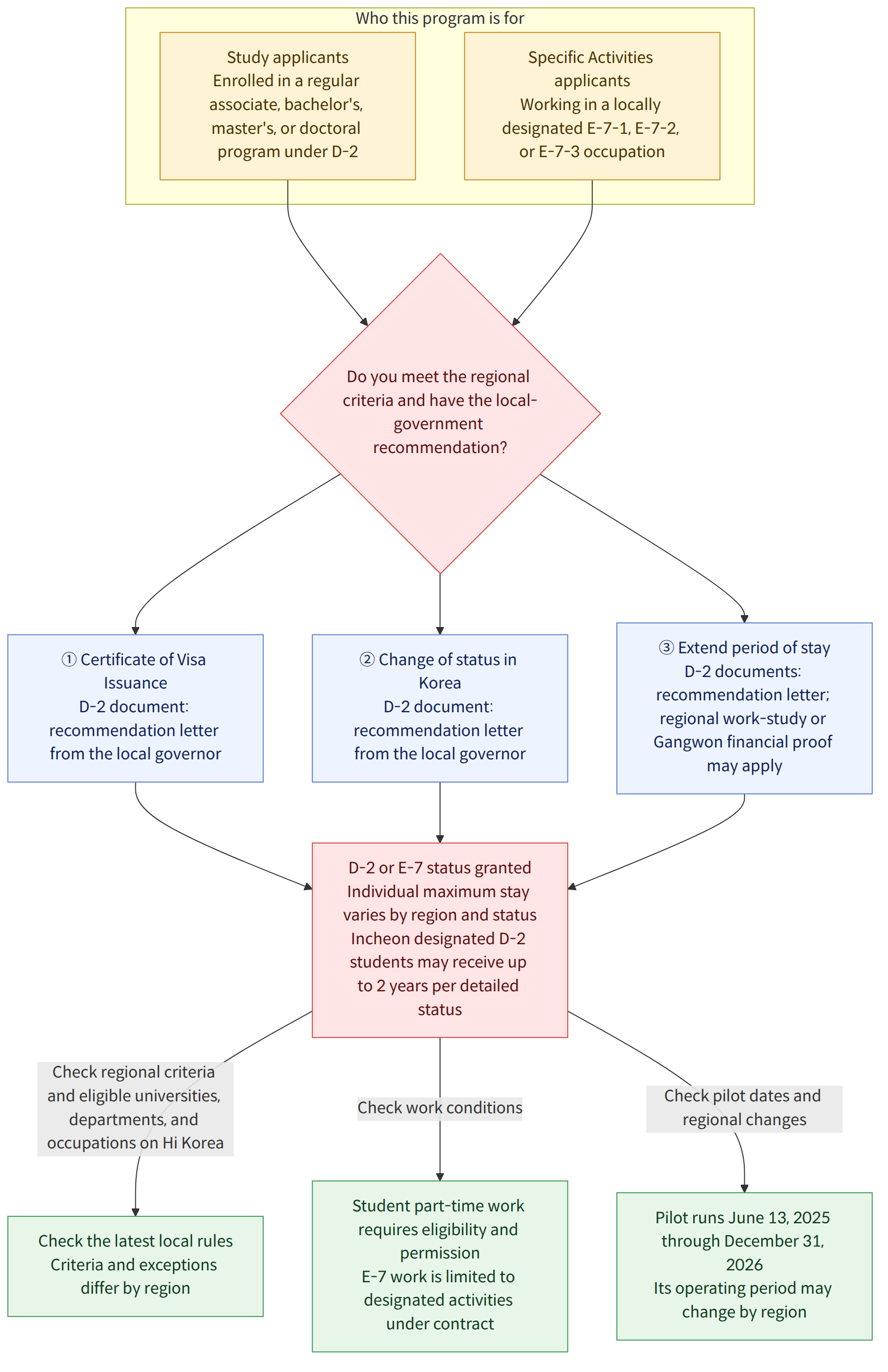
Who it is for
- Study (D-2): Applicants must be enrolled in a regular associate, bachelor's, master's, or doctoral degree program. Distance-learning universities, lifelong education institutions, vocational training programs at technical colleges, and evening universities (graduate schools) are excluded.
- Study (D-2): Applicants must not be enrolled at a lower-tier university under the International Education Quality Assurance System (a university subject to consulting or visa restrictions), and must attend a university and department designated by the relevant local government and receive a recommendation from its head.
- Study (D-2): Eligible fields vary by region. Examples include science and engineering fields such as robotics, AI, biotechnology, and fintech in Seoul, and departments related to semiconductors, secondary batteries, and future automobile parts in Busan. Check Hi Korea announcements for details of eligible universities and departments.
- Specific Activities (E-7): Applicants must work in an occupation designated by the relevant local government among currently operating occupations for Professional Workers (E-7-1), Associate Professionals (E-7-2), or General Skilled Workers (E-7-3), and receive a recommendation from the head of the local government.
- Specific Activities (E-7): Designated occupations and eligibility exceptions differ among Daegu, Ulsan, Gyeonggi, Gyeongbuk, and Gyeongnam. Some regions also apply requirements for designated employers or separate qualifications, training, or skills verification.
What you can do
- You may pursue a regular degree program under Study (D-2) status.
- Part-time work by international students is subject to the eligibility requirements for part-time work and the requirement to obtain part-time work permission. Some regions provide exceptions, such as extended permitted hours, but even those eligible for preferential treatment must obtain permission.
- Some eligible international students in Seoul, Busan, Incheon, Gangwon, and Jeonbuk may, if they meet the prescribed requirements, undertake internships in specialized fields (E-1–E-7) at institutions or companies outside their university.
- Some eligible international students in Jeollanam-do may apply for part-time work in a specialized field as a chef, cook, or care worker if they meet the requirements, such as holding a relevant qualification.
- Holders of Specific Activities (E-7) status may engage in activities designated by the Minister of Justice in accordance with their contract. The occupations and requirements actually permitted are subject to regional criteria.
Period of stay
The regional visa pilot program runs from June 13, 2025, through December 31, 2026. The operating period may change by region depending on local-government evaluations or circumstances such as a large number of cases of illegal stay. The maximum period of stay for an individual varies by region and status. The excerpt provides an exception for international students admitted, after these guidelines take effect, to designated universities in Incheon: when a Certificate of Visa Issuance is issued, their status of stay is changed, or their period of stay is extended, they may be granted a maximum period of stay of two years for each detailed Study status.
Applications & documents
Issuance of a Certificate of Visa Issuance, Change of Status of Stay, or Extension of Period of Stay for Study (D-2)
- Recommendation letter from the governor of the relevant metropolitan city or province
- Commitment to Participate in the Chungbuk-type or Chungnam-type Work-Study Program (충북형 또는 충남형 일·학습병행 참여 확약서) (for a new application in the relevant region)
- Confirmation of Participation in the Chungbuk-type or Chungnam-type Work-Study Program (충북형 또는 충남형 일·학습병행 참여 확인서) (for an extension of period of stay, change of school, etc., in the relevant region)
- For application of the Gangwon Special Self-Governing Province exception: transaction history for the most recent year for the designated primary transaction account (proof of financial capacity for an extension of period of stay)
Financial standards and supporting documents vary by region. In Chungbuk and Chungnam, separate conditions apply, including participation in the relevant work-study program.
Part-Time Work Permission for International Students
The required documents and terms of permission are subject to the existing Guidelines for Visa Issuance and Sojourn Management for International Students (외국인 유학생 사증발급 및 체류관리 지침). Permission is required even for those receiving preferential treatment regarding permitted working hours under the regional visa program.
Issuance of a Certificate of Visa Issuance or Change of Status of Stay for Specific Activities (E-7)
- Recommendation from the head of the relevant metropolitan or provincial local government (for the relevant region and occupation)
- Ulsan shipbuilding welder: valid certificate, certificate of completion of a training program at a local workforce training center, and skills verification confirmation
- Ulsan ship electrician or ship painter: degree certificate, certificate of completion of a training program at a local workforce training center, and skills verification confirmation issued by Ulsan City
- For application of the Gyeongbuk exception: documents verifying a record of recruiting Korean nationals for at least seven days (may replace some supporting documents)
Required documents and eligibility requirements vary by occupation and region. For some occupations, an employment recommendation from the minister of the relevant supervising ministry is still required.
Change of Workplace for Specific Activities (E-7)
- Ulsan City employment recommendation (where applicable)
- Ulsan City on-site company inspection report (for an unavoidable change of workplace)
- Gyeongsangbuk-do local-government recommendation (where applicable)
In Ulsan, this is limited to unavoidable circumstances, such as business closure or suspension or worsening business conditions, or cases where the foreign national is not at fault. In Gyeongbuk, certain grounds and conditions, including a local-government recommendation, apply.
Frequently asked questions
Q. What is a regional visa?
This is a pilot program operated by the Ministry of Justice and metropolitan and provincial governments to attract international students and workers in designated fields according to regional needs. It covers Study (D-2) and Specific Activities (E-7).
Q. Which universities or occupations can I apply for?
Only the universities and departments or occupations designated for each region are eligible. The manual states that the list of eligible universities, departments, and occupations will be announced on Hi Korea.
Q. Is a recommendation from the local government mandatory?
International students eligible for the regional visa and applicants for Specific Activities must receive a recommendation from the governor of the relevant metropolitan city or province. They must also meet the general or special requirements for E-7.
Q. Can international students with regional D-2 status work?
You may apply for permission if you meet the requirements for part-time work permission. Some regions extend the permitted working hours, but even those eligible for preferential treatment must obtain part-time work permission.
Q. Can any international student take part in an internship?
No. The applicable regions and eligible groups are limited, and applicants must meet all regional requirements, including those for their stage of study, Korean-language proficiency, and academic performance. For some eligible groups, the activity is limited to one time and no more than one year; for associate degree students, it is limited to no more than six months.
Q. Is the financial-capacity threshold KRW 8 million per year in every region?
No. Although an annual financial-capacity threshold of KRW 8 million applies in several regions, the eligible groups, timing, and methods of proof vary, and some regions, such as Jeju, have separate standards. You must check the standards for the region where you are applying.
Q. How long will the regional visa pilot program run?
The manual states that the pilot program runs through December 31, 2026. However, the operating period may vary by local government depending on evaluations or changes in circumstances.
Watch out for
- Eligibility for a regional visa does not mean that status will be approved automatically. Check the regional requirements and the general requirements for the relevant existing visa status.
- Lists of eligible universities, departments, and occupations, as well as recommendation requirements, vary by region. Check Hi Korea announcements and the relevant local-government criteria.
- Preferential treatment regarding permitted part-time work hours does not exempt you from obtaining work permission.
- Operating periods and quotas may change following local-government evaluations or changes in circumstances.
Source
Compiled by AI from the Ministry of Justice "Visa Issuance Guide Manual" and "Residence Guide Manual" (HiKorea notice, in Korean). hikorea.go.kr
This is general guidance; the immigration office makes the final decision. Before applying, check the latest rules on HiKorea (hikorea.go.kr) or call the Immigration Contact Center at 1345.