
Tourism Employment (H-1) Visa — Eligibility, Work and Study Restrictions, Period of Stay, and Alien Registration
Based on Ministry of Justice manual (2026-09-18) · Translated from the Korean original.
Tourism Employment (H-1) is a status for nationals of countries that have concluded a tourism-employment agreement or memorandum of understanding with Korea. People who intend to visit Korea primarily for tourism and work for a short period to help cover their travel expenses may apply.
At a glance
Who it is for
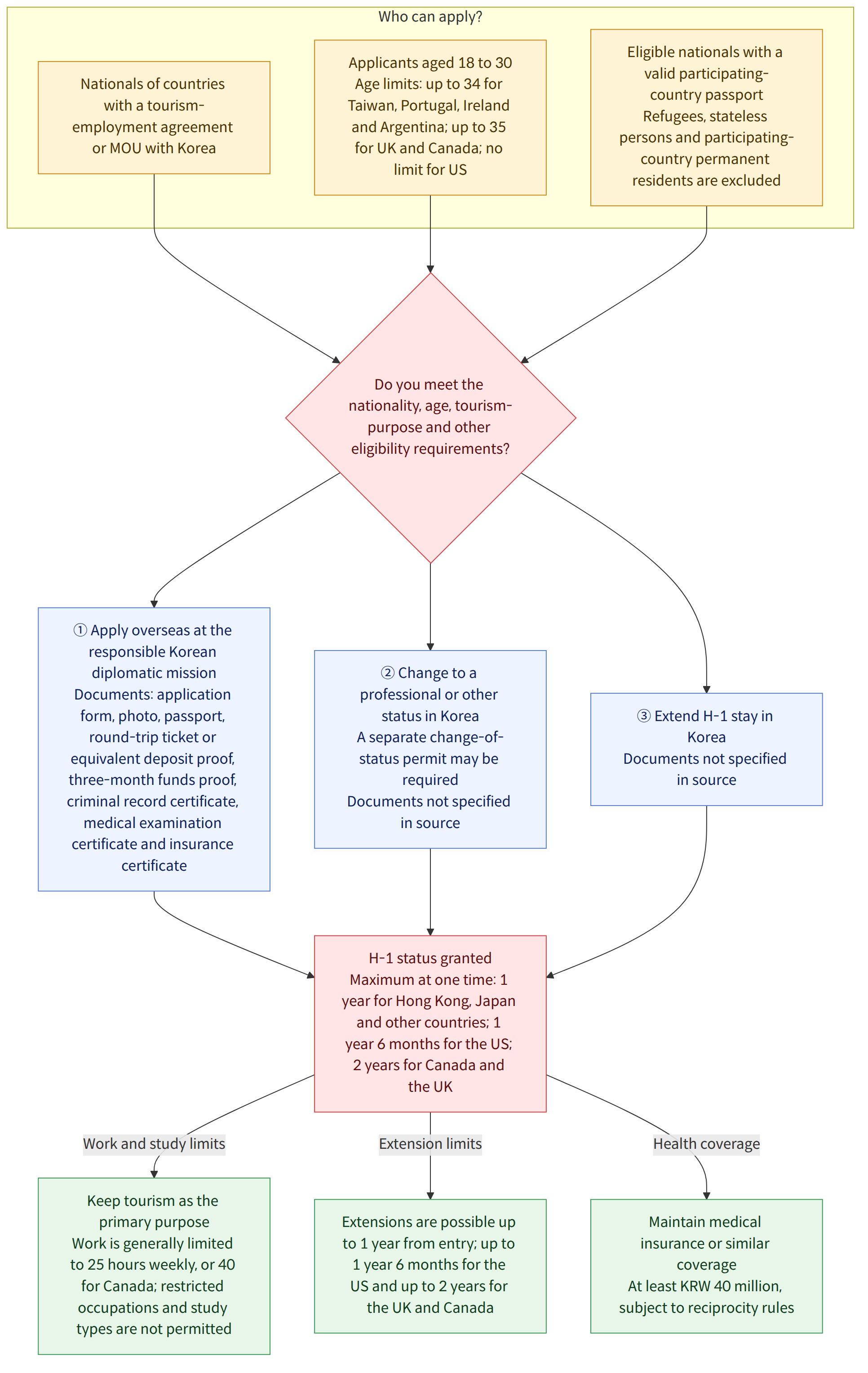
- You must be a national of a country that has concluded a tourism-employment agreement or memorandum of understanding with Korea. Refugees, stateless persons, and permanent residents recognized by a participating country are not nationals of that country and are therefore not eligible to apply.
- As a general rule, you must be at least 18 and no older than 30 at the time of application. Applicants from Taiwan, Portugal, Ireland, and Argentina may apply up to age 34; those from the United Kingdom and Canada may apply up to age 35. No age limit applies to applicants from the United States.
- You must hold a valid passport issued by a participating country. As a general rule, your passport must have at least six months of validity remaining when you apply. Under the agreement, Chile applies a minimum remaining validity of three months.
- You must not have a serious criminal record. Issuance may be denied if your criminal record certificate confirms a finalized fine of KRW 3 million or more.
- You must be in good health and must have medical insurance or similar coverage of at least KRW 40 million while staying in Korea. Whether insurance must be submitted and the required coverage amount may vary on the basis of reciprocity.
- You must provide proof of a round-trip ticket and initial living expenses. If you do not have a round-trip ticket, you may provide documents showing that you have deposited an equivalent amount. You must demonstrate living expenses of at least KRW 3 million for a three-month period.
- You must not be accompanied by dependents or other family members, and as a general rule, you must not have previously participated in a tourism-employment program. However, applicants with prior participation may still be granted a visa under reciprocity rules in some cases, including for Ireland, Sweden, and the United States.
What you can do
- Tourism must be the primary purpose. Devoting yourself exclusively to work from immediately after entry, or focusing exclusively on work and study, reporting, political activities, or similar activities, is inconsistent with the purpose of the agreement.
- You may work for a short period to help cover your travel expenses. You may work regardless of the type of employment, including fixed-term or part-time work.
- As a general rule, you may work up to 25 hours per week. The limit is up to 40 hours per week for Canada. Follow the country-specific limits in the manual for the work period and total working hours.
- You may not work in occupations at establishments providing adult entertainment, professions requiring specific qualifications, E-7 Specific Activities occupations, industries involving gambling or activities related to public morals, and certain other fields. Private tutoring is also restricted.
- You may study, including by attending an academy or taking language courses, within the period permitted for your country. Regular academic courses corresponding to D-2 status, and studies combined with work assisting in foreign-language education, are not permitted.
- You may work without separate permission to change or add a workplace. However, occupations requiring qualifications or licenses and E-7 occupations are restricted. A separate change-of-status permit may be required to change to a professional or other status.
Period of stay
The maximum period of stay granted at one time is the period of stay permitted under the agreement. The country-specific limits listed in the manual are one year for Hong Kong and Japan, 1 year and 6 months for the United States, two years for Canada and the United Kingdom, and one year for all other countries. You may extend your stay for up to one year from the date of entry; extensions are possible for up to 1 year and 6 months for the United States and up to two years for the United Kingdom and Canada.
Applications & documents
Visa Application
- Visa Application Form (사증발급신청서)
- Photograph
- Passport
- Round-trip ticket or proof of deposit of an equivalent amount
- Bank balance certificate or other proof of funds sufficient for three months of stay
- Criminal Record Certificate
- Medical Examination Certificate
- Medical insurance certificate
- Certificate of enrollment or certificate of highest level of education completed (may be required on the basis of reciprocity)
- Tourism Employment Activity Plan (관광취업 활동계획서)
Apply at the overseas diplomatic mission with jurisdiction over the country that concluded the agreement. Austrian nationals may also apply at the diplomatic missions in Japan, China, Shanghai, Hong Kong, or Taipei listed in the manual. This status is not eligible for a visa issuance confirmation.
Alien Registration (외국인등록)
- Application form
- Passport
- One standard-format photograph
- Travel itinerary and activity plan
- If employed, a copy of the workplace’s business registration certificate and contract, etc.
- Documents proving place of residence
Anyone intending to stay for more than 90 days must register as an alien. A fee is also listed among the required submission items, but the excerpt does not specify the amount.
Frequently asked questions
Q. Who is the Tourism Employment (H-1) visa for?
This status is for nationals of countries that have concluded a tourism-employment agreement or memorandum of understanding with Korea and who visit Korea primarily for tourism. They may work for a short period to help cover their travel expenses.
Q. What is the maximum age for applying?
As a general rule, applicants must be at least 18 and no older than 30 at the time of application. Applicants from the United Kingdom and Canada may apply up to age 35; those from Taiwan, Portugal, Ireland, and Argentina may apply up to age 34. No age limit applies to applicants from the United States.
Q. How many hours can I work on an H-1?
As a general rule, up to 25 hours per week. The limit is up to 40 hours per week for Canada. Israel, Australia, Italy, Belgium, and Denmark also have separate rules for the period and total hours of work.
Q. Can I work in any occupation?
No. You may not work in occupations at establishments providing adult entertainment, professions requiring specific qualifications, E-7 occupations, industries involving gambling or activities contrary to good morals, and certain other fields. Private tutoring is also restricted.
Q. Can I attend a Korean language academy on an H-1?
You may attend an academy or study a language within the period permitted for your country. However, regular academic courses corresponding to D-2 status, or studies combined with work assisting in foreign-language education, are not permitted.
Q. How long can I stay on an H-1?
The period of stay permitted under the agreement is the maximum. The manual lists a one-year limit for most countries, 1 year and 6 months for the United States, and 2 years for Canada and the United Kingdom.
Q. Can I extend my period of stay?
You may extend your stay for up to one year from the date of entry. Extensions are possible for up to 1 year and 6 months for the United States and up to 2 years for the United Kingdom and Canada.
Q. Do I have to register as an alien after arriving in Korea?
Anyone intending to stay for more than 90 days must register as an alien. When applying for Alien Registration (외국인등록), submit your passport, a photograph, a travel itinerary and activity plan, and documents proving your place of residence. If you are working, you must also submit documents related to your workplace.
Q. Can I change from another status of stay to H-1?
Changing from another status of stay to Tourism Employment (H-1) is not permitted. A change from H-1 to a professional or other status may be possible if you meet the requirements, but nationals of certain countries are excluded from eligibility for such a change.
Watch out for
- If you do not have a round-trip ticket, you may submit documents showing that you have deposited an equivalent amount. You must demonstrate living expenses of at least KRW 3 million for a three-month period.
- Check the restricted occupations and the work-hour and work-period limits for your country. Except for Canada, the general maximum is 25 working hours per week.
- You must register as an alien if you intend to stay for more than 90 days.
- You must enter Korea while your passport and visa are valid. The manual advises renewing or reissuing your passport before it expires.
Source
Compiled by AI from the Ministry of Justice "Visa Issuance Guide Manual" and "Residence Guide Manual" (HiKorea notice, in Korean). hikorea.go.kr
This is general guidance; the immigration office makes the final decision. Before applying, check the latest rules on HiKorea (hikorea.go.kr) or call the Immigration Contact Center at 1345.