
Other (G-1) Status of Stay — Eligibility, Period of Stay, Work Permits, and Extension Documents
Based on Ministry of Justice manual (2026-09-18) · Translated from the Korean original.
Other (G-1) is a status of stay granted to people recognized by the Minister of Justice who do not fall under Diplomat (A-1) through Working Visit (H-2), or Permanent Resident (F-5). Eligibility and required documents vary depending on the reason, such as an industrial accident, medical treatment for an illness, litigation, unpaid wages, or a refugee application.
At a glance
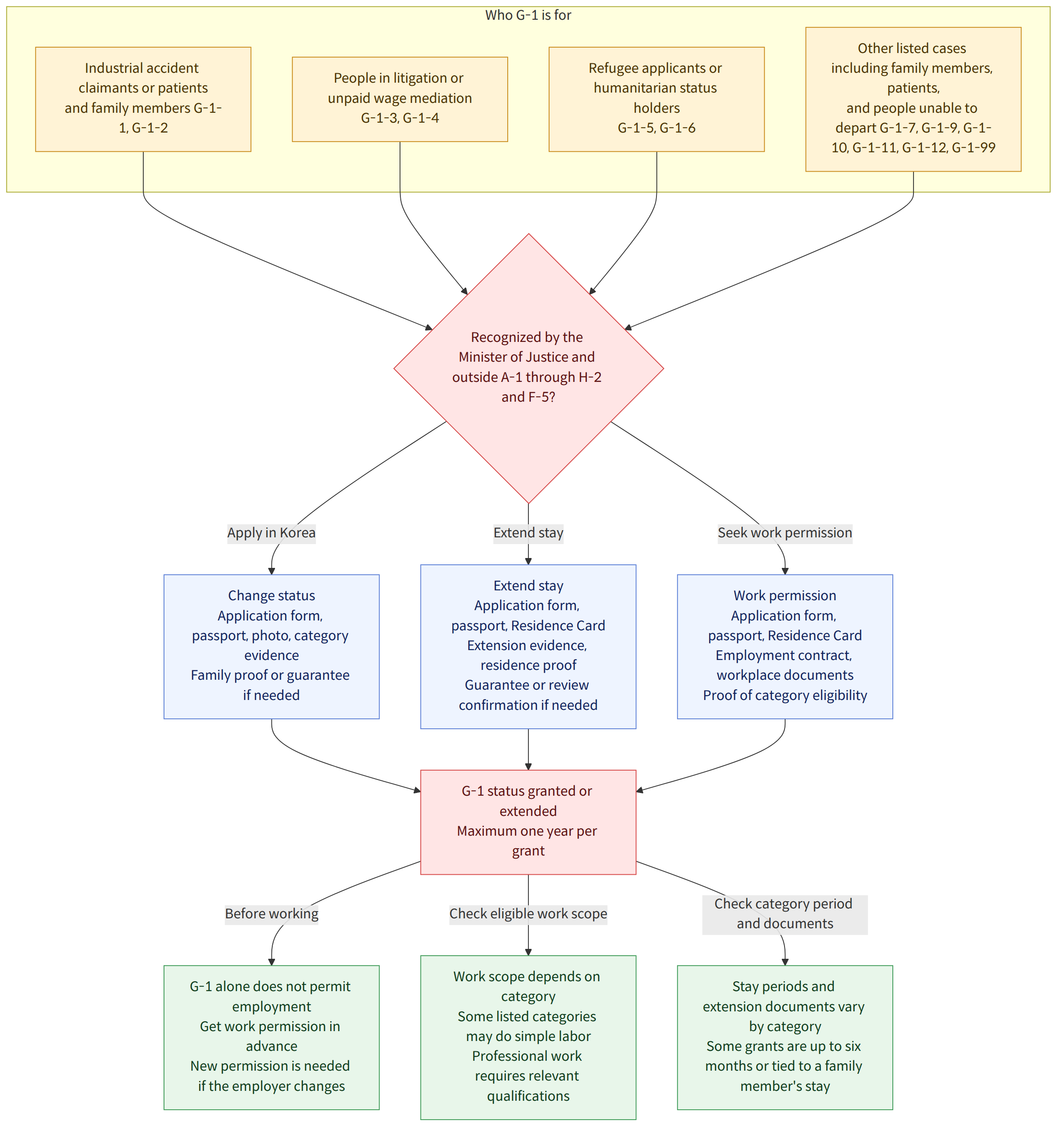
Who it is for
- People who have filed a claim for industrial accident compensation or are receiving treatment, and their family members (G-1-1)
- People receiving long-term treatment for an illness or accident, and their family members (G-1-2)
- People involved in civil, criminal, family, or administrative litigation (G-1-3)
- People involved in mediation by a labor office (노동관서) for unpaid wages or in related civil litigation (G-1-4)
- Refugee applicants (G-1-5), and people denied refugee status who have received humanitarian status (G-1-6)
- People unable to depart immediately due to pregnancy, childbirth, or similar circumstances (G-1-9), and people requiring humanitarian consideration, including victims of sexual violence (G-1-11)
- Foreign patients requiring long-term treatment, and accompanying family members or caregivers whose need is recognized (G-1-10)
- Family members of a person who died in an accident (G-1-7), family members of a humanitarian status holder (G-1-12), and children born in Korea to refugee applicants who meet the specified requirements (G-1-99)
What you can do
- The basic scope covers activities that do not fall under Diplomat (A-1) through Marriage Migrant (F-6), Working Holiday (H-1), or Working Visit (H-2).
- Employment is not permitted solely on the basis of G-1 status. To work, you must obtain permission to engage in activities not covered by your status of stay, as applicable to your category.
- People in categories G-1-7, G-1-11, and G-1-99 may work in simple labor outside fields subject to employment restrictions. To work in a professional field, you must hold the relevant qualifications.
- Refugee applicants who fall within the designated categories eligible for permission may perform simple labor, except in occupations subject to employment restrictions. Humanitarian status holders and certain others may receive permission for the same scope of work as refugee applicants and may also work in the construction industry.
- A work permit must be obtained in advance. If your employer changes, you must obtain new permission to engage in activities not covered by your status of stay.
Period of stay
The maximum period of stay granted at one time is one year. The permitted period may vary by detailed category; some categories are granted a period of up to six months or until the expiration of a specified family member’s period of stay.
Applications & documents
Permission to Change Status of Stay
- Application Form (신청서(별지 제34호 서식))
- Passport
- One standard-size photograph
- Documents supporting the reason for the applicable G-1 category (e.g., a medical institution’s opinion, litigation-related documents, or a receipt confirming submission of a refugee application)
- Documents proving family relationships or a letter of guarantee, depending on the reason
Required documents vary by detailed G-1 category. The application fee is KRW 100,000.
Permission to Extend Period of Stay
- Application Form
- Passport
- Residence Card
- Documents supporting the reason for the extension (e.g., a medical certificate, litigation documents, or a Certificate of Unpaid Wages)
- Documents proving your place of residence
- A letter of guarantee or a review confirmation for Other (G-1) status, depending on the category
The permitted period and required documents vary by detailed category. The application fee is KRW 60,000.
Permission to Engage in Activities Not Covered by Status of Stay (Employment)
- Application Form
- Passport
- Residence Card
- Employment contract
- Documents related to the workplace, such as a copy of the business registration certificate
- Documents proving eligibility for the applicable category
Eligible applicants and the scope of permitted employment are specified. The application fee is KRW 120,000.
Alien Registration
- Application Form
- Passport
- One standard-size photograph
- Documents proving your place of residence
The application fee is KRW 35,000.
Frequently asked questions
Q. Can I start working right away if I have G-1 status?
No. Employment is not permitted solely on the basis of G-1 status of stay. You must obtain permission in advance to engage in activities not covered by your status of stay, as applicable to your category.
Q. When can a refugee applicant apply for a work permit?
A person whose refugee application has been pending for six months may be eligible for permission. Periods during which the submission of supporting documents is delayed due to the applicant’s responsibility, or the applicant’s whereabouts cannot be confirmed, may not count toward the six months. A person may also be eligible if, for example, they support a dependent who is unable to work because of a disability.
Q. What kind of work can I do with a G-1 work permit?
It depends on the category of applicant. Refugee applicants may be permitted to perform simple labor, except in occupations subject to employment restrictions. Humanitarian status holders and certain others may also work in the construction industry. Some other categories, including victims of sexual violence, may work in simple labor outside restricted fields.
Q. Can I continue using my existing work permit if I change jobs?
No. If your employer changes, you need new permission to engage in activities not covered by your status of stay. You must obtain permission before starting the job.
Q. How long is the period of stay for G-1 status usually?
The maximum period granted at one time is one year. However, the permitted period varies by detailed category; for example, some permits are granted for up to six months, while others are granted for periods ranging from six months to one year.
Q. What documents are required to apply for an extension of stay?
The basic required documents include an application, passport, Residence Card, and proof of your place of residence. Depending on your category, you must also submit documents supporting the reason for your stay, such as a medical certificate, litigation documents, or a Certificate of Unpaid Wages.
Q. How much is the fee for changing to G-1 status?
The application fee for a change of status of stay is KRW 100,000. An extension of stay costs KRW 60,000, and permission to engage in activities not covered by your status of stay costs KRW 120,000.
Q. Can family members of a humanitarian status holder also receive G-1 status?
A spouse and minor children may be eligible for G-1-12, subject to the applicable requirements. A minor child is not eligible if the person has a spouse.
Watch out for
- Detailed categories and requirements differ depending on the reason for G-1 status, so you must prepare documents supporting the applicable reason.
- Even if you have a work permit, you may not work in fields subject to employment restrictions. If your employer changes, you must obtain new permission in advance.
- Refugee applicants are prohibited from working in the construction industry. Separate permit and basic occupational safety and health training requirements are specified for construction work by humanitarian status holders and certain others.
- G-1-99 does not apply to every other circumstance. You must meet the requirements in the manual for a child born in Korea to a refugee applicant.
Source
Compiled by AI from the Ministry of Justice "Visa Issuance Guide Manual" and "Residence Guide Manual" (HiKorea notice, in Korean). hikorea.go.kr
This is general guidance; the immigration office makes the final decision. Before applying, check the latest rules on HiKorea (hikorea.go.kr) or call the Immigration Contact Center at 1345.