
Permanent Resident Status (F-5) — Eligible Applicants, Period of Stay, Required Documents, and Criminal Record Certificates
Based on Ministry of Justice manual (2026-09-18) · Translated from the Korean original.
Permanent resident status (F-5) is not subject to activity restrictions based on a person’s status of residence. Applicants and requirements vary by specific eligibility category. Overseas Koreans (F-5-6 and F-5-7) and refugees (F-5-27) are covered by separate guidelines and are therefore not included in this guide.
At a glance
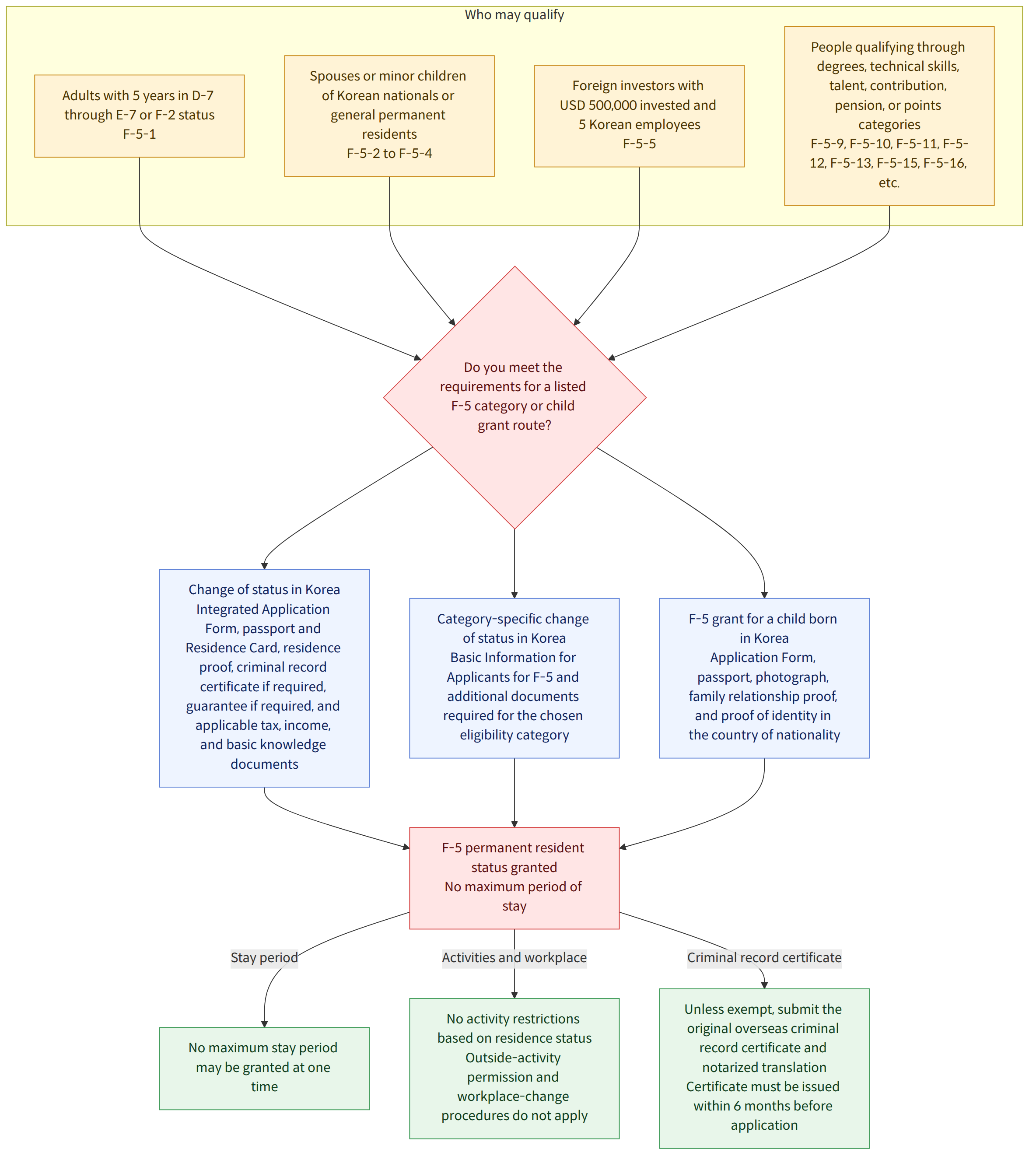
Who it is for
- Adults who have resided in Korea for at least five years under a status from Intra-Company Transferee (D-7) through Specific Activities (E-7), or under Resident (F-2) status (F-5-1)
- Spouses of Korean nationals or minor children of Korean nationals who meet the relevant requirements (F-5-2 and F-5-3)
- Spouses or minor children of general permanent residents who have resided in Korea for at least two years and are recognized by the Minister of Justice (F-5-4)
- Foreign investors who have invested at least USD 500,000 and employed at least five Korean nationals (F-5-5)
- People who meet degree or employment requirements, such as those with a doctorate in an advanced field or those who have earned a doctoral degree from a graduate school in Korea (F-5-9 and F-5-15)
- People who hold a prescribed degree or technical qualification and are employed by a company in Korea (F-5-10)
- People with outstanding ability in a particular field or recognized as having made a special contribution to the Republic of Korea (F-5-11 and F-5-12)
- People who meet the requirements for other specific eligibility categories, such as those aged 60 or older who receive a pension from abroad and points-based residents (F-5-13, F-5-16, etc.)
What you can do
- There are no activity restrictions based on the classification of the status of residence.
- Permission for activities outside the status of residence and procedures to change or add a workplace do not apply.
Period of stay
There is no maximum period of stay that may be granted at one time.
Applications & documents
Change of Status of Residence to Permanent Resident Status (F-5)
- Integrated Application Form (통합신청서)
- Passport and Residence Card
- Proof of place of residence
- Overseas criminal record certificate (except for those exempt from submission)
- Letter of Guarantee (신원보증서) (except for those exempt)
- Tax and income documents related to the requirement to support oneself (if applicable)
- Documents proving basic knowledge (except for those exempt)
- Basic Information for Applicants for Permanent Resident Status (F-5)
- Additional documents required for the specific eligibility category applied for
The application fee for permission to change to permanent resident status is KRW 200,000. As a rule, the original overseas criminal record certificate and a notarized translation must be submitted, and the certificate must have been issued within six months before the application date.
Grant of Permanent Resident Status (F-5) to a Child Born in Korea
- Application Form (신청서)
- Passport
- One standard-size photograph
- Documents proving the family relationship (such as a birth certificate)
- Documents proving the child’s identity in the country of nationality
This applies to a child born in Korea to a holder of permanent resident status who is residing in Korea. The application must be filed within 90 days of the child’s birth. Children born overseas are excluded.
Frequently asked questions
Q. Can I work if I obtain permanent resident status (F-5)?
Permanent residents (F-5) are not subject to activity restrictions based on their status of residence. The manual indicates that permission for activities outside the status of residence and procedures to change or add a workplace do not apply.
Q. How long a period of stay can I receive with permanent resident status (F-5)?
There is no maximum period of stay that may be granted at one time.
Q. Who can apply for general permanent resident status (F-5-1)?
Applicants must be adults under the Civil Act (민법) and must have resided in Korea for at least five years under a status from Intra-Company Transferee (D-7) through Specific Activities (E-7), or under Resident (F-2) status. At the time of application, they must be engaged in economic activities recognized under the relevant status.
Q. Do all applicants have to submit an overseas criminal record certificate?
This is included among the common required documents, but applicants who are exempt under the manual do not need to submit it. Those who have continuously resided lawfully in Korea for at least 10 years by the application date are also exempt.
Q. How must an overseas criminal record certificate be authenticated?
A certificate issued by a country that is party to the Apostille Convention must be authenticated with an apostille by the issuing country. A certificate issued by a country that is not a party to the Convention must be authenticated by a Korean diplomatic mission in the issuing country.
Q. How long is a criminal record certificate valid?
The certificate must have been issued within six months before the date of application for permanent resident status. As a rule, you must submit the original and a notarized translation.
Q. Are there income or asset requirements for an application for permanent resident status?
The requirements for supporting oneself vary depending on the specific eligibility category. You should check the specific category under which you are applying to determine which income or asset standard applies and whether you are exempt from screening.
Q. Does this guide also cover permanent resident status for overseas Koreans or refugees?
No. Overseas Koreans (F-5-6), foreign-national Koreans (F-5-7), and refugees eligible for Resident status (F-5-27) are subject to separate guidelines.
Watch out for
- An overseas criminal record certificate issued by the applicant’s country of nationality is required. A certificate from a third country where the applicant continuously resided for at least one year within the five years before the application date may also be required.
- The certificate must include all criminal records within the relevant country and must be an official document issued by a competent authority.
- The translation must include the translator’s personal details and contact information, and a copy of the translator’s ID must be attached. If the applicant has no criminal record, the notarized translation may be replaced by the translator’s confirmation form specified in the manual and a copy of the translator’s ID.
- Applications for permanent resident status may be subject to requirements concerning good conduct, ability to support oneself, and basic knowledge. Whether these requirements apply and which documents must be submitted depend on the specific eligibility category under which the applicant applies.
Source
Compiled by AI from the Ministry of Justice "Visa Issuance Guide Manual" and "Residence Guide Manual" (HiKorea notice, in Korean). hikorea.go.kr
This is general guidance; the immigration office makes the final decision. Before applying, check the latest rules on HiKorea (hikorea.go.kr) or call the Immigration Contact Center at 1345.