
Overseas Korean (F-4) Visa — Eligibility, Stay Period, Employment Restrictions, and Application Procedures
Based on Ministry of Justice manual (2026-09-18) · Translated from the Korean original.
F-4 is a status of stay for foreign nationals of Korean origin who previously held Republic of Korea nationality and their direct descendants. Documents proving Korean-language proficiency and an overseas criminal record may be required when applying for a visa or for permission related to your stay in Korea.
At a glance
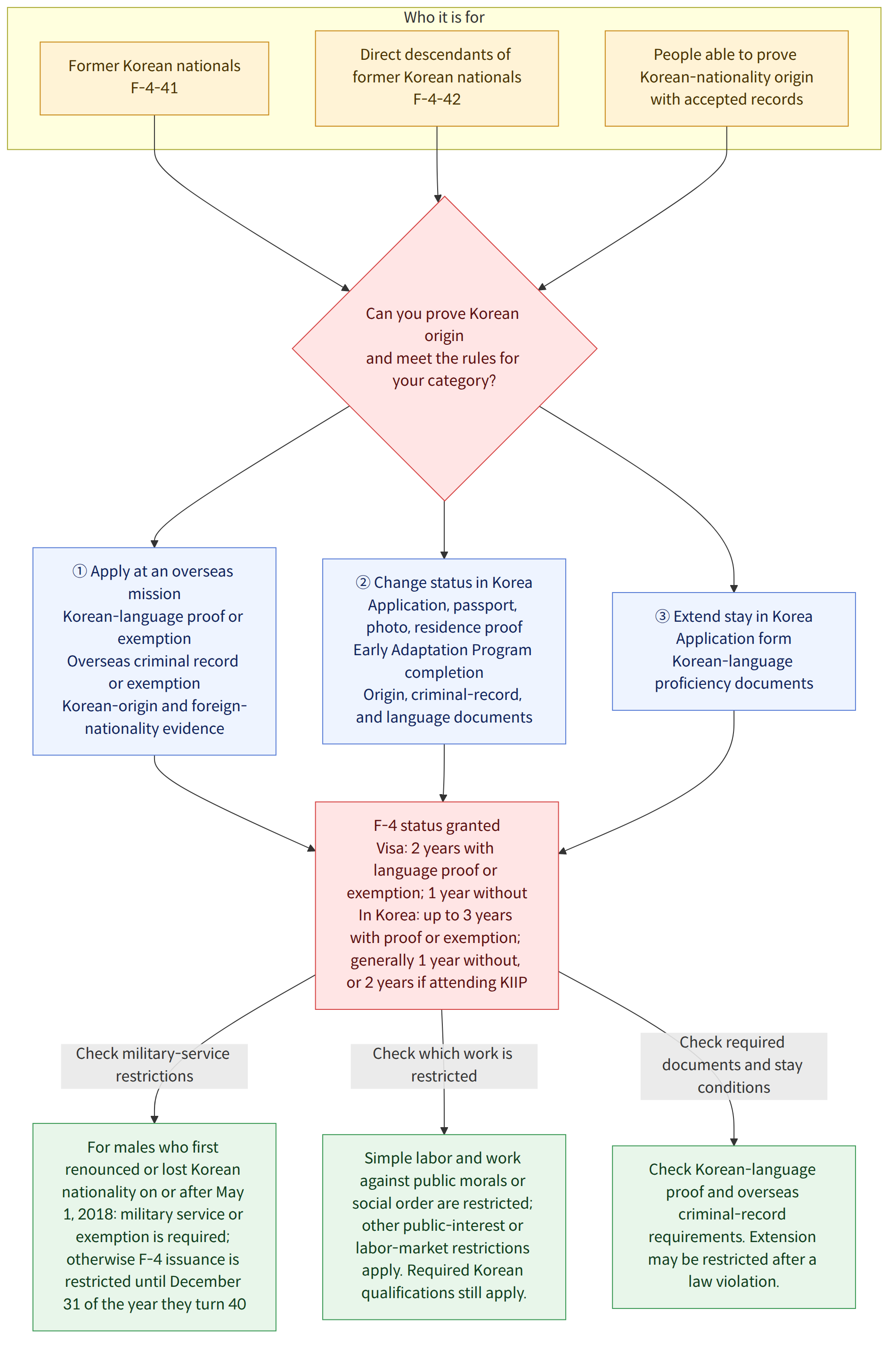
Who it is for
- A person who acquired foreign nationality after having held Republic of Korea nationality from birth (F-4-41)
- A person who acquired foreign nationality as a direct descendant of a person who held Republic of Korea nationality (F-4-42)
- A person who can prove foreign Korean-nationality origin through documents such as a certificate of family relations, an archived family register, a household register, an identity card, or a birth certificate
- A male who first renounced or lost Republic of Korea nationality on or after May 1, 2018, must have completed military service or received an exemption from military service. Otherwise, issuance of F-4 status is restricted until December 31 of the year in which the person turns 40.
What you can do
- You may not engage in simple labor. Restricted occupations include parcel delivery workers, building cleaners, and apartment security guards.
- Employment contrary to public morals or social order is restricted, such as working as an entertainment service worker at a venue involving gambling or other speculative activities or at an adult entertainment establishment.
- You may not engage in other occupations restricted in the public interest or to maintain order in the domestic labor market.
- You may engage in employment activities that do not fall under these restrictions, but you must hold any separate qualifications required by Korean law.
- If you intend to continue working at a workplace where you reported the start of employment under H-2, you may apply for permission to engage in activities outside your status of stay.
Period of stay
When a visa is issued, a multiple-entry visa valid for a two-year stay is issued if you submit documents proving Korean-language proficiency or are exempt from submitting them; if you do not submit them, a multiple-entry visa valid for a one-year stay is issued. For permission to stay in Korea, you may be granted a stay of up to three years if you submit the documents or are exempt from submitting them. If you do not submit the documents, the stay period is generally one year for a residence report, change of status, or extension of stay; if you are registered for and attending the Korea Immigration & Integration Program, you will be granted two years.
Applications & documents
Visa Issuance at an Overseas Diplomatic Mission (재외공관)
- Documents proving Korean-language proficiency or documents confirming that you are exempt from submitting them
- An overseas criminal record certificate or documents confirming that you are exempt from submitting one
- Documents proving that you or your direct ascendant was a Republic of Korea national
- Documents proving the reason for and date of acquisition of foreign nationality
- For applicants who are direct descendants: documents proving the relationship between the applicant and their direct ascendant
You may apply for an F-4 visa at an overseas diplomatic mission. Check the requirements for submitting an overseas criminal record certificate and documents proving Korean-language proficiency.
Change of Status of Stay in Korea
- Overseas Korean Integrated Application Form (재외동포 통합신청서)
- Passport and a copy
- One standard-size photograph
- Proof of place of residence
- Tuberculosis test certificate
- Certificate of completion of the Early Adaptation Program
- Documents proving foreign Korean-nationality origin
- Overseas criminal record certificate
- Documents proving Korean-language proficiency
You may change your status in Korea only if the required documents for your category can be issued in Korea or verified through the Immigration Information System. You must complete the Early Adaptation Program (조기적응프로그램) before applying for a change of status; exemptions apply to some applicants.
Domestic Residence Report
- Overseas Korean Integrated Application Form
- Passport and a copy
- One standard-size photograph
- Proof of place of residence
- Certificate of completion of the Early Adaptation Program
If you intend to stay for 90 days or longer, you must report to the Immigration Office with jurisdiction over your place of residence within 90 days of entering Korea. A fee applies.
Extension of Stay
- Application form
- Documents proving Korean-language proficiency
- Proof of place of residence
A fee applies. The period of stay depends on factors such as whether you submit documents proving Korean-language proficiency. An extension may be restricted if you have violated the law.
Permission to Engage in Activities Outside the Status of Stay
- Overseas Korean Integrated Application Form
- Passport and a copy
- Overseas Korean Residence Report Card
- Official documents proving employment in an occupation involving simple labor
- Employment contract
- Business registration certificate
You may apply if you intend to continue working at a workplace where you reported the start of employment under H-2. Submission may be waived if official documents can be verified through the Immigration Control Information System (출입국관리정보시스템). A fee applies.
Frequently asked questions
Q. Can I apply for F-4?
You may be eligible if you acquired foreign nationality after having held Republic of Korea nationality from birth, or if you acquired foreign nationality as a direct descendant of such a person. You must prove your status as an overseas Korean, for example through family relations.
Q. Do I need to submit documents proving Korean-language proficiency when I apply for an F-4 visa?
In principle, you must submit documents proving Korean-language proficiency. Exemptions may apply to people who previously held Republic of Korea nationality, people aged 60 or older, and others. People aged 13 or younger are also exempt from submitting F-4 Korean-language documents.
Q. Do I need to submit an overseas criminal record certificate?
You may be required to submit one when applying for an F-4 visa or for permission related to your stay in Korea. Exemptions apply to some applicants, including people aged 60 or older, so check the criteria in the attached materials against your circumstances.
Q. Can I work in Korea on an F-4 visa?
You may engage in employment that is not restricted. You may not engage in simple labor, employment contrary to public order such as activities involving gambling or other speculative behavior, or other occupations that are specifically restricted. You must also hold any separate qualifications required by law for the work.
Q. What occupations am I not allowed to work in on an F-4 visa?
Occupations involving simple labor include parcel delivery workers, restaurant delivery workers, building cleaners, and apartment security guards. For the full scope of restricted occupations, check the Notice on the Scope of Restricted Employment Activities included in the manual.
Q. When do I need to report my place of residence after entering Korea on an F-4 visa?
If you intend to stay for 90 days or longer, you must report your place of residence within 90 days of entering Korea. Report to the Immigration Office (출입국·외국인관서) with jurisdiction over your place of residence.
Q. Can I change another status of stay to F-4 while in Korea?
You may change your status of stay in Korea only if the relevant documents can be issued in Korea or verified through the Immigration Information System (출입국정보시스템). Procedures for certain overseas Koreans from CIS countries and holders of the Region-Specific Overseas Korean (F-4-R) status are also available.
Q. What is the maximum stay period I can receive when extending my stay?
You may be granted a stay of up to three years if you submit documents proving Korean-language proficiency or are exempt from submitting them. In principle, if you do not submit the documents, you will be granted one year; if you are registered for and attending the Korea Immigration & Integration Program (사회통합프로그램), you will be granted two years.
Q. Can I continue working at my former H-2 workplace after changing to F-4?
You may obtain permission for activities outside your status of stay if you intend to continue working at a workplace where you reported the start of employment under H-2. You will need an application, your Overseas Korean Residence Report Card (거소신고증), documents proving your employment, an employment contract, and other documents.
Watch out for
- If you intend to stay in Korea for 90 days or longer on an F-4 visa, you must report your place of residence within 90 days of entering Korea.
- If you do not submit documents proving Korean-language proficiency, the period of stay granted with permission to stay in Korea may be shorter.
- Scores from a preliminary Korean-language assessment or TOPIK must be from within two years of the score announcement date.
- As a rule, an overseas criminal record certificate must have been issued within six months before the application date. Depending on the issuing country, an apostille or consular verification may be required.
Source
Compiled by AI from the Ministry of Justice "Visa Issuance Guide Manual" and "Residence Guide Manual" (HiKorea notice, in Korean). hikorea.go.kr
This is general guidance; the immigration office makes the final decision. Before applying, check the latest rules on HiKorea (hikorea.go.kr) or call the Immigration Contact Center at 1345.