
Dependent (F-3) Visa — Eligibility, Period of Stay, Work, and Application Documents
Based on Ministry of Justice manual (2026-09-18) · Translated from the Korean original.
Dependent (F-3) is a status of stay for the spouse and minor children of a person holding certain long-term statuses of stay. The period of stay is subject to the limit for each status of stay. To work, you must check whether you are among those permitted and whether your field of activity is allowed, and obtain permission to engage in activities outside the scope of your status of stay.
At a glance
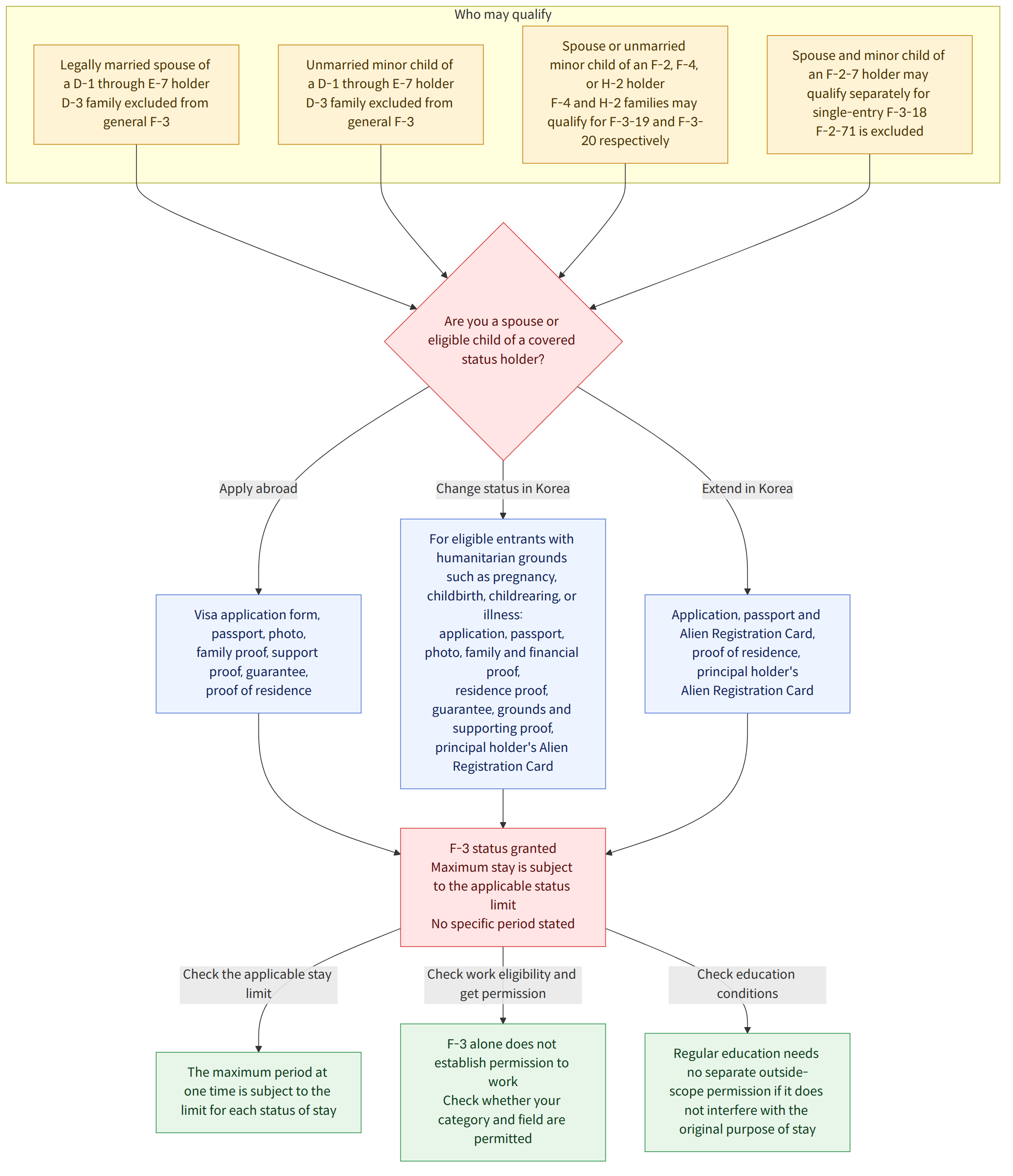
Who it is for
- The legally married spouse of a holder of a status from Culture and Arts (D-1) through Specific Activities (E-7)
- A minor child of a holder of a status from Culture and Arts (D-1) through Specific Activities (E-7), provided that the child is unmarried
- The spouse or unmarried minor child of a holder of Resident (F-2), Overseas Korean (F-4), or Working Visit (H-2) status
- Family members of holders of Technical Training (D-3) status are excluded from the general Dependent (F-3) category.
- The spouse and minor children of a person with Outstanding Talent under the Points System (F-2-7) may be eligible for a separate single-entry F-3-18 visa. F-2-71 is not included in this category.
- The spouse and minor children of a holder of Overseas Korean (F-4) or Working Visit (H-2) status may be eligible for a multiple-entry F-3-19 or F-3-20 visa, respectively.
What you can do
- The manual does not state that a person may work solely on the basis of F-3 status. Permission to engage in activities outside the scope of the status of stay may be required for work.
- Spouses of holders of Professional Foreign Workforce status (E-1, E-2, E-3, E-4, E-5, E-6 excluding E-6-2, and E-7) and spouses of holders of Skilled Workers (E-7-4) may engage in activities in professional occupations (E-1 through E-7, excluding E-6-2) with permission.
- Adult spouses of holders of Resident (F-2), Overseas Korean (F-4), or Working Visit (H-2) status may also engage in activities in professional occupations with permission.
- Spouses in some permitted categories may engage, with permission, in simple labor in agriculture, forestry, and livestock farming, which are within the employment scope of Working Visit (H-2).
- No separate permission to engage in activities outside the scope of the status of stay is required for education at a regular educational institution, provided that it does not interfere with the original purpose of stay.
Period of stay
The maximum period of stay granted at one time is subject to the limit for each status of stay set out in Appendix 1 to the Enforcement Rule of the Immigration Control Act (출입국관리법 시행규칙). The excerpt does not specify a particular number of days or years.
Applications & documents
Visa issuance
- Visa Application Form (사증발급신청서)
- Passport
- One standard-size photograph
- Documents proving family relationship
- Documents proving the ability to support oneself
- Letter of Guarantee (신원보증서)
- Documents proving place of residence, such as proof of accommodation
Documents proving the ability to support oneself are not required for holders of E-1, E-3, E-4, E-5, F-4, or H-2 status. For some statuses, documents proving the ability to support oneself and proof of residence are not required. The head of the Korean diplomatic mission abroad may add or waive document requirements.
Application for a Certificate of Visa Issuance
- Application for Confirmation of Visa Issuance (사증발급인정신청서)
- Copy of passport
- One standard-size photograph
- Documents proving family relationship
- Documents proving the ability to support oneself
- Letter of Guarantee
- Documents proving place of residence
As a rule, it is issued only when the application is submitted together with that of the principal status holder. For some statuses, documents proving the ability to support oneself and proof of place of residence are not required.
Permission to change status of stay
- Application Form (신청서)
- Passport
- One standard-size photograph
- Documents proving family relationship
- Documents proving financial means, such as funds for the period of stay
- Documents proving place of residence
- Letter of Guarantee
- Statement of grounds for change of status of stay (체류자격 변경 사유서) and supporting documents
- Alien Registration Card of the spouse or parent who is the principal status holder
This applies to visa-waiver entrants, transit-tourism entrants, short-term visa entrants, or foreign nationals lawfully staying long term in Korea who require humanitarian consideration due to pregnancy, childbirth, childrearing, illness, or similar circumstances after entering Korea. The review fee is KRW 100,000.
Permission to extend period of stay
- Application Form
- Passport and Alien Registration Card
- Documents proving place of residence
- Alien Registration Card of the spouse or parent
The review fee is KRW 60,000.
Alien registration
- Application Form
- Passport
- One standard-size photograph
- Documents proving place of residence
- Documents proving family relationship
Documents proving family relationship are required only when additional permission to stay, such as an extension, is needed. The fee for issuing an Alien Registration Card is KRW 35,000.
Frequently asked questions
Q. Can I work on an F-3 visa?
The manual does not state that a person may work solely on the basis of F-3 status. Spouses of some principal status holders may work in specified fields after obtaining permission to engage in activities outside the scope of their status of stay. Check whether you are among those permitted and whether the field is allowed, and obtain permission before working.
Q. How long is the period of stay for F-3?
The maximum period of stay granted at one time is subject to the limit for each status of stay. The excerpt does not specify a particular period, so you should check the period actually authorized in the review result.
Q. What family relationship documents must I submit when applying for an F-3 visa?
A spouse must submit documents such as a marriage certificate from their home country; a minor child must submit a birth certificate or other documents proving the parent-child relationship. Official documents require a translator’s confirmation. Documents from countries party to the relevant convention require apostille certification, while documents from non-party countries require consular authentication by a Korean diplomatic mission.
Q. Can I apply for a Certificate of Visa Issuance for F-3 separately from the principal status holder?
As a rule, a Certificate of Visa Issuance is issued only when the application is submitted together with that of the principal status holder.
Q. Can family members of an F-4 or H-2 status holder also obtain an F-3 visa?
A spouse or minor child may be eligible for a multiple-entry F-3-19 or F-3-20 visa, respectively. Both visas are valid for one year. The manual states a period of stay of one year for F-3-19 and 90 days for F-3-20.
Q. Can family members of an F-2-7 status holder also obtain an F-3 visa?
A spouse or minor child may be eligible for a single-entry F-3-18 visa. The visa is valid for 90 days. This does not apply when the principal status holder has F-2-71 status.
Q. Does an F-3 holder need separate permission to attend school?
No separate permission to engage in activities outside the scope of the status of stay is required when attending a regular educational institution, provided that doing so does not interfere with the original purpose of stay.
Q. Must an F-3 holder submit a tuberculosis diagnosis certificate?
The manual specifies a tuberculosis diagnosis certificate for Dependent (F-3) status. Submission requirements are governed by the Guidelines for Visa Issuance and Sojourn Management for Foreign Tuberculosis Patients (외국인 결핵환자 사증발급 및 체류관리 지침) and other applicable rules.
Watch out for
- Family members of holders of Technical Training (D-3) status are excluded from the general F-3 category.
- Check the requirements for translator confirmation and, depending on the country, apostille certification or consular authentication for official family relationship documents.
- The types of persons and fields in which F-3 holders may work are restricted. Check whether permission to engage in activities outside the scope of your status of stay is required before starting the activity.
- The head of a Korean diplomatic mission abroad or an immigration office may request additional documents or waive some document requirements if necessary for the review.
Source
Compiled by AI from the Ministry of Justice "Visa Issuance Guide Manual" and "Residence Guide Manual" (HiKorea notice, in Korean). hikorea.go.kr
This is general guidance; the immigration office makes the final decision. Before applying, check the latest rules on HiKorea (hikorea.go.kr) or call the Immigration Contact Center at 1345.