
Visiting and Joining Family (F-1) Visa — Eligibility, Period of Stay, and Application Documents by Subcategory
Based on Ministry of Justice manual (2026-09-18) · Translated from the Korean original.
The Visiting and Joining Family (F-1) status is for people staying in Korea for purposes such as visiting relatives, living with family, dependent status, or handling household affairs. Application requirements, documents, and periods of stay vary according to the specific category, including parents of international students, family members of marriage immigrants, and domestic helpers of foreign diplomatic mission officials.
At a glance
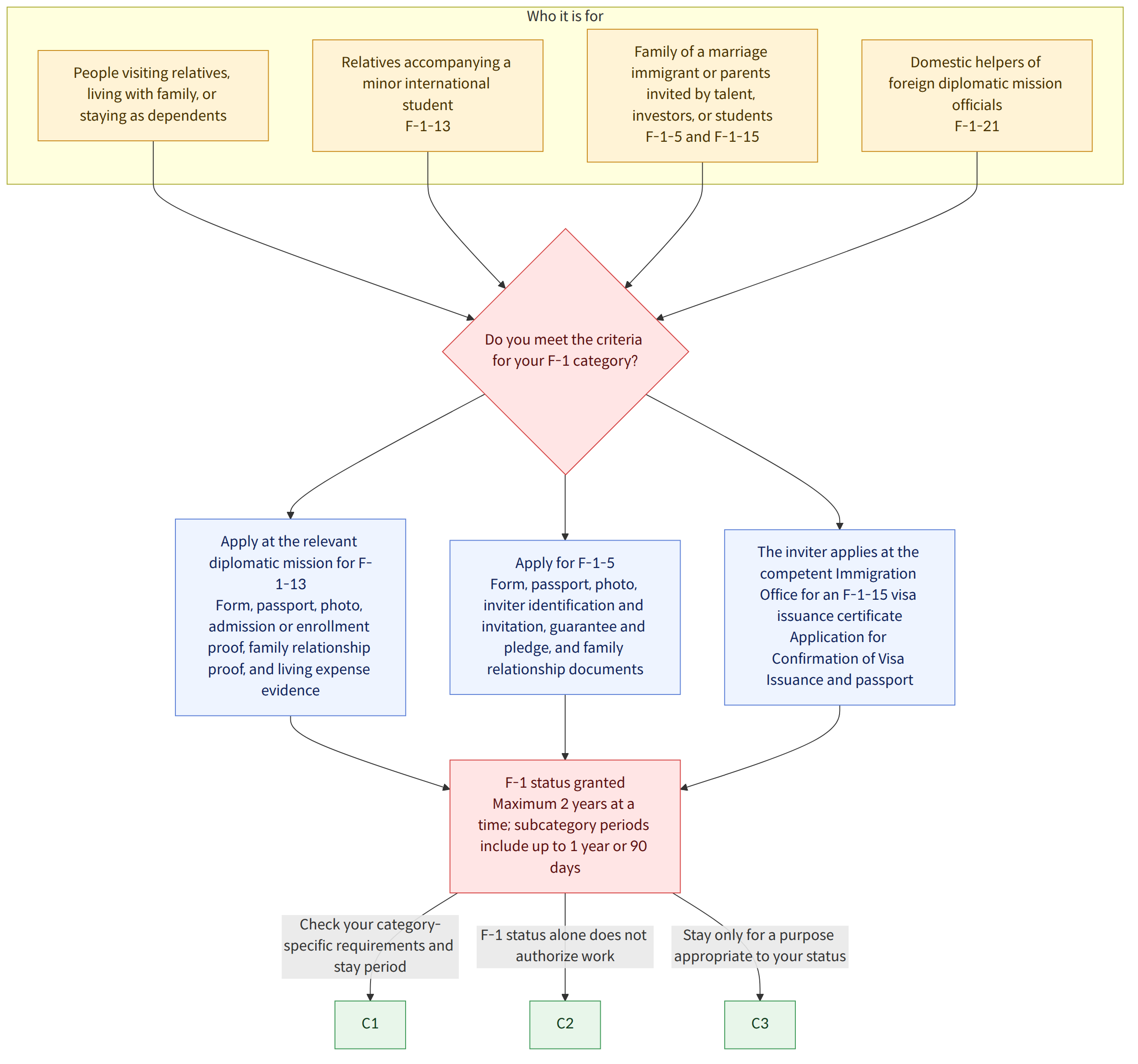
Who it is for
- People who intend to stay for purposes such as visiting relatives, living with family, dependent status, handling household affairs, or similar purposes.
- Domestic helpers of foreign diplomatic mission officials in Korea. If the helper is a national of the same country as the mission official, they may be eligible for issuance of F-1-21 at the discretion of the head of the mission.
- People who live with holders of statuses from Diplomat (A-1) through Agreement (A-3) but are not members of their household.
- Relatives within the second degree of kinship, including parents, who intend to accompany a minor international student who is scheduled to enroll in or is enrolled at an educational institution at or below the high-school level (F-1-13).
- Accompanying children aged 21 or older, or other family members, of persons covered by SOFA.
- Family members, including parents, of a marriage immigrant invited for child-rearing support or on humanitarian grounds (F-1-5).
- Parents invited by outstanding talent, investors, or international students who meet the relevant requirements (F-1-15).
- People granted permission to change their status of stay because they are recognized as needing to stay in Korea for an extended period without engaging in work due to unavoidable circumstances.
What you can do
- Stay for a purpose appropriate to the status, such as visiting relatives, living with family, dependent status, or handling household affairs.
- F-1-13 applies to parents and others who intend to stay with an international student enrolled, or scheduled to enroll, in an educational institution at or below the high-school level.
- Domestic-helper subcategories such as F-1-21 are for stays to provide domestic assistance to the relevant employer.
- The excerpt does not specify general work authorization applicable to all F-1 holders. F-1 status alone should not be taken to mean that the holder may work.
- For an F-1-15 invitation, a letter explaining the reason for the invitation and stating that the invitee will not engage in employment must be submitted.
Period of stay
The maximum period of stay granted at one time for F-1 is 2 years. However, separate issuance criteria apply by subcategory, including periods of up to 1 year or up to 90 days.
Applications & documents
Visa application for parents accompanying an international student and others (F-1-13)
- Visa Application Form (사증발급신청서), passport, and one standard-format photograph (표준규격사진)
- Certificate of Admission (입학허가서) or Certificate of Enrollment (재학증명서)
- Documents proving the family relationship
- Documents proving the ability to cover living expenses in Korea
- Documents proving financial capacity, if applicable
As a rule, the application should be filed at the diplomatic mission with jurisdiction over the applicant’s country of residence or the location of the international student’s last school. This is a single-entry visa with a period of stay of up to 1 year.
Visa application for family members, including parents, of a marriage immigrant (F-1-5)
- The applicant’s Visa Application Form, passport, and one standard-format photograph
- A copy of the inviter’s identification and an invitation letter
- A letter of guarantee and a pledge to prevent illegal stay and employment
- The inviter’s Basic Certificate (기본증명서), Family Relations Certificate (가족관계증명서), Marriage Relations Certificate (혼인관계증명서), and Resident Registration Record (주민등록표 등본)
- A Family Relations Certificate in the child’s name
- Documents proving family relationships in the marriage immigrant’s country of origin
- Certificate of Enrollment or documents proving a serious illness or disability, if applicable
The specific requirements and documents differ for the child-rearing support and humanitarian grounds categories. The child-rearing support category is for a single-entry visa valid for 90 days or less.
Application for a Certificate of Visa Issuance for parents of outstanding talent, investors, and international students (F-1-15)
- Application for Confirmation of Visa Issuance (사증발급인정신청서), passport, and one standard-format photograph
- A letter explaining the reason for the invitation and stating that the invitee will not engage in employment
- A letter of guarantee
- Documents proving the family relationship
- Documents proving income, investment funds, or funds for living expenses
The inviter applies to the Immigration Office with jurisdiction (Immigration Office (출입국·외국인청), branch office, or field office). This category is for a Certificate of Visa Issuance for a single-entry visa valid for 90 days or less.
Visa application for a domestic helper of a foreign diplomatic mission official in Korea (F-1-21)
- Visa Application Form, passport, and one standard-format photograph
- A letter of cooperation from the foreign diplomatic mission
- Employment contract
- A copy of the employer’s proof of identity
A domestic helper who is a national of the same country as the mission official is eligible for a single-entry visa with a period of stay of up to 1 year. A domestic helper of a different nationality must follow a procedure requiring approval from the Minister of Justice or a Certificate of Visa Issuance.
Frequently asked questions
Q. Who is eligible for the Visiting and Joining Family (F-1) status?
This status is for people staying in Korea for purposes such as visiting relatives, living with family, dependent status, or handling household affairs. The eligible applicants and requirements vary by subcategory.
Q. What is the maximum period of stay for F-1?
The maximum period of stay granted at one time, as stated in the manual, is 2 years. However, F-1-13, F-1-21, F-1-5, and other subcategories may be issued for shorter periods under their specific criteria.
Q. Can I apply to live with my minor child who is studying in Korea?
Relatives within the second degree of kinship of a self-funded international student who has been admitted to an educational institution, is scheduled to enroll there, or is currently enrolled may be eligible to apply for F-1-13. As a rule, one relative is permitted per international student. Scholarship students invited by government agencies or local governments are generally not eligible to obtain visas for accompanying parents.
Q. Can I work on an F-1 visa?
The excerpt does not state a general work authorization rule that applies to all F-1 holders. In particular, F-1-15 applicants must submit a letter explaining the reason for the invitation and stating that they will not engage in employment. Domestic-helper subcategories are subject to the purpose and criteria applicable to that subcategory.
Q. When can a marriage immigrant invite their parents under F-1-5?
Under the child-rearing support category, parents may be invited while the marriage immigrant or their spouse is pregnant, or until the end of September in the year the child turns 9. A special provision for single-parent and multi-child families allows an invitation until the end of September in the year the child turns 12.
Q. How many family members can be invited under F-1-5?
One person may be invited. Only parents may be invited at the same time or consecutively. Under the child-rearing support category, a person may be invited up to twice per child.
Q. Which parents may be invited under F-1-15?
The parents of the inviter or of the inviter’s spouse may be invited. A maximum of two may stay in Korea at the same time.
Q. Are all domestic-helper visas subject to the same application procedure?
No. A domestic helper who is a national of the same country as a foreign diplomatic mission official in Korea may apply at the discretion of the head of the mission. For a domestic helper of a mission official who is a national of a different country, the guidance describes procedures such as obtaining a Certificate of Visa Issuance. Domestic helpers of investors and professionals are also subject to separate requirements.
Watch out for
- F-1-13 applicants must prove that they can cover their living expenses in Korea. The manual specifies an amount equivalent to twice the annual living-expense benchmark for an international student, for one year of living expenses.
- Nationals of 21 countries who apply for F-1-13 are subject to separate financial-capacity requirements. They must meet either the annual income or asset requirement. Spouses’ income or assets may be combined.
- An invitation or visa issuance under F-1-5 may be restricted depending on legal violations by the inviter or the invitee.
- The place of application, issuance period, number of permitted invitations, and required documents vary by subcategory. The head of the diplomatic mission or an Immigration Office (출입국·외국인관서) may add or waive some attached documents if necessary for the review.
Source
Compiled by AI from the Ministry of Justice "Visa Issuance Guide Manual" and "Residence Guide Manual" (HiKorea notice, in Korean). hikorea.go.kr
This is general guidance; the immigration office makes the final decision. Before applying, check the latest rules on HiKorea (hikorea.go.kr) or call the Immigration Contact Center at 1345.