
Arts and Entertainment (E-6) Visa — Eligibility, Activities, Period of Stay, and Extension and Change Procedures
Based on Ministry of Justice manual (2026-09-18) · Translated from the Korean original.
The Arts and Entertainment (E-6) status is for foreign nationals seeking to engage in remunerated artistic activities or performance, entertainment, sports, advertising, and fashion modeling activities for profit. It is divided into Arts and Entertainment (E-6-1), Hotels and Entertainment Establishments (E-6-2), and Sports (E-6-3).
At a glance
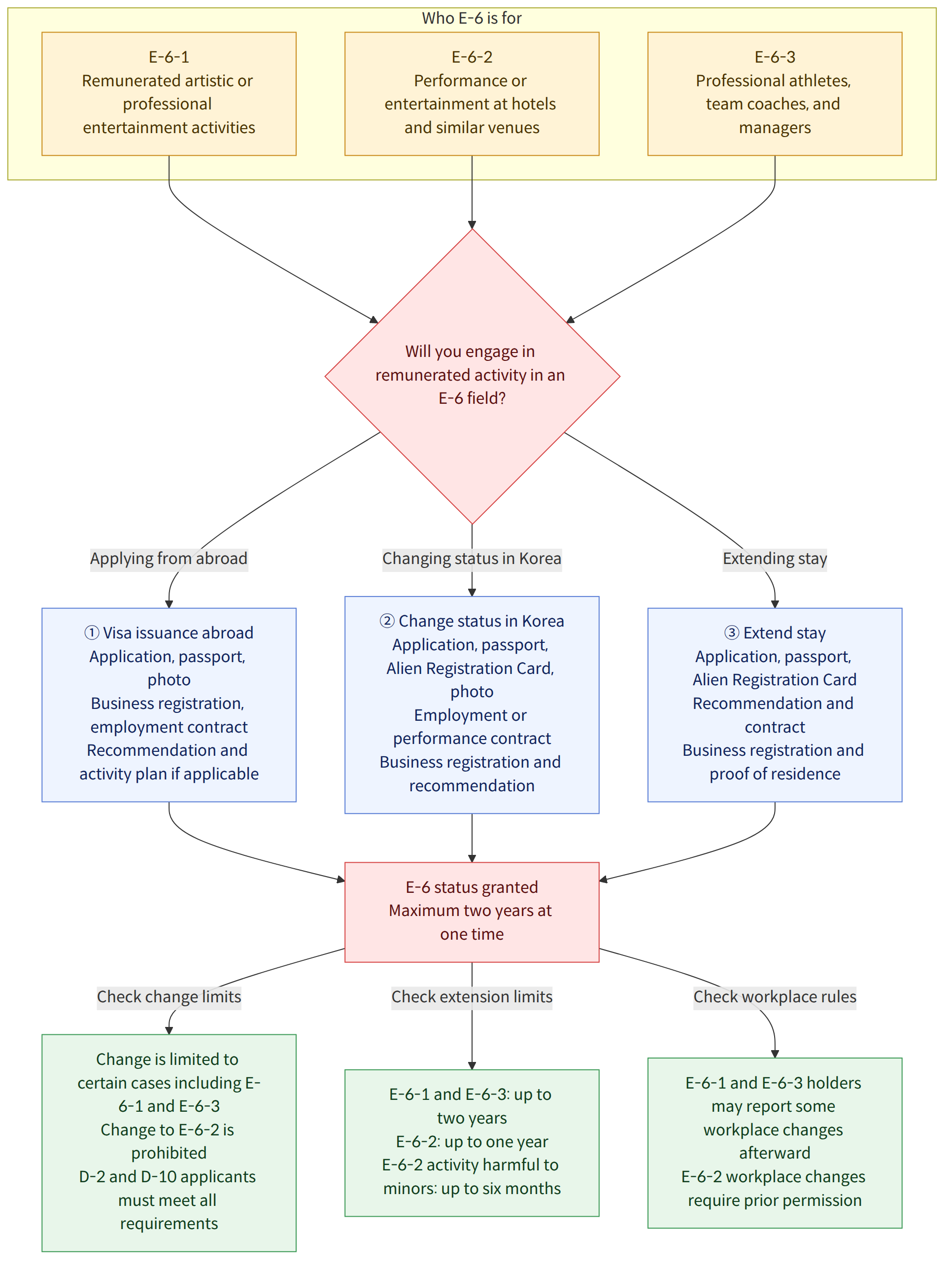
Who it is for
- People engaged in remunerated creative artistic activities, such as composers, painters, sculptors, craft artists, writers, and photographers
- People who teach artistic activities such as music, fine arts, literature, photography, musical performance, dance, film, and sports
- People appearing in entertainment, musical performance, theater, sporting events, and similar activities for profit
- People engaged in advertising or fashion modeling
- Makeup artists, managers, and others working alongside performers
- People engaged in performance or entertainment activities at hotels, entertainment establishments, and similar venues (E-6-2)
- Professional athletes in sports such as soccer, baseball, and basketball, as well as professional team coaches and managers (E-6-3)
What you can do
- E-6-1 includes remunerated artistic activities, professional broadcast acting, and professional entertainment activities under the Public Performance Act (공연법).
- E-6-2 covers performance or entertainment activities at hotels, entertainment establishments, and similar venues that do not fall under E-6-1.
- E-6-3 covers activities in the sports field, including those of professional athletes and professional team coaches and managers.
- If the period of stay is 90 days or less, the applicable status is Short-Term Employment (C-4-5).
- Registered E-6-1 and E-6-3 holders who meet certain requirements may report a change or addition of workplace after the fact, but a change or addition of workplace for E-6-2 requires prior permission.
- Broadcasting, film, and modeling activities by lawfully staying registered foreign nationals may require permission to engage in activities outside their status of sojourn. E-6-2 activities are excluded from the activities covered by this permission.
Period of stay
The maximum period of stay that may be granted at one time is two years. The actual period granted is determined with reference to the recommendation period, employment contract period, and other relevant factors. For extensions, E-6-1 and E-6-3 may be extended for the employment contract period plus one month, up to a maximum of two years. E-6-2 may be extended until the end of the performance recommendation period or employment contract period, up to a maximum of one year. If the E-6-2 recommendation states that the activity is “harmful” to minors, the extension period is limited to a maximum of six months.
Applications & documents
Application for a Certificate of Visa Issuance
- Application for Confirmation of Visa Issuance (사증발급인정신청서), passport, and one standard-size photograph
- Copy of the business registration certificate
- Copy of the employment contract
- Performance recommendation and performance plan or entertainment activity plan (for applicable activities)
- Certificate of qualifications or certificate of work experience (for applicable performance activities at hotels or entertainment establishments)
- Letter of guarantee (for applicable activities)
- Consent of the legal representative (법정대리인 동의서), if the applicant is a minor
As a rule, E-6 visas are issued based on a Certificate of Visa Issuance. Additional documents vary by field of activity, and documents may be added or waived depending on the review.
Permission to Change Status of Sojourn
- Application form, passport, and Alien Registration Card (외국인등록증)
- One standard-size photograph
- Employment contract or performance contract
- Business Registration Certificate (사업자등록증)
- Employment recommendation or performance recommendation
Students (D-2) and job seekers (D-10) must meet all the requirements, including lawful stay, qualification for the relevant E-6 status, and conclusion of an employment contract. A change of status of sojourn is permitted only in limited cases, including E-6-1 and E-6-3; a change to a status in the E-6-2 category is prohibited.
Permission to Extend Period of Stay
- Application form, passport, and Alien Registration Card (외국인등록증)
- Employment recommendation or performance recommendation
- Employment contract or performance contract
- Copy of the Business Registration Certificate (사업자등록증)
- Proof of residence
- Letter of guarantee (신원보증서) (E-6-2 only)
- Health insurance special-room confirmation (E-6-2 only)
If necessary, additional documents may be submitted, such as a certificate of employment, foreign worker employment status, and a record of withholding tax on earned income. The application fee for an extension of stay is KRW 60,000.
Alien Registration
- Application form, original passport, and one standard-size photograph
- Copy of the Business Registration Certificate (사업자등록증), Unique Identification Number Certificate (고유번호증), or similar document for the employing organization or company
- Proof of residence
- Pre-employment medical examination report (채용신체검사서) (E-6-2 only)
The fee for issuance of an Alien Registration Card is KRW 35,000.
Change or Addition of Workplace
- Application form, passport, and Alien Registration Card (외국인등록증)
- Business Registration Certificate (사업자등록증)
- Employment contract
- Employment recommendation or performance recommendation
- Consent of the head of the original workplace (unless an exemption or substitute reason applies)
- Original letter of guarantee (신원보증서) (E-6-2 only)
E-6-1 and E-6-3 holders who meet the requirements must report a change or addition after the fact within 15 days of the reason arising; there is no fee. E-6-2 holders must obtain permission in advance. The fee for a change or addition of workplace is KRW 120,000.
Frequently asked questions
Q. What activities does the Arts and Entertainment (E-6) status cover?
This status is for remunerated artistic activities and entertainment, musical performance, theatrical performance, sporting events, advertising, and fashion modeling activities undertaken for profit. Accompanying personnel, such as makeup artists and managers, may also qualify.
Q. What is the difference between E-6-1, E-6-2, and E-6-3?
E-6-1 covers arts and entertainment activities, E-6-2 covers performance and entertainment activities at hotels, entertainment establishments, and similar venues, and E-6-3 covers sports activities. You must check which specific category matches your field of activity.
Q. How long can the period of stay for E-6 be granted at one time?
The maximum period granted at one time is two years. The actual period is determined with reference to the performance recommendation period, employment contract period, and other relevant factors.
Q. Do I need to apply for E-6 even if I will be working for 90 days or less?
The manual states that activities lasting 90 days or less fall under the Short-Term Employment (C-4-5) status.
Q. Can I apply for an E-6 visa directly at an overseas diplomatic mission?
As a rule, an E-6 visa is issued based on a Certificate of Visa Issuance. However, there is an exception for E-6-2 applications by nationals of certain countries, including countries designated as having high rates of illegal stay: they may apply for and receive the visa at a diplomatic mission in their home country.
Q. Can E-6-1 or E-6-3 holders change their workplace?
Registered foreign nationals who meet the requirements may report a change or addition of workplace after the fact, provided they meet the requirements for the relevant status at the new workplace. The report must be made within 15 days of the reason arising. This does not apply if the person resigns for reasons attributable to them and cannot obtain the original employer’s consent to transfer.
Q. Can E-6-2 holders change their workplace and report it afterward?
If the employer, such as a performance agency, changes, you must obtain prior permission to change or add a workplace. If only the performance venue is changed or added under a dispatch arrangement without changing the employer, you must report the change in employment within 15 days of the change.
Q. What documents are required to extend the period of stay for E-6?
The basic documents are an application form, passport and Alien Registration Card (외국인등록증), employment or performance recommendation, employment or performance contract, a copy of the business registration certificate, and proof of residence. E-6-2 applicants must also submit a letter of guarantee and a health insurance special-room confirmation.
Watch out for
- Even when seeking Permission to Engage in Activities Outside the Status of Sojourn (체류자격외 활동허가) for broadcasting, film, or modeling activities, E-6-2 activities are excluded from the activities covered by that permission.
- The guidance states that a one-time, non-continuous guest appearance on terrestrial broadcasting for a non-profit purpose may be undertaken without separate permission if the only compensation received is at the level of actual expenses, such as meals and transportation.
- For E-6-2, the performance venue cannot be changed within six months of entry into Korea. An exception may be made in unavoidable circumstances, such as the suspension or closure of the original venue.
- The procedures and deadlines differ for post-reporting a change or addition of workplace for E-6-1 and E-6-3, obtaining prior permission for E-6-2, and reporting a change of performance venue.
Source
Compiled by AI from the Ministry of Justice "Visa Issuance Guide Manual" and "Residence Guide Manual" (HiKorea notice, in Korean). hikorea.go.kr
This is general guidance; the immigration office makes the final decision. Before applying, check the latest rules on HiKorea (hikorea.go.kr) or call the Immigration Contact Center at 1345.