
Conversational Language Instruction (E-2) Visa — Eligibility, Scope of Activities, Period of Stay, and Application Documents
Based on Ministry of Justice manual (2026-09-18) · Translated from the Korean original.
The Conversational Language Instruction (E-2) status of stay is for foreign nationals who meet specified qualifications and teach students how to communicate in a foreign language at eligible institutions such as academies, schools, and businesses. Activities that use a foreign language to teach a specific language, literature, or interpreting or translation techniques do not constitute conversational language instruction.
At a glance
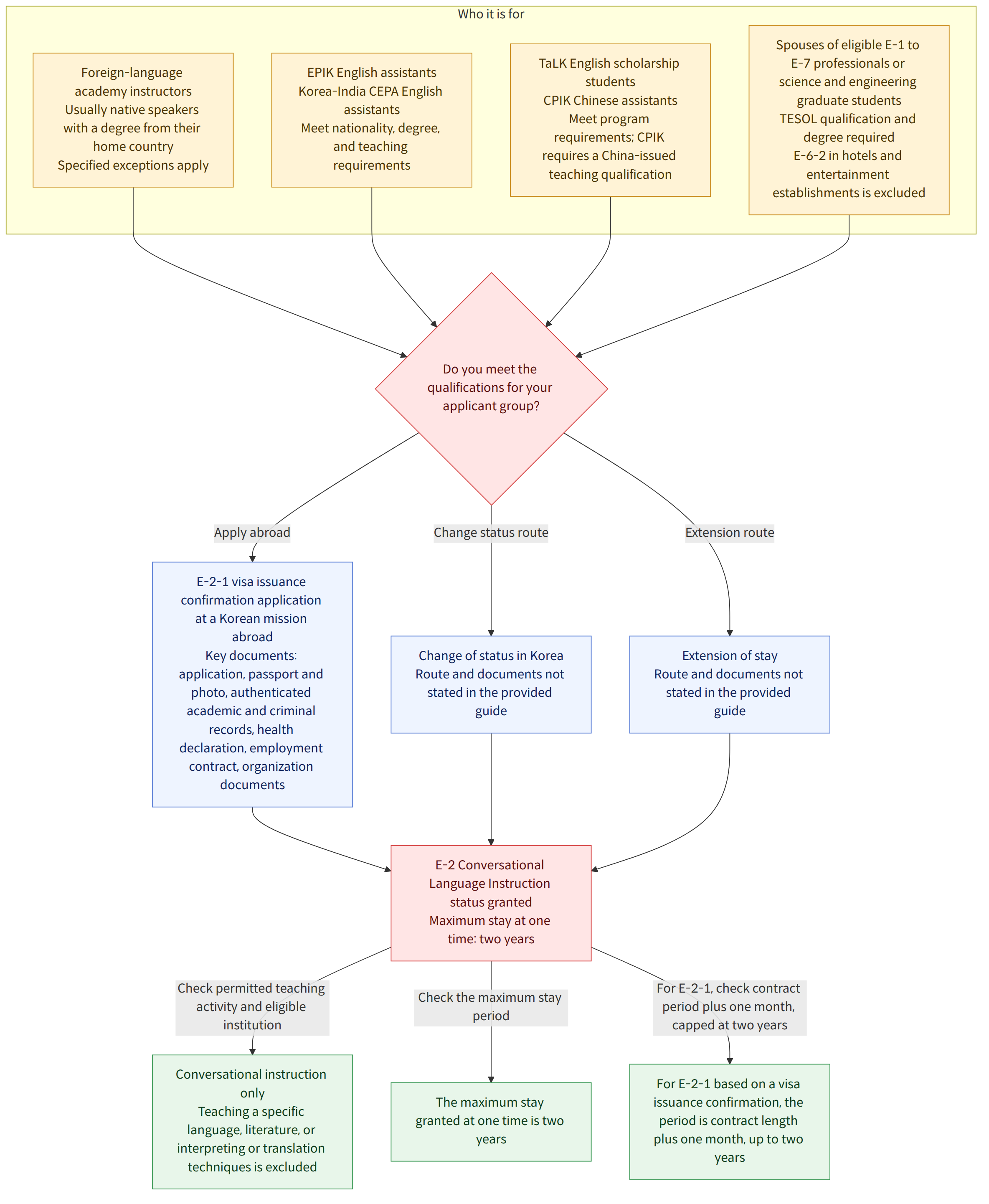
Who it is for
- Foreign-language academy instructors: Applicants must be nationals of a country where the relevant foreign language is the native language and must have graduated from a university or higher-education institution in that country, holding at least a bachelor’s degree or an equivalent or higher qualification.
- Exception for graduates of Korean universities: Applicants must have graduated from a high school or junior college in a country where the relevant foreign language is the native language and earned at least a bachelor’s degree from a university in Korea.
- Exception for nationals of countries where the language is an official language: For foreign languages other than English, Chinese, and Japanese, applicants must hold an accredited teacher qualification in the relevant language or at least a bachelor’s degree in a related major, and meet the specified salary requirements.
- EPIK English Assistant Teachers: Applicants must be nationals of a country where English is the native language, have graduated from a university in their country of origin, and hold at least a bachelor’s degree.
- Korea-India CEPA English Assistant Teachers: Applicants must be Indian nationals who have graduated from a university or higher-education institution and hold at least a bachelor’s degree and a teaching certificate with a major in English.
- TaLK English Scholarship Students and CPIK Chinese Assistant Teachers: Applicants must be nationals of an English-speaking country or Chinese nationals who meet the educational and training requirements specified in the Manual. CPIK applicants must have graduated from a university or higher-education institution in China, hold at least a bachelor’s degree, and possess a teacher qualification issued by China’s National Office for Teaching Chinese as a Foreign Language.
- Exception for spouses from non-English-speaking countries: Applicants must be spouses of professional workers in E-1 through E-7 (excluding E-6-2 in hotels and entertainment establishments) or international students pursuing master’s or doctoral degrees in science or engineering, and must hold a TESOL qualification and at least a bachelor’s degree or an equivalent or higher qualification.
What you can do
- You may provide conversational language instruction at eligible specialized foreign-language academies, educational institutions from elementary school level upward and their affiliated language research institutes, language training centers affiliated with broadcasters or businesses, and similar institutions.
- School-subject tutoring academies that provide remote instruction using information and communications technology are also included as places where the activity may be conducted.
- Conversational language instruction for colleagues at a workplace, and instruction provided as social service without a profit-making or paid purpose, may not require permission for activities outside the status of stay if the specified requirements are met.
- You may engage in educational activities at a regular educational institution without separate permission during your period of stay, provided that the activities do not interfere with the original purpose of your stay.
- Teaching a specific language, literature, or interpreting or translation techniques does not constitute conversational language instruction.
Period of stay
The maximum period of stay that may be granted at one time is two years. For E-2-1 based on a visa issuance confirmation, the period is determined by adding one month to the contract period, but may not exceed two years.
Applications & documents
E-2-1 Application Based on a Visa Issuance Confirmation
- Visa Issuance Confirmation Application (사증발급인정신청서)
- Passport and one standard-size photograph
- Officially authenticated academic credential
- Officially authenticated criminal record certificate from your country of citizenship
- Where applicable, an officially authenticated criminal record certificate from a third country
- Self-Health Declaration
- Employment contract
- Documents related to the establishment of the academy or organization
- Where required, a teacher utilization plan and information on students and staff
You may apply at a Korean diplomatic mission abroad. Academic and criminal record documents must receive official authentication, such as an apostille or, where applicable, consular confirmation.
Permission to Change Status of Stay
- Application
- Passport and Residence Card
- Employment contract
- Business Registration Certificate or documents related to the establishment of the employer
- Officially authenticated academic credential
- Officially authenticated criminal record certificate from your country of citizenship
- Where applicable, an officially authenticated criminal record certificate from a third country
- Medical examination certificate for employment
Registered foreigners and others who meet the E-2 requirements may apply. To change from D-2 or D-10, applicants must meet all of the following requirements: lawful stay, satisfaction of the eligibility requirements for the relevant status, and execution of an employment contract. The fee for permission to change status of stay is KRW 100,000.
Permission to Extend Period of Stay
- Application
- Passport and Residence Card
- Original and copy of the employment contract
- Copy of the Business Registration Certificate
- Where applicable, copy of the Academy Establishment and Operation Registration Certificate
- Where required, information on students, class schedule, and similar materials
- Certificate of Income Amount
- Documents proving place of residence
Native English-speaking teachers invited by the Ministry of Education or a Superintendent of Education of a City or Province are not required to submit a criminal record certificate, academic verification, or a medical examination certificate for employment. The fee for permission to extend the period of stay is KRW 60,000.
Foreigner Registration
- Application
- Original passport and one standard-size photograph
- Business Registration Certificate
- Medical examination certificate for employment
- Documents proving place of residence
Native English-speaking assistant teachers hired by Superintendents of Education of Cities or Provinces and government-invited TaLK English scholarship students are exempt from submitting a medical examination certificate for employment. The fee for issuance of a Residence Card is KRW 35,000.
Report of Change or Addition of Workplace
- Report form
- Passport and Residence Card
- Employment contract
- Business Registration Certificate
- Where required, consent form from the head of the original workplace
- Documents related to the establishment of the facility
File a report with the competent Immigration Office (출입국·외국인관서) within 15 days of the date the reason for reporting arises. If the contract period has ended or the original workplace has suspended or closed its business, for example, you may submit documents proving the relevant reason instead of a consent form.
Frequently asked questions
Q. What activities does E-2 conversational language instruction cover?
This is an activity that teaches students how to communicate with one another in a foreign language. Even when a foreign language is used, teaching a specific language, literature, or interpreting or translation techniques does not constitute conversational language instruction.
Q. Where can I provide conversational language instruction?
Eligible institutions include specialized foreign-language academies, educational institutions from elementary school level upward and their affiliated language research institutes, and language training centers affiliated with broadcasters or businesses. Certain lifelong education facilities and vocational skills development training facilities specified in the Manual may also be eligible, as may corporations and public institutions with lecture rooms for employee training.
Q. How long can I stay on an E-2 visa?
The maximum period of stay that may be granted at one time is two years. For E-2-1 based on a visa issuance confirmation, the period is determined by adding one month to the contract period and is granted for no more than two years.
Q. What authentication is required for my degree and criminal record certificate?
When applying for a visa issuance confirmation, your academic credential must receive official authentication, such as an apostille or, where applicable, consular confirmation. Your criminal record certificate from your country of citizenship must also receive official authentication and must have been issued within six months of the application date.
Q. Do I need a criminal record certificate if I earned my degree in a third country?
If you earned your degree in a country other than your country of citizenship, you must also submit an officially authenticated criminal record certificate from that third country. The same requirements that apply to criminal record certificates from your country of citizenship apply.
Q. Can I change to E-2 if I am in Korea on a different status of stay?
The Manual provides for a change of status of stay for registered foreigners and others who meet the E-2 requirements. Holders of D-2 or D-10 must meet all of the following requirements: lawful stay, satisfaction of the eligibility requirements for the employment field, and execution of an employment contract.
Q. Can I teach at another place while working on E-2?
If you change or add a workplace, check the reporting requirements and procedures set out in the Manual. A report of a change or addition of workplace must be filed within 15 days of the date the reason arises.
Q. Can I teach conversational language to coworkers or volunteer while on E-2?
Permission may not be required when a registered foreigner holding a designated status of stay teaches conversational language to colleagues within their workplace, or when a lawfully staying foreigner who has completed registration provides instruction as social service without a profit-making or paid purpose. This exception does not apply if conversational language instruction becomes the person’s primary activity or falls outside the permitted criteria.
Watch out for
- A criminal record certificate must cover criminal history throughout your country of citizenship and, when applying for a visa issuance confirmation, must have been issued within six months of the application date.
- If you have a criminal record, a change to the Conversational Language Instruction status of stay may in principle be denied.
- A report of a change or addition of workplace must be filed within 15 days of the date the reason arises.
- In principle, the period of permission to stay is granted only within the validity period of your passport.
Source
Compiled by AI from the Ministry of Justice "Visa Issuance Guide Manual" and "Residence Guide Manual" (HiKorea notice, in Korean). hikorea.go.kr
This is general guidance; the immigration office makes the final decision. Before applying, check the latest rules on HiKorea (hikorea.go.kr) or call the Immigration Contact Center at 1345.