
Religion (D-6) Visa — Eligibility, Period of Stay, and Documents for Issuance and Extension
Based on Ministry of Justice manual (2026-09-18) · Translated from the Korean original.
The Religion (D-6) status of stay is for people dispatched or invited by foreign religious or social welfare organizations to engage in religious or social welfare activities in Korea. People who engage in religious practice, training, or research on the recommendation of a domestic religious organization may also qualify.
At a glance
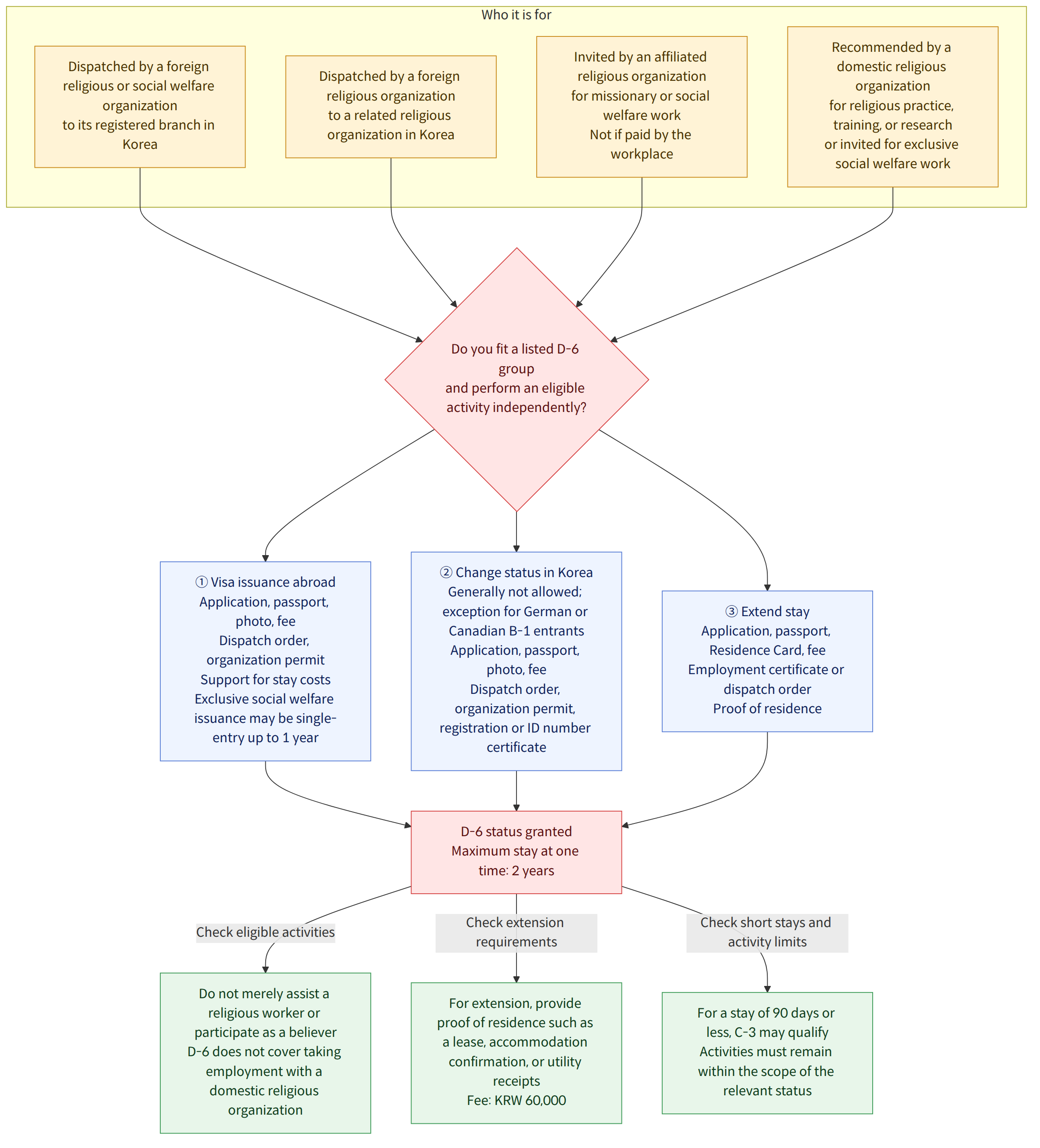
Who it is for
- People dispatched by a foreign religious or social welfare organization to work at its branch registered in Korea
- People dispatched by a foreign religious or social welfare organization to engage in religious activities at a related religious organization in Korea
- People invited to a medical, educational, relief, or other organization operated by their affiliated religious organization to engage in missionary or social welfare activities. However, people who receive remuneration from the institution where they work are excluded.
- People who engage in religious practice, training, or research at a domestic religious organization on its recommendation
- People invited by a domestic religious or social welfare organization to engage exclusively in social welfare activities
What you can do
- Religious workers dispatched by foreign religious organizations may engage in missionary work and other religious activities in Korea.
- People invited by a domestic religious or social welfare organization may engage exclusively in social welfare activities.
- People who merely assist a religious worker, do not engage in religious activities independently, or simply participate as believers do not qualify for D-6.
- Activities performed after taking employment with a domestic religious organization are not eligible for D-6. A visa also cannot be issued to someone taking up a position such as pastor at a local church in Korea.
- If a person attends an educational institution in the regular school system without interfering with their original purpose of stay, no separate permission is required during their period of stay.
- Employees of institutions affiliated with the same religious foundation may, if they meet the requirements, apply for permission to engage in activities outside their status of stay to undertake Professor (E-1) activities while on D-6.
Period of stay
The maximum period of stay that may be granted at one time is 2 years. If the period of stay is 90 days or less, the person may qualify for Short-Term Visit (C-3). However, activities are limited to those within the scope of activities for the relevant status of stay prescribed by the Enforcement Decree.
Applications & documents
Visa Issuance — For Those Engaging Exclusively in Social Welfare Activities
- Visa Application Form (별지 제17호 서식)
- Passport
- One standardized photograph
- Fee
- Dispatch Order (파견명령서)
- Copy of the Permit to Establish the Religious or Social Welfare Organization (설립허가서)
- Documents concerning support for the costs of stay from the affiliated organization
This is a single-entry visa with a period of stay of up to 1 year, which may be issued at the discretion of the head of the diplomatic mission. The head of an overseas diplomatic mission may add or omit documents as necessary for the review.
Application for Confirmation of Visa Issuance
- Application for Confirmation of Visa Issuance (별지 제21호 서식)
- Copy of passport and one standardized photograph
- Statement of Reasons for Invitation (초청사유서)
- Dispatch Order (파견명령서)
- Copy of the Permit to Establish the Religious or Social Welfare Organization (설립허가서)
- Copy of the Certificate of Unique Identification Number (고유번호증)
- Documents concerning support for the costs of stay from the affiliated organization
If an agent submits the application, additionally submit a power of attorney, the agent’s certificate of employment, and a copy of the agent’s identification. Documents may be added or omitted depending on the review.
Permission to Change Status of Stay
- Application Form (별지 제34호 서식)
- Passport and one standardized photograph
- Fee
- Dispatch Order (파견명령서)
- Permit to Establish the relevant organization (설립허가서)
- Copy of the Certificate of Business Registration (사업자등록증) or Certificate of Unique Identification Number (고유번호증)
As a rule, a change of status of stay is not permitted. The manual provides exceptions for German nationals or Canadian nationals who entered Korea under visa waiver status (B-1). The fee is KRW 100,000.
Permission to Extend Period of Stay
- Application Form (별지 제34호 서식)
- Passport and Residence Card
- Fee
- Certificate of Employment (재직증명서) or Dispatch Order (파견명령서)
- Proof of Residence (체류지 입증서류)
Proof of residence may include a lease agreement, a confirmation of accommodation provided, or utility payment receipts. The fee is KRW 60,000.
Foreigner Registration
- Application Form (별지 제34호 서식)
- Original passport and one standardized photograph
- Documents related to the establishment of the religious or social welfare organization
- Proof of Residence (체류지 입증서류)
- Fee
The fee for issuance of a Residence Card is KRW 35,000.
Frequently asked questions
Q. How long can I receive a period of stay for D-6 at one time?
The maximum period of stay that may be granted at one time is 2 years. As a rule, the period of stay is granted within the validity period of the passport.
Q. Can I obtain D-6 if I take a job at a church or temple in Korea?
The manual describes the activities of religious workers dispatched by foreign religious organizations as eligible for D-6. Activities performed after taking employment with a domestic religious organization are not eligible for D-6, and the manual states that a visa cannot be issued to someone taking up a position such as pastor at a local church in Korea.
Q. Does merely assisting with religious activities qualify for D-6?
No. Merely assisting a religious worker, not engaging in religious activities such as missionary work independently, or simply participating as a believer does not qualify for D-6.
Q. What is the visa issuance procedure for engaging in social welfare activities on D-6?
If a person is invited by a domestic religious or social welfare organization and engages exclusively in social welfare activities, the head of the diplomatic mission may issue a single-entry visa with a period of stay of up to 1 year at their discretion. Required documents include an application form, passport, photograph, dispatch order, a copy of the organization’s permit to establish, and documents concerning support for the costs of stay.
Q. Can I change my D-6 status of stay to another status?
As a rule, this is not permitted; only the exceptions specified in the manual are allowed. The manual provides exceptions for German nationals and Canadian nationals who entered Korea under visa waiver status (B-1), so you should check the eligibility requirements and period-of-stay conditions.
Q. Do I need separate permission to study at a regular school on D-6?
If you attend an elementary, middle, or high school, or a university, without interfering with your original purpose of stay, no separate permission procedure is required during your period of stay.
Q. What documents do I need to submit to extend my period of stay on D-6?
You need an application form, passport and Residence Card, a certificate of employment or dispatch order, and proof of residence. The fee for permission to extend the period of stay is KRW 60,000.
Q. What documents are required for D-6 holders to register as foreigners?
Submit an application form, your original passport and a photograph, documents related to the establishment of the religious or social welfare organization, and proof of residence. The fee for issuance of a Residence Card is KRW 35,000.
Watch out for
- If the period of stay is 90 days or less, the person may qualify for Short-Term Visit (C-3), but permitted activities are limited to those within the scope of activities for the relevant status of stay prescribed by the Enforcement Decree (시행령).
- The guidance states that people who receive remuneration from the institution where they work are excluded from the scope of activities.
- A visa cannot be issued to religious workers affiliated with a denomination whose activities conflict with the fundamental ideology of the state or run counter to public order and good morals or public sentiment.
- If the affiliated institution or organization changes or is added, the person must report a change to their foreigner registration details within 15 days of the change.
Source
Compiled by AI from the Ministry of Justice "Visa Issuance Guide Manual" and "Residence Guide Manual" (HiKorea notice, in Korean). hikorea.go.kr
This is general guidance; the immigration office makes the final decision. Before applying, check the latest rules on HiKorea (hikorea.go.kr) or call the Immigration Contact Center at 1345.