
Technical Training (D-3) Visa — Eligibility, Period of Stay, Certificate of Visa Issuance, Extension, and Registration Documents
Based on Ministry of Justice manual (2026-09-18) · Translated from the Korean original.
The Technical Training (D-3) status of stay is for foreign nationals who meet the training requirements set by the Minister of Justice and who will receive technical training at an industrial establishment in Korea. It covers training related to companies making overseas direct investments, companies exporting technology, or companies exporting industrial plants.
At a glance
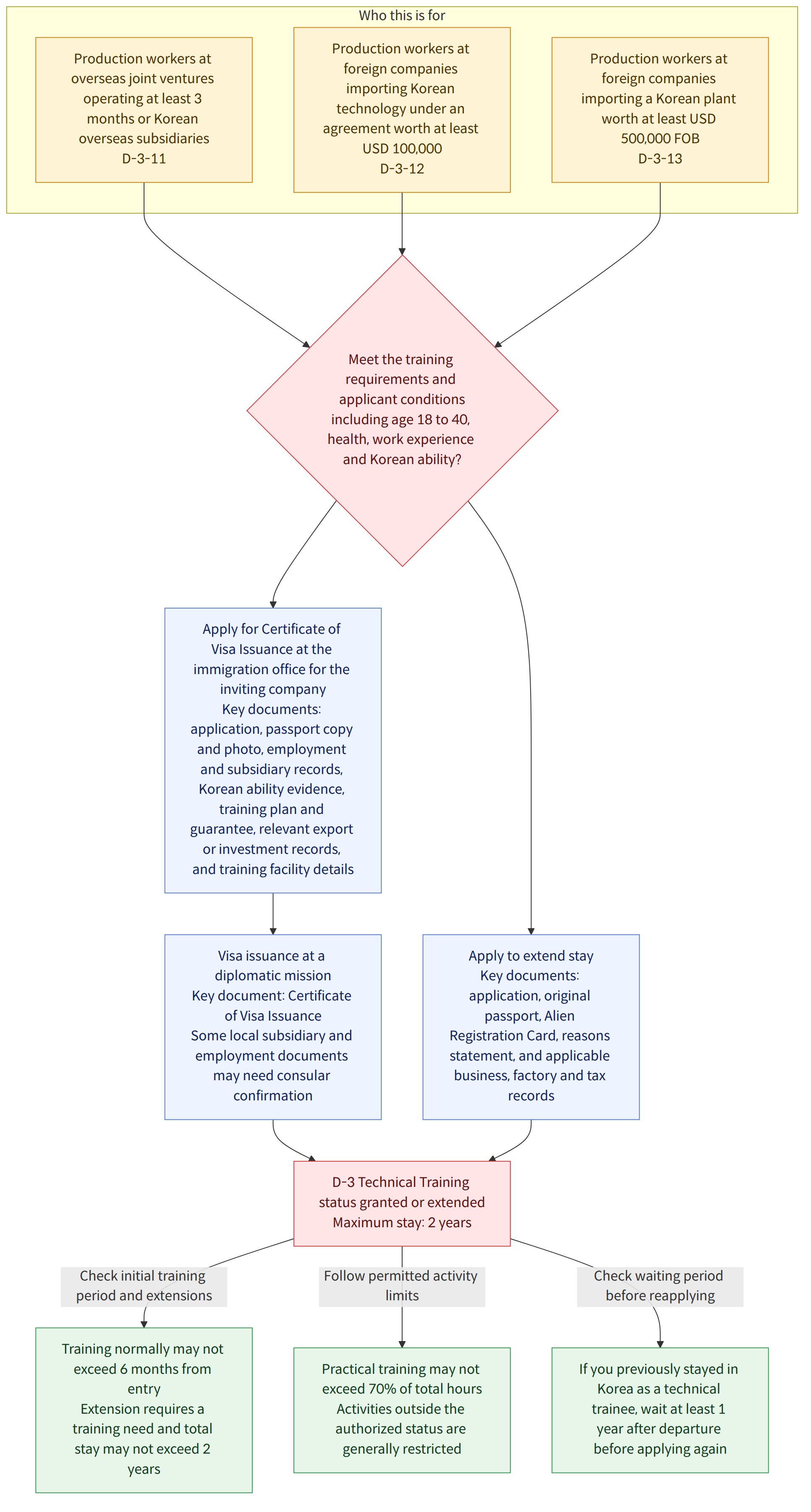
Who it is for
- Production workers employed by an overseas joint venture established under the laws of the relevant country and in operation for at least three months, or by a Korean company’s overseas subsidiary, who are recognized as needing training because it is difficult for them to acquire the relevant skills locally.
- Production workers employed by a foreign company that has imported technology under a technology import or technology cooperation agreement worth at least USD 100,000 with a Korean company, where training is needed to operate that technology.
- Production workers employed by a foreign company that has imported a plant from a Korean company worth at least USD 500,000 based on the free-on-board (FOB) price, where training is needed to operate that plant.
- Applicants must generally be in good health and between 18 and 40 years of age. They must have at least three months of work experience at the local subsidiary, except for personnel performing key functions as specified in the manual.
- Anyone who has previously stayed in Korea as a technical trainee must wait at least one year from the date of departure before applying again.
- In principle, applicants must have TOPIK Level 2 or higher, or have completed at least Beginner Level 2 at a King Sejong Institute (세종학당). Exceptions may apply to degree holders specified in the manual and trainees at companies that submit an undertaking to provide Korean-language education.
- The detailed classifications of this status of stay are overseas direct investment (D-3-11), technology export (D-3-12), and plant export (D-3-13).
What you can do
- You may receive technical training at an authorized industrial establishment in Korea.
- Practical training may not exceed 70% of the total training hours.
- Activities outside the authorized status of stay are generally restricted.
- A change of status of stay is generally not permitted, and changing or adding a place of employment does not apply. However, the manual allows a change of training location in certain cases and commissioned training for up to three months.
Period of stay
A Certificate of Visa Issuance (사증발급인정서) is issued for a period of stay of up to six months. In principle, the training period may not exceed six months from the date of entry. If additional training is deemed necessary, the period may be extended, provided the total period does not exceed two years from the date of entry. The maximum period of stay is two years.
Applications & documents
Application for a Certificate of Visa Issuance and issuance of a technical training visa
- Application for a Certificate of Visa Issuance (사증발급인정신청서), copy of passport, and one standard-format photograph (표준규격 사진)
- Copy of the local subsidiary’s certificate of registration or certificate of establishment approval
- Certificate of employment and copy of the invitee’s passport
- Evidence of Korean-language proficiency
- Training plan and the inviter’s Letter of Guarantee (신원보증서)
- As applicable, documents reporting the overseas direct investment, the technology export contract, or the plant export approval
- Evidence of the number of regular Korean employees and documents describing the training environment, including training and accommodation facilities
Apply for a Certificate of Visa Issuance at the Immigration Office (출입국·외국인관서) with jurisdiction over the inviting company’s address. A technical training visa is issued based on a Certificate of Visa Issuance issued by the head of an Immigration Office; it is not eligible for discretionary issuance by a head of a diplomatic mission. If Korea has a diplomatic mission in the country where the applicant is based, some local subsidiary and employment documents require consular confirmation.
Permission to extend the period of stay
- Application Form (신청서), original passport, and Alien Registration Card (외국인등록증)
- Statement of Reasons for Applying to Extend the Training Period (연수기간 연장신청 사유서)
- Business registration certificate and factory registration certificate or certificate of factory registration (공장등록증명서), if applicable
- Tax payment certificate for the Korean corporation and documents certifying tax payments by the local subsidiary
- The local subsidiary’s payroll register for the most recent month and the Korean company’s register of training allowances paid
- Original Letter of Guarantee
- Documents certifying enrollment in Industrial Accident Compensation Insurance (산업재해보상보험) and National Health Insurance (국민건강보험), and documents certifying enrollment in guarantee insurance
- Documents proving place of residence
Permission is determined after reviewing the need to extend the training period, the trainee’s past rate of absconding, and any criminal or other legal violations. The fee for permission to extend the period of stay is KRW 60,000.
Alien registration
- Application Form, passport, and one color photograph
- Business registration certificate
- Health examination certificate
- Documents certifying enrollment in Industrial Accident Compensation Insurance or guarantee insurance
- Documents proving place of residence
The fee for issuing an Alien Registration Card is KRW 35,000.
Report of a change in training location
- Original passport, Alien Registration Card, and Report of Change in Circumstances Concerning Employment or Training of a Foreign National (고용·연수외국인 변동사유발생신고서)
- Copies of the business registration certificate and factory registration certificate, and documents related to relocation or expansion
- List of trainees
A factory may be relocated or expanded only if the employer remains the same. Commissioned training is permitted when the trainee needs to learn a function or technology not available at the original training company, or when it is unavoidable to achieve the training purpose. It may not exceed three months.
Frequently asked questions
Q. What kind of training is the D-3 visa for?
It is a status of stay for receiving technical training at an industrial establishment in Korea. It covers training related to overseas direct investment, technology exports, or industrial plant exports.
Q. Is a Certificate of Visa Issuance required when applying for the visa?
Yes. A technical training visa is issued based on a Certificate of Visa Issuance issued by the head of an Immigration Office. It is not a visa that can be issued directly at the discretion of the head of a diplomatic mission.
Q. What is the initial period of stay?
A Certificate of Visa Issuance is issued for a period of stay of up to six months. In principle, the training period may not exceed six months from the date of entry.
Q. Can the D-3 period of stay be extended to two years?
If additional training is deemed necessary, the period may be extended, provided it does not exceed two years from the date of entry. Whether to grant an extension is determined after reviewing the need for training, the trainee’s past rate of absconding, and any criminal or other legal violations.
Q. Can I do other work while training?
The manual states that activities outside the authorized status of stay are generally restricted. The training location and content must accord with the authorized training purpose, and practical training may not exceed 70% of the total training hours.
Q. Can I change from D-3 to another status of stay?
In principle, a change of status of stay is not permitted. The excerpt does not provide separate application documents required for a change of status of stay.
Q. Can the training location be changed?
The training location may be changed in the event of a factory relocation or expansion, provided the employer remains the same. Commissioned training requires specified grounds and may not exceed three months.
Q. Are there cases where a trainee does not have to submit Korean-language test results?
An applicant who has earned at least a bachelor’s degree from a university in Korea may be exempt. An exception may also apply when training is provided by a company that has submitted an undertaking to provide Korean-language education, but the company must fulfill the undertaking.
Watch out for
- The training period is calculated from the date of entry and may not exceed two years from that date, even if an extension is granted.
- Meeting the requirements for a technical trainee does not guarantee issuance of a Certificate of Visa Issuance. The training purpose, training environment, number of applicants, and other factors are also reviewed.
- Practical training may not exceed 70% of the total training hours.
- A change of training location and commissioned training must comply with the specified grounds and conditions. The commissioned training period may not exceed three months.
Source
Compiled by AI from the Ministry of Justice "Visa Issuance Guide Manual" and "Residence Guide Manual" (HiKorea notice, in Korean). hikorea.go.kr
This is general guidance; the immigration office makes the final decision. Before applying, check the latest rules on HiKorea (hikorea.go.kr) or call the Immigration Contact Center at 1345.