
Study Abroad (D-2) Visa — Eligibility, Period of Stay, Applications, Extensions, and Part-Time Work
Based on Ministry of Justice manual (2026-09-18) · Translated from the Korean original.
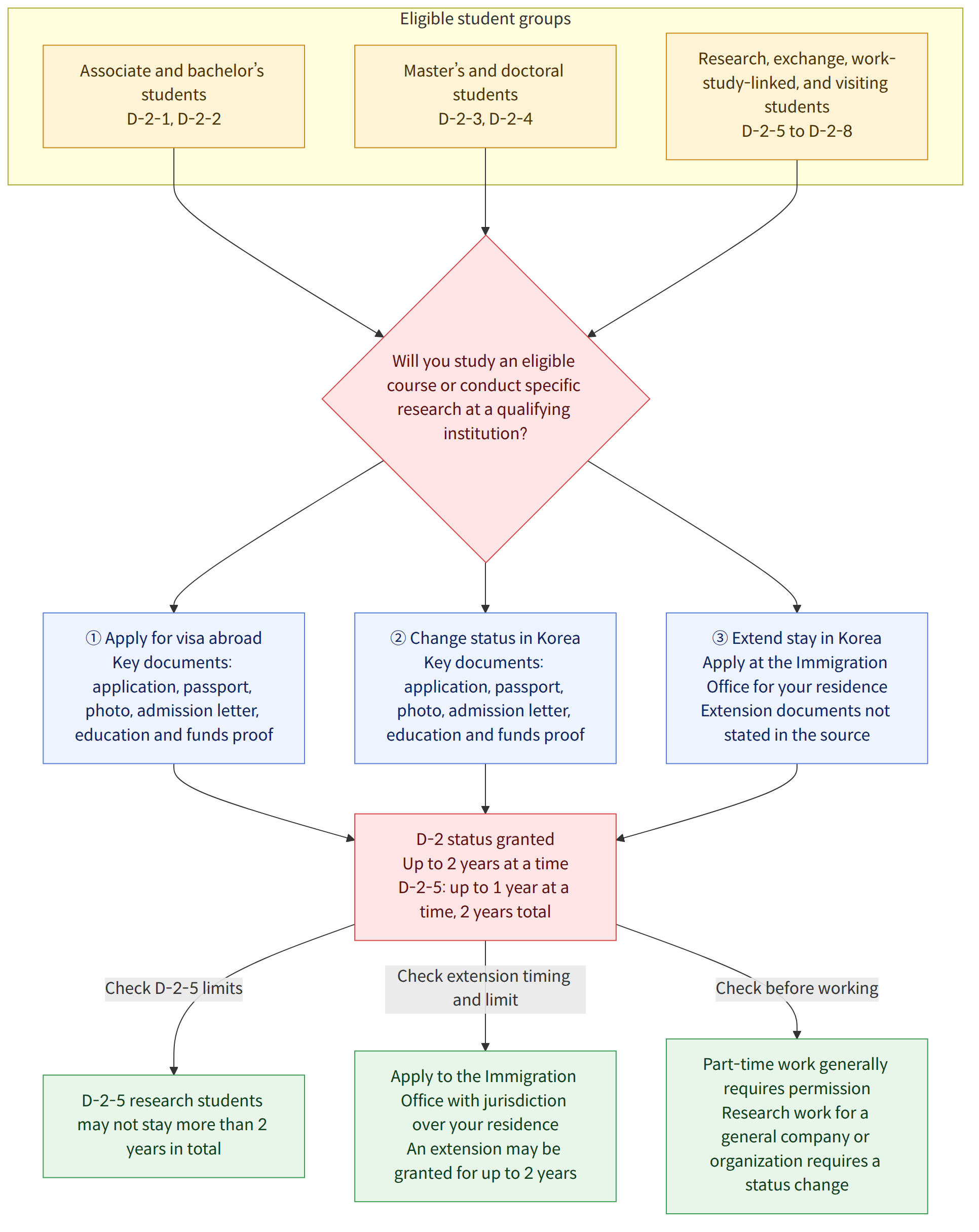
The Study Abroad (D-2) status of stay is for foreign nationals who wish to study a regular course or conduct specific research at an educational institution at the junior college level or higher, or at an academic research institution, that meets requirements set by the Ministry of Justice. It covers associate, bachelor’s, master’s, and doctoral degree programs, research programs, exchange programs, work-study-linked study programs, and visiting student programs.
At a glance
Who it is for
- Foreign nationals who wish to complete a regular course at an educational institution at the junior college level or higher, or at an academic research institution, that meets the requirements
- Students in an associate degree program (D-2-1) or bachelor’s degree program (D-2-2)
- Students in a master’s degree program (D-2-3) or doctoral degree program (D-2-4)
- Students in a research program (D-2-5) who wish to conduct specific research
- Exchange students (D-2-6), students in work-study-linked study programs (D-2-7), and visiting students (D-2-8)
- Distance-learning institutions such as open universities, correspondence universities, and cyber universities; lifelong education institutions; and vocational training courses at polytechnic colleges are excluded from the educational institutions eligible for study abroad. Night universities and graduate schools are also excluded, except for some permitted programs.
What you can do
- You may receive regular instruction in your approved study program or conduct specific research at the authorized educational institution.
- You may generally work part-time after obtaining permission. Permitted hours and conditions vary depending on your eligible status, Korean-language proficiency, academic performance, and other factors.
- Working as a researcher for a general company or organization is not permitted as an activity outside your status of stay. You may work only after changing your status of stay.
- Master’s or doctoral students and graduates who meet the requirements may apply for permission to engage in activities outside their status of stay if they enter into an employment contract as student researchers with a qualifying government-funded research institute.
- Research or internship activities at your university that are connected to your studies may be exempt from the part-time work permit requirement. Research activities at institutions outside the university require either a part-time work permit or permission to engage in activities outside your status of stay, depending on whether they are connected to your studies.
Period of stay
The maximum period of stay that may be granted at one time is 2 years. For the research program (D-2-5), the maximum at one time is 1 year, and research students may not stay for more than 2 years in total.
Applications & documents
Visa Issuance
- Visa Issuance (Confirmation) Application Form (사증발급(인정)신청서)
- Copy of passport
- One photograph taken within the last 6 months
- Copy of the educational institution’s business registration certificate or certificate of unique identification number
- Standard Admission Letter (표준입학허가서)
- Tuberculosis diagnosis certificate, if applicable
- Documents proving the highest level of education completed
- Documents proving funds equivalent to one year of tuition and living expenses
- If submitting a parent’s bank balance certificate or similar document, documents proving family relationship
As a rule, visa applications must be submitted to the Korean diplomatic mission with jurisdiction over your country of residence or the location of your last school. Eligibility for a visa issuance confirmation or electronic visa may vary depending on the university, nationality, and student category.
Change of Status of Stay
- Application Form (신청서)
- Passport and copy
- One standard-size photograph
- Copy of the educational institution’s business registration certificate or certificate of unique identification number
- Standard Admission Letter
- Documents proving educational qualifications and financial ability
- If changing from a Korean-language training program, documents proving grades, attendance, or completion of the previous program (if the information cannot be verified through the system)
- If submitting a parent’s bank balance certificate or similar document, documents proving family relationship
Long-term residents lawfully staying in Korea may apply for a change of status. Short-term visitors are generally restricted, and exceptions and restrictions may apply depending on nationality and current status. The application fee is KRW 100,000.
Extension of Period of Stay
- Application Form
- Passport
- Alien Registration Card
- Certificate of completion
- Confirmation from academic advisor and person in charge of international students
- Documents proving academic progress, such as a certificate of enrollment, transcript, or attendance certificate
- Documents proving financial ability
- Documents proving place of residence
Apply to the Immigration Office with jurisdiction over your place of residence. An extension may be granted for up to 2 years. The application fee is KRW 60,000.
Alien Registration
- Application Form
- Passport and copy
- One standard-size photograph
- Certificate of enrollment or research student status
- Documents proving place of residence
Documents proving financial ability are not required when registering. The fee for issuing the registration card is KRW 35,000.
Permission for Part-Time Work
- Application Form
- Passport and Alien Registration Card
- Certificate of grades or attendance (may be omitted if the information can be verified through the system)
- Documents proving Korean- or English-language proficiency
- Confirmation Form for Part-Time Work by an International Student (외국인 유학생 시간제취업 확인서)
- Copy of the business registration certificate and copy of the employer’s identification
- Copy of the standard employment contract (표준근로계약서), including the hourly wage, job duties, and working hours
- If manufacturing or construction is listed on the business registration certificate, Confirmation of Compliance with Part-Time Work Requirements (시간제취업 요건 준수 확인서)
You may apply online or in person, and the fee for this permission is waived. If your employer or workplace changes, you must obtain new permission.
Frequently asked questions
Q. Can I obtain a D-2 visa to attend a vocational training school?
You cannot apply for a D-2 visa for the purpose of taking a course at a vocational skills development training facility. Vocational training courses at polytechnic colleges are also excluded from study abroad eligibility.
Q. Can I work part-time on a D-2 visa?
You may apply for permission to work part-time if you have a certain level of Korean-language proficiency, are focused on your studies, and have confirmation from the university staff member responsible for international students. You should not work before receiving permission. Permitted hours and conditions vary depending on your program, year of study, Korean-language proficiency, and other factors.
Q. How long can I receive for my period of stay on a D-2 visa at one time?
The maximum period of stay that may be granted at one time is 2 years. The research program (D-2-5) is limited to 1 year at a time, and the total period of stay may not exceed 2 years.
Q. Can I change another status of stay to D-2 while in Korea?
Long-term residents lawfully staying in Korea may apply to change their status of stay. However, changes from certain statuses are restricted, and short-term visitors are generally restricted as well. Check the requirements based on your status and planned school admission schedule.
Q. What procedures are required if I want to change schools?
Changing schools in Korea is generally restricted. However, a change to a degree program at the same level may be permitted if you are progressing normally through your degree program and have a reason to change schools. You will need documents such as a certificate of enrollment, withdrawal, or grades, and a Standard Admission Letter from the new school. Restrictions relating to Korean-language proficiency, period of stay, and other criteria also apply.
Q. Can I extend my period of stay if I take a leave of absence?
An extension is restricted if you interrupt your studies for personal reasons or because you have not earned enough credits. An exception may be made if an unavoidable reason, such as illness or an accident, is recognized.
Q. Do I have to report a change of school?
If your school changes, you must report the change to your alien registration information within 15 days of the change. The permissibility of changing schools and the requirement to report changes to registration information must be checked separately.
Q. Are there cases where I do not need permission for part-time work?
Incidental remuneration associated with daily life, such as a one-time honorarium or prize, is excluded from the permission requirement if it does not undermine the fundamental purpose of the study status. Some field training, such as the Standard Field Training Semester Program (표준 현장실습학기제), may also be exempt from permission, but voluntary field training requires permission.
Watch out for
- Do not start part-time work until you have checked the permission conditions. Repeated violations may result in a ban on working during your study period or cancellation of your study status.
- Permission to stay may be restricted if classes are scheduled only at night or on weekends. Some degree programs held at night and authorized by the Ministry of Justice are exceptions.
- Changes to alien registration information, including a change of school, must be reported within 15 days of the change.
- When applying for an extension of your period of stay, you must provide evidence of your academic progress, financial ability, and place of residence. The period actually granted may vary depending on the academic calendar and the validity of your passport.
Source
Compiled by AI from the Ministry of Justice "Visa Issuance Guide Manual" and "Residence Guide Manual" (HiKorea notice, in Korean). hikorea.go.kr
This is general guidance; the immigration office makes the final decision. Before applying, check the latest rules on HiKorea (hikorea.go.kr) or call the Immigration Contact Center at 1345.