
Job-Seeking (D-10) Visa — Eligibility, Scope of Activities, Period of Stay, and Required Documents
Based on Ministry of Justice manual (2026-09-18) · Translated from the Korean original.
The Job-Seeking (D-10) status of stay is for foreign nationals who wish to seek employment in a professional field in Korea, prepare to start a technology-based business, or engage in an internship in an advanced technology field. It is divided into General Job-Seeking (D-10-1), Preparation for Technology-Based Startup (D-10-2), Advanced Technology Internship (D-10-3), and Top Talent (D-10-T).
At a glance
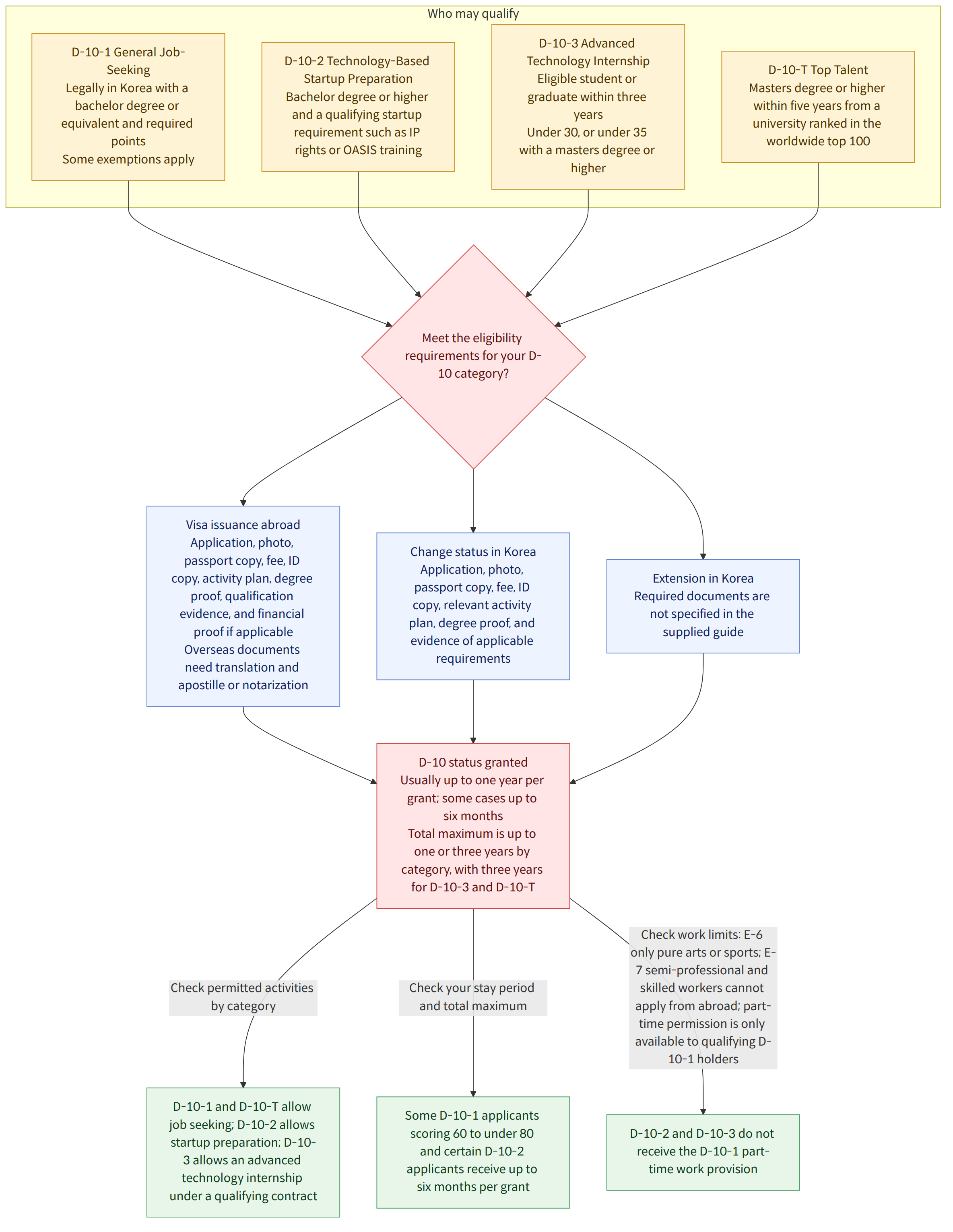
Who it is for
- General Job-Seeking (D-10-1): Foreign nationals legally staying in Korea who hold a bachelor’s degree or higher, or an equivalent qualification, and meet the points-based requirements. There are also special exemptions from the points system, including for certain graduates of Korean universities applying for their first job-seeking status after graduation.
- Preparation for Technology-Based Startup (D-10-2): Applicants who hold a bachelor’s degree or higher and meet at least one of the requirements specified in the manual, such as holding intellectual property rights in Korea or an OECD country, or completing OASIS training.
- Advanced Technology Internship (D-10-3): Current students enrolled in at least a bachelor’s degree program in an advanced technology field at a top-ranked university in the world, or people who graduated no more than three years ago. Applicants must be under 30, or under 35 if they hold a master’s degree or higher.
- Top Talent (D-10-T): Applicants who earned a master’s degree or higher within the past five years from a university ranked among the top 100 worldwide and intend to seek employment or undertake training in Korea.
- Professional employment fields range from Professor (E-1) to Specific Activities (E-7). Arts and Entertainment (E-6) is permitted only in the pure arts and sports fields. E-7 semi-professional workers and skilled workers cannot apply from abroad.
What you can do
- D-10-1 and D-10-T holders may engage in job-seeking activities at Korean companies or organizations.
- The permitted activities also include short-term internships for which training allowances are paid before formal employment.
- D-10-2 holders may engage in startup preparation activities, such as participating in startup education, preparing to apply for or applying for intellectual property rights, and preparing to establish a startup corporation. Internship activities are restricted.
- D-10-3 holders may engage in an internship in an advanced technology field after entering into an internship employment contract with a company or organization that meets the requirements.
- General Job-Seeking (D-10-1) holders may apply for permission for part-time employment if they meet certain requirements. This special provision does not apply to D-10-2 or D-10-3.
Period of stay
As a general rule, a period of stay of up to one year is granted at a time. Some applicants, including those with a D-10-1 points score of 60 or more but less than 80, and certain D-10-2 applicants, are granted up to six months at a time. The maximum total period of stay, including extensions, is up to three years or one year depending on the applicant’s category; the maximum is three years for D-10-3 and D-10-T.
Applications & documents
Visa Issuance
- Application Form (신청서), photograph, copy of passport, fee, and copy of identification
- Job-Seeking Activity Plan (구직활동 계획서) or activity plan for the relevant status
- Degree certificate or certificate of graduation
- Documents proving that the applicant meets the relevant requirements, such as points-based assessment, Korean-language proficiency, or work experience
- Documents proving financial capacity for living expenses (if applicable)
- For D-10-3, internship employment contract and documents proving that the inviting company or organization meets the requirements
Apply at a Korean diplomatic mission in the applicant’s home country or a country where they reside long-term. Documents issued overseas must be translated into Korean or English and submitted after completing the apostille or notarization process. D-10-3 may be issued only through a Certificate of Visa Issuance (사증발급인정서).
Change of Status of Stay
- Application Form (신청서), photograph, copy of passport, fee, and copy of identification
- Job-Seeking Activity Plan (구직활동 계획서), Technical Startup Plan (기술창업계획서), or Internship Activity Plan (인턴활동 계획서)
- Degree certificate or certificate of graduation
- Documents proving that the applicant meets the applicable points-based, points-system exemption, startup, or internship requirements
- Documents proving the place of residence (for applicable categories)
- Documents proving financial capacity for living expenses (for applicable categories)
If there is a change in the applicant’s status, apply immediately at the Immigration Office (출입국·외국인관서) with jurisdiction over the applicant’s place of residence. When nationals of certain designated countries change from specified statuses of stay, a D-10-1 points score of at least 80 is required.
Extension of Period of Stay
- Application Form (신청서), photograph, copy of passport, fee, and copy of identification
- Job-Seeking Activity Plan (구직활동 계획서) or activity plan for the relevant activities
- Documents proving the place of residence
- Documents proving financial capacity for living expenses (if applicable)
- Certificate of internship employment or documents required for the points-based assessment (if applicable)
The period for which an extension may be granted varies according to the category and points applicable to the status of stay. Documents proving financial capacity for living expenses may be waived for certain applicants covered by special provisions or replaced with a statement of salary payments.
Alien Registration
- Application Form (신청서)
- Passport and copy of passport
- Photograph meeting the standard specifications
- Documents proving the place of residence
- Fee
- For D-10-3, a copy of the business registration certificate or certificate of unique identification number for the company where the internship is planned, and a certificate of employment
The manual specifies the documents required for alien registration. It states that the fee for extension or adjustment of the period of stay is waived when a period of stay of one year is granted at the time of registration.
D-10-1 Permission for Part-Time Employment
- Application Form (신청서), photograph, copy of passport, fee, and copy of identification
- Degree certificate
- Employment contract
- Business registration certificate
- Documents proving Korean-language proficiency
- Job-Seeking Part-Time Employment Confirmation Form (구직 시간제 취업 확인서)
Apply for permission to engage in activities outside the scope of the status of stay. The fee is KRW 120,000. If the foreign national works before receiving permission, both the foreign national and the employer may be subject to penalties.
Frequently asked questions
Q. What kind of work can I do on a D-10 status of stay?
You may engage in job-seeking activities and short-term internship activities before formal employment. D-10-2 mainly covers startup preparation activities, while D-10-3 mainly covers advanced technology internships at companies or organizations that meet the requirements.
Q. What points score do I need for D-10-1?
You must earn at least 20 points in the basic category and at least 60 points out of a total of 190. The manual also provides for special exemptions from the points system.
Q. Can I apply for D-10-1 without the points system if I graduate from a Korean university?
The points system does not apply when you graduate from an associate degree program or higher at a Korean university as an international student (D-2), obtain the degree, and change to D-10-1 for the first time. The initial period of stay under this special provision is one year; the points system applies to extensions.
Q. How long can I be granted a D-10 period of stay at a time?
As a general rule, up to one year at a time. Some applicants, including those with a points score of 60 or more but less than 80, may be granted up to six months at a time. The maximum total period, including extensions, also varies by status and applicant category.
Q. Can I work part-time on D-10-1?
You may obtain permission for part-time employment if you meet all the requirements. You must have earned an associate degree or higher from an educational institution for international students in Korea, and no more than three years may have passed since you earned the degree. You must also check the Korean-language requirements and restrictions on your history of holding E-1 through E-7 statuses of stay.
Q. How many hours can I work part-time?
If permission is granted, you may work up to 25 hours per week on weekdays, with no time limit on weekends and public holidays. Those who have completed Level 5 or higher of the Korea Immigration and Integration Program may work up to 30 hours per week on weekdays. Manufacturing work is permitted only for those who have completed Level 4 or higher of the program; a TOPIK score alone is not sufficient to obtain permission for manufacturing work.
Q. What kinds of companies can host D-10-3 interns?
Internships may be undertaken at domestic listed companies with research facilities specified in the manual; companies with corporate research institutes or dedicated R&D departments; advanced technology companies; venture companies; and national or public research institutes. As a general rule, the number of interns may not exceed 20% of the company’s Korean employees.
Q. Can I apply for a D-10 visa from abroad?
You may apply at a Korean diplomatic mission in your home country or a country where you reside long-term. As a general rule, a third country where you are staying temporarily, such as for tourism, is not an eligible place to apply. D-10-3 may be issued only through a Certificate of Visa Issuance (사증발급인정서).
Q. Do I have to report when I start an internship on D-10-1 or change internship organizations?
A D-10-1 holder who has completed alien registration must report within 15 days of the relevant event if they start an internship in the relevant field or change their affiliated organization. Those who changed to D-10-1 as technology startup preparers or as people with professional employment experience may not engage in these internship activities.
Watch out for
- Eligibility for special exemptions from the D-10-1 points system varies by category, including the date the degree was earned, the time elapsed since graduation, and whether it is the applicant’s first job search. People who have previously held D-10 may be excluded from some special exemptions.
- Check the requirements and reporting procedures for internships while job-seeking. D-10-1 holders must report the start of training or a change of organization within 15 days of the relevant event.
- In addition to general grounds for disqualification, D-10-T is subject to separate restrictions related to entry, criminal offenses, and violations of immigration laws.
- Part-time employment is permitted only at the workplace specified in the permission. If the foreign national works before permission is granted, both the foreign national and the employer may be subject to penalties.
Source
Compiled by AI from the Ministry of Justice "Visa Issuance Guide Manual" and "Residence Guide Manual" (HiKorea notice, in Korean). hikorea.go.kr
This is general guidance; the immigration office makes the final decision. Before applying, check the latest rules on HiKorea (hikorea.go.kr) or call the Immigration Contact Center at 1345.