
Culture and Arts (D-1) Visa — Eligibility, Period of Stay, and Application and Extension Documents
Based on Ministry of Justice manual (2026-09-18) · Translated from the Korean original.
The Culture and Arts (D-1) status of stay is for people who intend to engage in academic or artistic activities that are not intended to generate income. This may include writing a thesis, engaging in creative activities, conducting specialized research on Korea’s traditional culture or arts, or receiving instruction from an expert.
At a glance
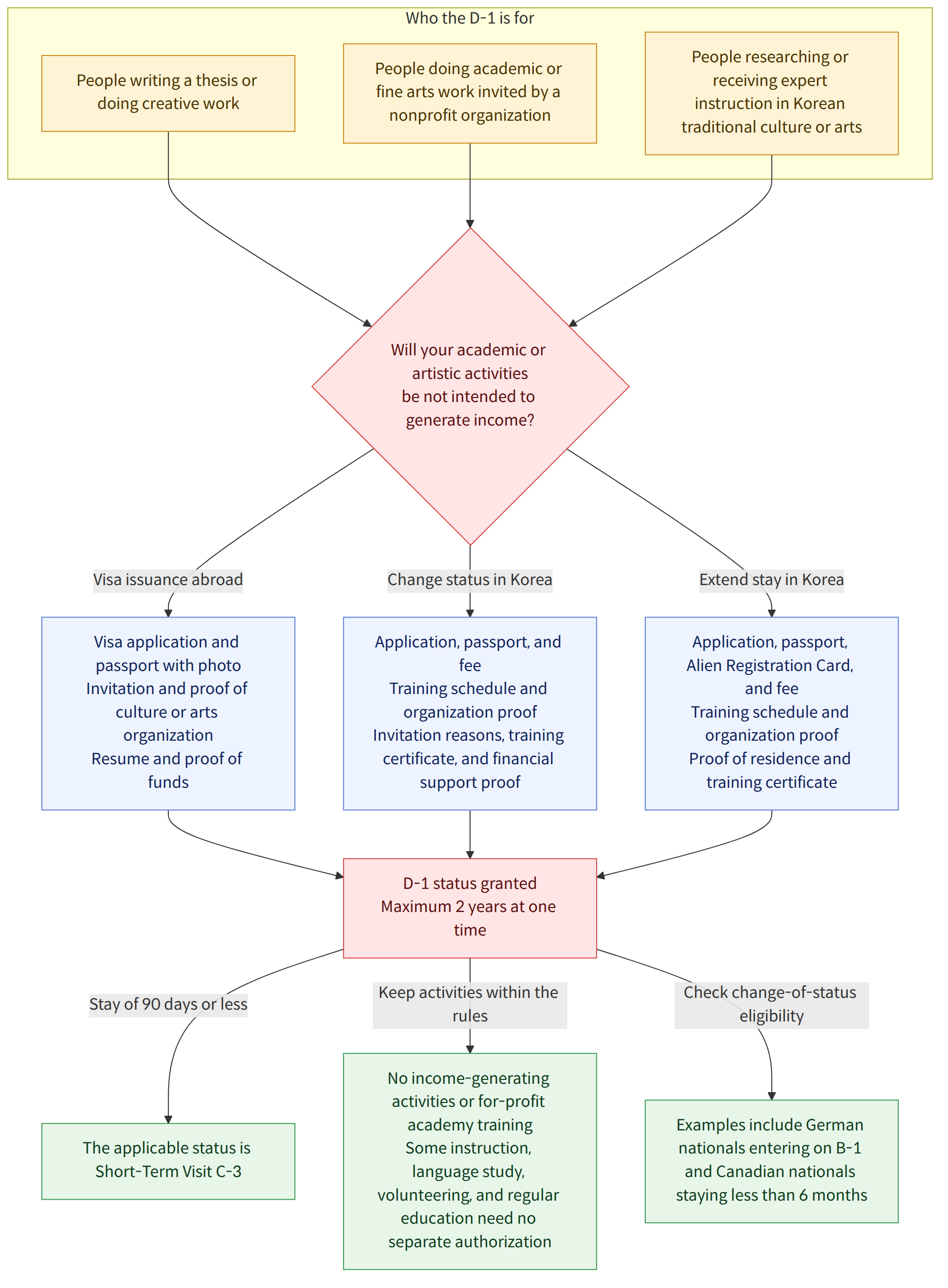
Who it is for
- People who intend to write a thesis or engage in creative activities
- People who intend to engage in academic or fine arts activities at the invitation of a nonprofit academic or arts organization
- People who intend to conduct specialized research on Korea’s traditional culture or arts
- People who intend to receive instruction from an expert on Korea’s traditional culture or arts
- Experts include holders of intangible cultural heritage designations and nationally recognized holders of craft skills. This may also include people receiving instruction from a fine arts research organization or a prominent figure in the relevant field.
What you can do
- You may engage in academic or artistic activities that are not intended to generate income.
- An invitation from a for-profit organization, such as a general taekwondo or dance academy, does not qualify as a D-1 activity. Training at a private academy for profit is also not covered.
- Within the period of stay, you may receive instruction from an expert in Korea’s traditional culture or arts, or study Korean at a university-affiliated language institute, without separate authorization.
- Within the period of stay, you may volunteer at public institutions, orphanages, nursing homes, and similar places, provided the activities are not intended to generate income. You may receive meal and transportation expenses.
- You may receive regular education at an elementary, middle, or high school, or at a university, as long as it does not interfere with your original purpose of stay. No separate authorization procedure is required.
Period of stay
The maximum period of stay that may be granted at one time is 2 years. If the period of stay is 90 days or less, the applicable status is Short-Term Visit (C-3).
Applications & documents
Visa Issuance
- Visa Application (사증발급신청서) or Application for Confirmation of Visa Issuance (사증발급인정신청서)
- Passport and 1 standard-size photograph
- Invitation letter
- Documents proving that the inviting organization is a culture and arts organization
- For instruction by an expert, a certificate of the instructor’s career history
- Resume or certificate of career history
- Documents proving the ability to pay all expenses during the stay
- Fee, when applying for visa issuance at the discretion of the head of the diplomatic mission
If you will engage in cultural or artistic activities at the invitation of the Korea Foundation or the Arts Council Korea and your period of stay is 1 year or less, the head of the diplomatic mission may issue a single-entry visa. In other cases, the visa is issued based on a Certificate of Confirmation of Visa Issuance. Documents may be added or waived depending on the review.
Permission to Change Status of Stay
- Application, original passport, and fee
- Training schedule prepared by the training institution
- Documents proving that the organization is a culture and arts organization
- Statement of reasons for the invitation
- Certificate of training
- Documents proving financial support for tuition, living expenses, and other costs
The excerpt describes examples of cases in which a change may be permitted, including German nationals who entered under the Visa Exemption (B-1) status and Canadian nationals intending to stay for less than 6 months. The fee is KRW 100,000. If you cannot submit documents proving financial support, you may be asked to provide a letter of guarantee.
Permission to Extend Period of Stay
- Application, original passport, Alien Registration Card, and fee
- Training schedule prepared by the training institution
- Documents proving that the organization is a culture and arts organization
- Documents proving place of residence
- Certificate of training
The fee for permission to extend the period of stay is KRW 60,000. Examples of documents proving place of residence include a lease agreement, confirmation of accommodation provision, utility bill payment receipts, and dormitory fee receipts.
Alien Registration
- Application, original passport, 1 standard-size photograph, and fee
- Documents proving that the organization is a culture and arts organization
- Documents proving place of residence
The fee for issuing an Alien Registration Card is KRW 35,000.
Frequently asked questions
Q. Can I engage in for-profit activities on a D-1 visa?
The scope of D-1 activities is limited to academic or artistic activities that are not intended to generate income. An invitation from a for-profit organization, such as a general taekwondo or dance academy, does not qualify.
Q. Can I apply for D-1 if my period of stay is 90 days or less?
The manual states that if your period of stay is 90 days or less, the applicable status is Short-Term Visit (C-3).
Q. What is the maximum period of stay for D-1?
The maximum period of stay that may be granted at one time is 2 years. The actual period authorized may vary depending on the review outcome and the applicable standards.
Q. Can I study Korean on a D-1 visa?
You may study Korean at a university-affiliated language institute within your period of stay, without a separate authorization procedure.
Q. Can I volunteer on a D-1 visa?
You may volunteer without a separate authorization procedure, provided the activities are not intended to generate income and take place within your period of stay. You may receive meal and transportation expenses.
Q. Can I receive regular school education on a D-1 visa?
You may receive education at an elementary, middle, or high school, or at a university, as long as it does not interfere with your original purpose of stay. No separate authorization procedure is required.
Q. Do I have to report a change in the culture and arts organization I belong to?
A change or addition to your affiliated institution or organization is subject to a Report of Change to Alien Registration Details (외국인등록사항 변경신고), not a report of change or addition to your place of employment. You must report it within 15 days of the change.
Q. Do I need to submit documents about my place of residence when applying to extend my D-1 period of stay?
Yes. Documents proving your place of residence are included in the extension application documents. Examples listed include a lease agreement, confirmation of accommodation provision, and utility bill payment receipts.
Watch out for
- Training at a private academy for profit or an invitation from a for-profit organization does not fall within the scope of D-1 activities.
- Activities involving a period of stay of 90 days or less fall under Short-Term Visit (C-3), not D-1.
- A change or addition to your affiliated institution or organization must be reported through a Report of Change to Alien Registration Details (외국인등록사항 변경신고) within 15 days of the change.
Source
Compiled by AI from the Ministry of Justice "Visa Issuance Guide Manual" and "Residence Guide Manual" (HiKorea notice, in Korean). hikorea.go.kr
This is general guidance; the immigration office makes the final decision. Before applying, check the latest rules on HiKorea (hikorea.go.kr) or call the Immigration Contact Center at 1345.