
Short-Term Visit (C-3) Visa — Eligibility, Period of Stay, Employment Restrictions, and Extension of Stay
Based on Ministry of Justice manual (2026-09-18) · Translated from the Korean original.
The Short-Term Visit (C-3) status is for people who wish to stay in Korea for a short period for purposes such as tourism, visiting relatives or acquaintances, participating in events, general training, or business activities. It cannot be used for employment for profit, and the general maximum period of stay for a single stay is 90 days.
At a glance
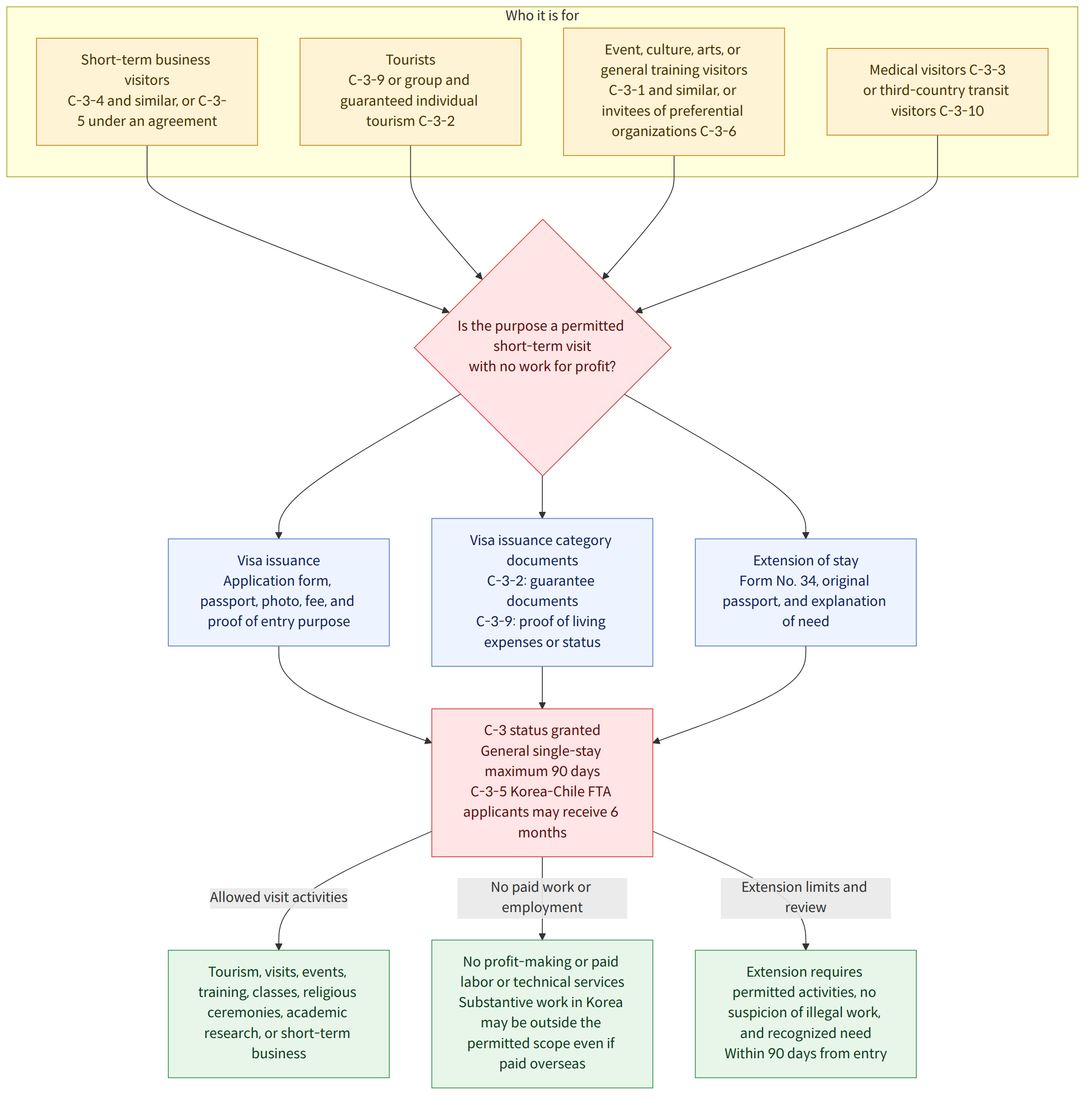
Who it is for
- People who wish to engage in business activities such as market research, business contacts, consultations, or contract negotiations (C-3-4, etc.)
- General tourists (C-3-9) or people eligible for group or guaranteed individual tourism (C-3-2)
- People who wish to participate in events or conferences, friendly matches, cultural or artistic activities, or general training (C-3-1, etc.)
- Short-term visitors who wish to receive medical treatment or recuperate at a medical institution in Korea (C-3-3)
- People who wish to enter Korea for short-term business purposes under an agreement (C-3-5)
- People invited by a preferential enterprise or organization (C-3-6)
- People who wish to travel to a third country via the Republic of Korea (C-3-10)
What you can do
- You may engage in tourism, visit relatives or acquaintances, recuperate, participate in or attend events or conferences, take part in cultural or artistic activities or general training, attend classes, participate in religious ceremonies, and collect academic materials.
- You may engage in short-term business activities such as market research, business contacts, consultations, contract negotiations, and small-scale trade.
- You may not engage in activities for profit or employment activities in which you provide labor or technical services and receive compensation in return.
- Even if you are paid overseas, being dispatched to an organization in Korea to provide substantive services or perform actual work may exceed the scope of activities permitted under a Short-Term Visit status.
- C-3-10 may be used only for transit purposes and may not be used for the purpose of undergoing immigration inspection.
Period of stay
The general maximum period of stay for a single stay is 90 days. However, among short-term business visas issued under an agreement (C-3-5), applicants covered by the Korea-Chile Free Trade Agreement may be issued a visa with a six-month period of stay. The details of issuance vary depending on the specific eligibility category and visa type.
Applications & documents
Visa issuance
- Visa Application Form (사증발급신청서)
- Passport
- Photograph
- Fee
- Relevant documents proving the purpose of entry, such as an invitation letter
- Documents related to a guarantee, when applying for C-3-2
- Documents proving the ability to pay living expenses in Korea or proving status, when applying for C-3-9
Required documents may vary depending on the specific eligibility category and the circumstances of the diplomatic mission, which may request additional documents.
Extension of stay
- Application Form (Form No. 34, 별지 제34호 서식)
- Original passport
- Documents explaining the need for an extension
An extension is reviewed when the activities fall within the scope permitted under a Short-Term Visit status, there is no suspicion of illegal employment, and the need for an extension is recognized. The period may be extended within the 90-day limit calculated from the date of entry.
Frequently asked questions
Q. Can I work in Korea on a C-3 visa?
You may not engage in employment activities for profit. Activities in which you provide labor or technical services and receive compensation in return are not eligible for C-3 issuance.
Q. Can I obtain a C-3 visa if I am visiting for business purposes?
Market research, business contacts, consultations, contract negotiations, and small-scale trade may fall within the scope of short-term business activities. However, being dispatched to an organization in Korea to perform substantive work or engaging in activities for which you receive employment-related compensation may exceed the scope of activities permitted under C-3.
Q. What is the maximum number of days I can stay in Korea at one time on a C-3 visa?
The general maximum period of stay for a single stay is 90 days. However, among short-term business visas issued under an agreement (C-3-5), applicants covered by the Korea-Chile Free Trade Agreement may be issued a visa with a six-month period of stay.
Q. Can I extend my period of stay on a C-3 visa?
You may apply for an extension if the need for an extension is recognized and there is no suspicion of illegal employment. The extension period must fall within the 90-day limit calculated from the date of entry.
Q. Can I apply for an extension of stay or a change of status for group tourism (C-3-2)?
This may be permitted only when there is no aircraft or vessel available for departure, or when there are unavoidable circumstances such as humanitarian reasons or an unforeseen accident or illness. Extensions or changes of status are generally restricted.
Q. Which specific eligibility category applies if I am applying for tourism purposes?
Group tourism or guaranteed individual tourism may fall under C-3-2. General tourists not covered by C-3-2 are eligible for C-3-9.
Q. Can I enter Korea on a C-3-10 visa?
C-3-10 is a visa solely for transit through the Republic of Korea en route to a third country. It may not be used for the purpose of undergoing immigration inspection. The excerpt states that it has a three-month validity period and a period of stay of zero days.
Q. Are the required documents the same for everyone applying for a visa?
Common documents include an application form, passport, photograph, and fee. Depending on the purpose of entry, specific eligibility category, and the diplomatic mission’s requirements, additional documents such as an invitation letter, guarantee documents, or proof of financial ability may be required.
Watch out for
- C-3 may not be used for employment activities for profit. Even if you are paid overseas, performing substantive work in Korea may exceed the permitted scope of activities.
- The general maximum period of stay for a single stay is 90 days, but the details of issuance may vary depending on the specific eligibility category or applicable agreement.
- Extensions of stay and changes of status are restricted for C-3-2 group tourism and guaranteed individual visas.
- C-3-10 may be used only for transit purposes and may not be used for the purpose of undergoing immigration inspection.
Source
Compiled by AI from the Ministry of Justice "Visa Issuance Guide Manual" and "Residence Guide Manual" (HiKorea notice, in Korean). hikorea.go.kr
This is general guidance; the immigration office makes the final decision. Before applying, check the latest rules on HiKorea (hikorea.go.kr) or call the Immigration Contact Center at 1345.