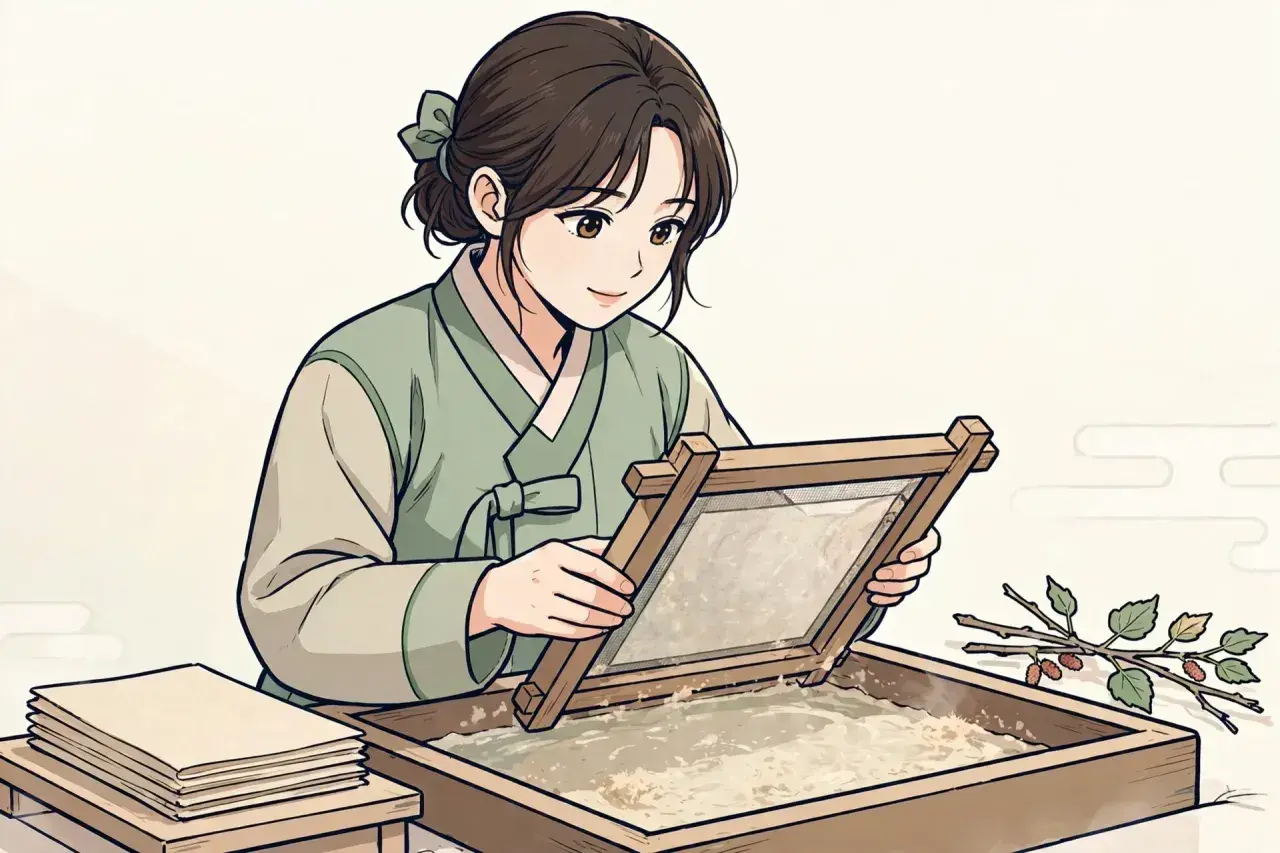
The history and manufacturing tradition of hanji, introduced in Mungyeong, North Gyeongsang Province, are on the verge of being recognized as international cultural heritage. According to the article, hanji has a history of more than 1,000 years, and the knowledge and practices of making it, passed down over hundreds of years, are expected to be added to UNESCO’s List of the Intangible Cultural Heritage of Humanity (유네스코 인류무형문화유산 목록). However, the meeting that will decide whether it is inscribed has not yet taken place.
Background and context
The article says hanji was first produced during the Three Kingdoms period (57 BCE–668 CE). It played an important role in the cultural and intellectual development of the Korean Peninsula and was also an essential material for the spread of Buddhism, the growth of publishing and the development of printing technology.
During the Silla and Goryeo periods, Korean paper was recognized throughout Asia for its exceptional whiteness, smooth texture and durability. It was also a popular export to China and Japan.
During the Joseon period (1392–1910), hanji production expanded as demand for books and scholarly publications grew. Because the uses and production of paper grew in tandem with demand for publishing, the history of hanji is connected not only to manufacturing techniques but also to the growth of recording and transmitting knowledge.
What this news means
If UNESCO inscription goes ahead, the knowledge and practices of making hanji could receive international attention and help raise awareness of Korea’s cultural heritage. In particular, the article emphasizes not just a sheet of paper’s form or appearance, but the knowledge and practices of making it that have been passed down over hundreds of years. As a result, attention could focus not only on the finished product but also on the tradition behind its production.
International recognition of cultural heritage and the continuation of a tradition are not the same thing. The fact that inscription is expected does not, by itself, mean that the manufacturing tradition has already been preserved or passed on. However, it could prompt renewed consideration of hanji’s history and uses, and broaden discussion about preserving the tradition and raising awareness of it internationally.
For example, if a reader who has read an article about hanji introduces its historical role to others, that could help them understand hanji not simply as paper, but as cultural heritage connected to the development of Buddhism, publishing and printing. This is a hypothetical example; it does not mean that UNESCO inscription has been confirmed or that inscription itself guarantees preservation.
Inscription has not yet been confirmed. According to the article, the final decision is expected at a UNESCO committee meeting scheduled to take place in Xiamen, China, from November 30 to December 5.
What is confirmed and what remains unknown
Confirmed facts
- The article says hanji has a history of more than 1,000 years.
- According to the article, hanji was first produced during the Three Kingdoms period.
- Hanji played an important role in the spread of Buddhism, the growth of publishing and the development of printing technology.
- During the Silla and Goryeo periods, its quality was recognized, and it was exported to China and Japan. Production expanded during the Joseon period as demand for publications increased.
- Inscription of the knowledge and practices of making hanji on UNESCO’s list is expected, and according to the article, the final decision is expected at a committee meeting scheduled to take place in Xiamen, China.
What remains unknown
- This article does not confirm whether the UNESCO committee has given final approval to inscribe the knowledge and practices of making hanji.
- The article does not discuss what specific changes inscription, if it happens, would bring to the preservation and continuation of the tradition.
What readers should check
- When assessing whether inscription has taken place, readers should distinguish between what the article describes as “expected” and the committee’s final decision.
- When considering hanji’s historical significance, readers can look not only at its manufacturing tradition but also at how it is connected to the spread of Buddhism, the development of publishing and printing, and the expansion of production in different periods.