



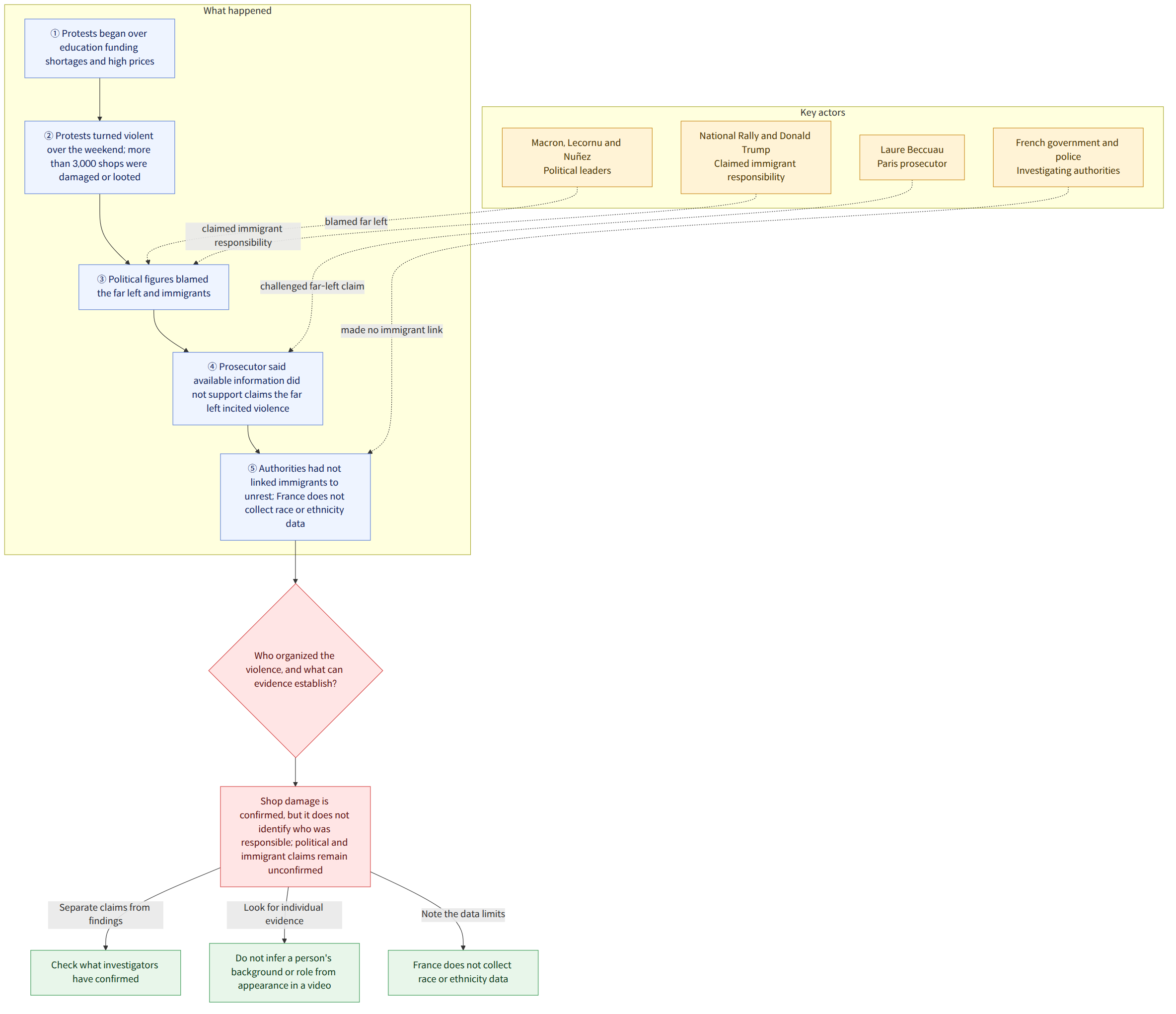
After protests in France that began over everyday concerns—shortages in education funding and high prices—turned violent over the weekend, political figures pointed to the far left or immigrants as responsible. But the Paris prosecutor said the information available to her did not support claims that the far left had incited the violence, and the French government and police have not linked immigrants to the unrest. Political claims have followed one another, but no empirical evidence to support them has been confirmed.
Background and context
The protests began over shortages in education funding and the cost of living. A separate report conveyed the views of French people living in South Korea, not those of South Koreans living in France. They said the public’s anger had grown because the government had not adequately responded to calls for better education and living conditions.
The protests turned violent over the weekend. According to reports, more than 3,000 shops were damaged or looted in major French cities. The scale of the damage is confirmed, but it does not, by itself, reveal the political leanings or backgrounds of those involved in the violence.
President Emmanuel Macron, Prime Minister Sébastien Lecornu and Interior Minister Laurent Nuñez, among others, claimed that the far left was leading the arson and looting. In response, Paris prosecutor Laure Beccuau said in a broadcast interview on October 19 that the claim did not match the information available to her. She also said authorities were working to identify the arrested protesters, who were not claiming political affiliations and were remaining silent.
Sébastien Roché, a professor at Grenoble Institute of Political Studies, said the scale of the violence was difficult to explain by the size of the radical left alone, and that looting was not characteristic of how radical groups operate. The report also described allegations that the “Black Bloc”—ultra-left and anarchist groups with no ties to established political parties—played a role in the violence. However, allegations must be distinguished from established responsibility.
What this news means
The causes of the protests and responsibility for acts of violence are two different questions. Even if dissatisfaction with education or the cost of living formed the backdrop to the protests, that does not mean every protester took part in violence. Nor can the fact that violence occurred establish that a particular political movement or group organized it. Since who did what must be determined through individual evidence and investigation, political claims should be read separately from investigators’ findings.
Claims of immigrant responsibility should be examined by the same standard. France’s far-right National Rally (RN) claimed that a very large number of the looters were of immigrant origin. U.S. President Donald Trump claimed that the protests were not about schools but about people coming into France who hate the country, and repeatedly called for the borders to be closed. But the French government and police have not linked the unrest to immigrants, and no empirical evidence has been confirmed that would justify concluding immigrants were the main force behind it.
Under France’s national principle of “race-blindness,” the country does not collect data based on race or ethnicity, either on these protests or on other incidents. This may mean there is not enough data to test claims that people from a particular background were the main force behind the protests. Conversely, the absence of such data does not allow anyone to make assumptions about an individual’s background or actions.
For example, if someone looks at the appearance of protesters in a video and says an immigrant group led the violence, the video alone would not establish the protesters’ backgrounds or their role in any organized action. Distinguishing what is visible from what has been established about responsibility is key to understanding this issue.
Claims concerning synagogues and churches should also be handled carefully. The Service for the Protection of the Jewish Community, a group that monitors antisemitic incidents, reported that a synagogue in Paris had been damaged in what appeared to be an attempted break-in, but said there was no evidence it had been targeted because of its religious background. The account was that a synagogue may have been damaged amid widespread damage to shops during the protests. Claims that Muslim antisemites attacked the synagogue or that a church was burned were reported to be false.
What is confirmed and what remains unknown
What is confirmed
- The protests began over everyday concerns: shortages in education funding and high prices.
- French political figures blamed the far left or immigrants for the violence, but investigators and the available evidence do not support those claims.
- The Paris prosecutor said authorities were working to identify the arrested protesters and that they were not claiming political affiliations and were remaining silent.
- France does not collect data based on race or ethnicity, and no evidence has been confirmed that the damage to the Paris synagogue was religiously motivated.
What remains unknown
- How were the identities and political affiliations of the arrested protesters subsequently established?
- How many people in total were arrested for violent acts during these protests?
- What role, if any, did the Black Bloc or another specific group actually play in the violence?
What readers should check
- When reading follow-up reports, distinguish politicians’ claims from information confirmed by investigators, and check whether authorities have released new information about the identities of those arrested or the circumstances of the incidents.
- For claims that immigrants or a particular religious group were responsible, check whether evidence about people’s backgrounds and evidence of individual actions have been presented. France’s policy of not collecting racial or ethnic data should also be taken into account.
- When damage to a synagogue or church is mentioned, it is important to check separately whether damage occurred and whether the site was targeted for religious reasons.
References
- Other coverage consulted: koreatimes.co.kr
- Other coverage consulted: koreatimes.co.kr

















