


Cases of “pushbacks”—in which migrants who have crossed a border are sent back across it without an individual assessment or an opportunity to apply for asylum—continue to be reported in Europe. The public database of the Border Violence Monitoring Network (BVMN; 국경폭력감시네트워크) lists 1,882 testimonies of pushbacks. Material submitted to the United Nations includes 1,863 testimonies collected in 16 European countries through December 2024, documenting experiences of harm affecting at least 33,755 people. Since the European Border and Coast Guard Agency (유럽연합 국경해안경비청), known as Frontex, is involved in border surveillance and joint operations, the responsibility of institutions that provide surveillance information and equipment is also at issue, alongside that of those who directly use violence.
Background and context
A pushback is different from simply preventing someone from crossing a border. It refers to sending someone who has crossed a border back to the other side without individually examining their identity and protection needs or giving them a chance to express an intention to seek asylum.
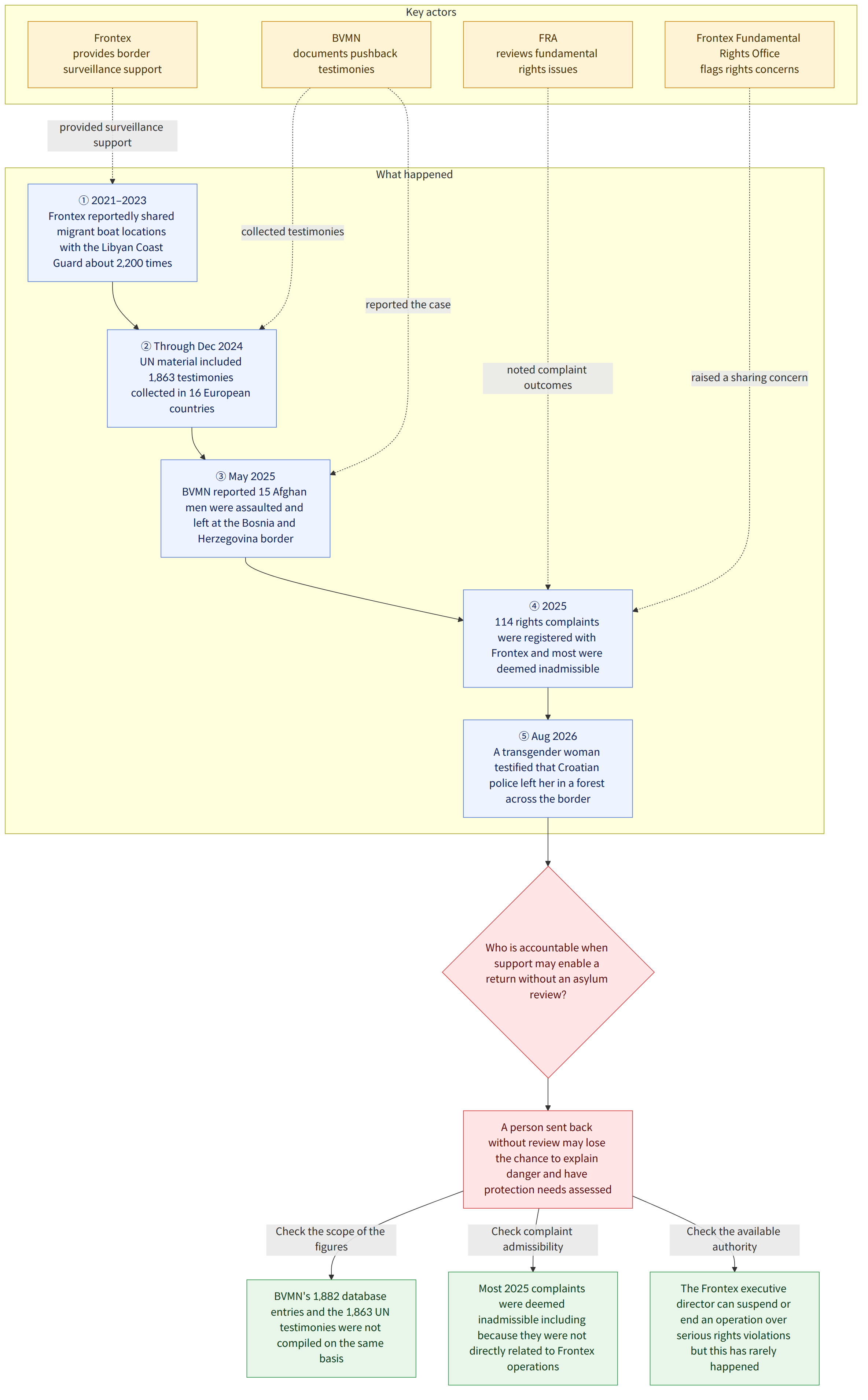
In a case reported by BVMN, a transgender woman in her 20s testified that after crossing from Bosnia and Herzegovina into Croatia on August 26, 2026, police took her belongings and left her in a forest on the Bosnia and Herzegovina side. According to BVMN, on May 4, 2025, 15 men from Afghanistan were apprehended by Croatian police, assaulted and detained, and then left at the border with Bosnia and Herzegovina. Both cases raise questions about whether the migrants had an opportunity to apply for asylum or receive an individual assessment.
The figures for testimonial data should be read with attention to their scope and timeframe. The 1,882 entries in BVMN’s public database and the 1,863 testimonies in the material submitted to the United Nations cannot be assumed to be counts compiled on the same basis. These figures therefore show the scale of recorded cases, but do not establish the total scale of harm.
What this news means
The issue is whether responsibility can be limited to those who directly commit acts of violence. Frontex is reported to provide personnel, aircraft, drones and surveillance equipment at the request of member states, and to coordinate joint operations. Even if it does not directly apprehend or send migrants back, the question remains how to assess its responsibility for support if surveillance and information-sharing enabled another agency to carry out a forced return. Josephine Solanki, project coordinator at the Transnational Institute (TNI; 초국적연구소), criticized Frontex’s surveillance and information-sharing, saying they enable other countries to carry out forced returns.
The issue is also evident in the sharing of maritime surveillance information. The investigative outlet Lighthouse Reports (라이트하우스 리포트) reported that Frontex passed information on the locations of migrant boats to the Libyan Coast Guard approximately 2,200 times between 2021 and 2023. In its 2025 annual report, the Frontex Fundamental Rights Office (FRO; 프론텍스 기본권사무소) identified sharing sightings of migrant boats with third countries accused of human rights violations as a serious concern. However, these materials alone do not establish what results followed from each instance of information-sharing or what action was taken afterward.
Even when a complaints system exists, it may be difficult to trace responsibility. In 2025, 114 fundamental rights complaints were formally registered with Frontex, and the European Union Agency for Fundamental Rights (FRA; 유럽연합 기본권기구) noted that most were deemed inadmissible, including on the grounds that they were not directly related to Frontex operations. According to the article, the Frontex executive director can suspend or terminate an operation if serious human rights violations occur, or are likely to continue, during it, but this has rarely happened in practice. This is significant because the existence of such authority alone does not show that procedures to prevent harm on the ground or establish accountability are working.
If Frontex’s support enabled an actual forced return, the central question is whether its role can be excluded from discussions of responsibility simply because it did not use physical violence itself.
For example, if someone who crossed a border asked for protection but was sent back without an assessment, they could lose the opportunity to explain the dangers they face and have their need for protection evaluated. This is a hypothetical example; the outcome of a specific case may vary depending on the person’s circumstances and the facts that are established. As alternatives, Solanki proposed abolishing Frontex, ending deportations and detention, legalizing migrants’ status, guaranteeing safe routes for travel, and ending the militarization of borders and surveillance of movement. These are policy proposals made in an interview, not measures that have already been implemented or agreed-upon solutions.
What is confirmed and what remains unknown
Confirmed facts
- A pushback was described as sending someone back across a border without an individual assessment or an opportunity to apply for asylum.
- BVMN’s database contains 1,882 testimonies, while material submitted to the United Nations includes 1,863 testimonies from 16 European countries through December 2024, documenting experiences of harm affecting at least 33,755 people.
- Frontex is reported to provide member states with personnel, aircraft, drones and surveillance equipment, and to coordinate joint operations.
- The FRO identified sharing sightings of migrant boats with third countries accused of human rights violations as a concern, and the FRA noted that most complaints registered in 2025 were deemed inadmissible.
What remains unknown
- What position have the Croatian authorities taken regarding the two migrant cases cited in the article?
- What follow-up action, if any, have the European Union or Frontex taken regarding the sharing of information on migrant boat locations and the handling of complaints?
- In individual cases, what connection did Frontex’s provision of information or equipment have to actions on the ground, and how was responsibility assessed?
What readers should check
- When reading related reports, check the collection period and geographic scope of the testimonies, as well as how the number of people affected was counted. Different counts should not be assumed to be statistics compiled on the same basis.
- In pushback cases, readers can distinguish whether an intention to seek asylum was expressed and an individual assessment conducted, and whether both the testimony and the authorities’ position have been confirmed.
- In assessing Frontex’s role, it is important to consider not only the actions of personnel on the ground, but also the provision of surveillance information and equipment, the outcomes of complaint procedures, and whether the authority to suspend operations has actually been exercised.

















