



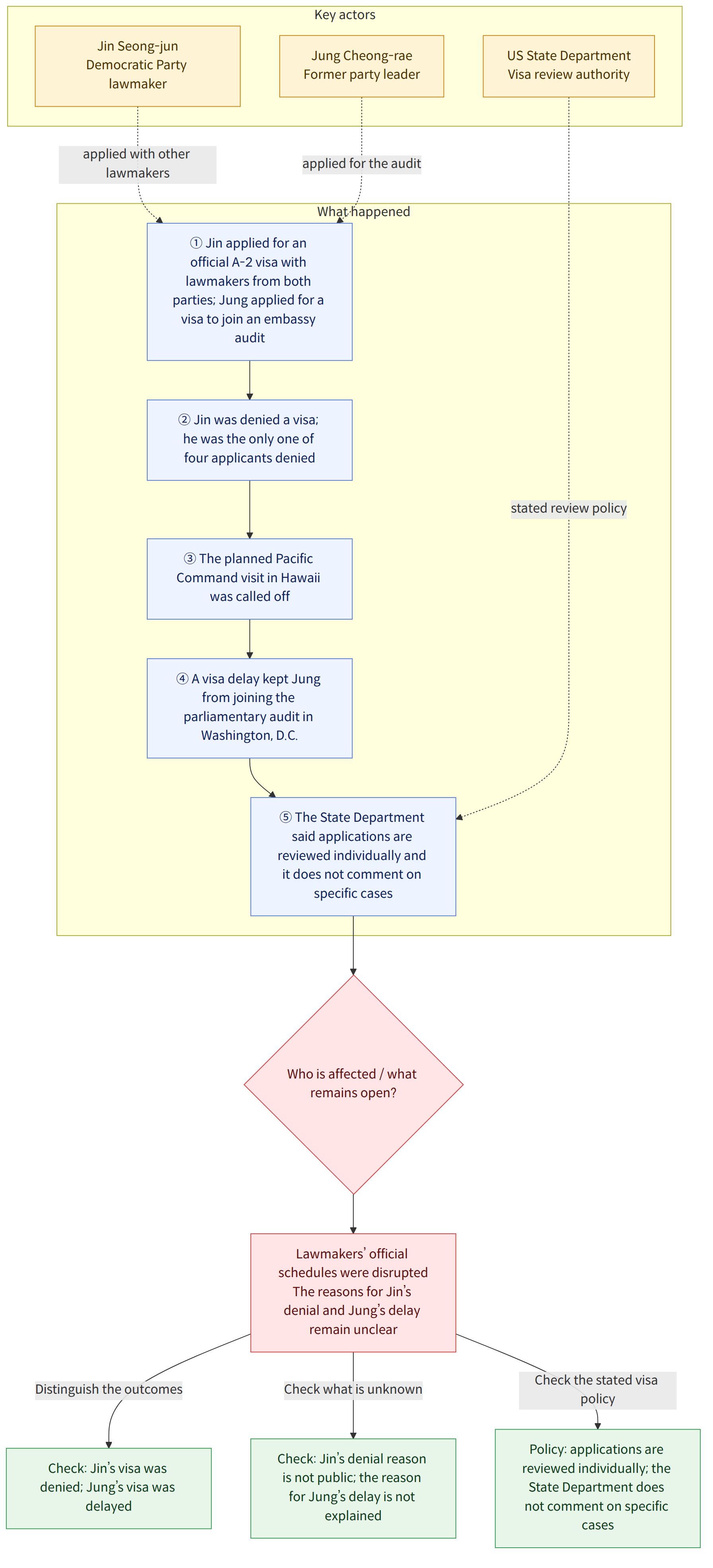
US visa denials and delays disrupted South Korean lawmakers’ official schedules. Jin Seong-jun of the Democratic Party of Korea (더불어민주당) was denied an official A-2 visa that he had applied for with lawmakers from both ruling and opposition parties, scuttling a planned visit to Pacific Command (태평양사령부) in Hawaii. Former Democratic Party leader Jung Cheong-rae was unable to join a parliamentary audit (국정감사) of the South Korean Embassy in Washington, D.C., because his visa was delayed. The US State Department said on October 29 that it reviews visa applications on a case-by-case basis.
Background and context
The US State Department said the Trump administration is rigorously enforcing US immigration laws and putting the United States and its national interests first while ensuring lawful travel through the visa process. A department spokesperson said each visa application is reviewed individually and that the department does not comment on actions in specific visa cases.
Jin was the only one of four applicants to be denied a visa. The US side has not disclosed the reason for the denial. According to the article, Jin was sentenced to three years in prison in 1991 on charges including organizing the Uibyeonghoe (의병회) while serving in the military and describing US forces as “occupying forces stationed in the southern part of the Korean Peninsula.” However, it has not been established how the reported past record affected this visa decision.
Jung’s case was reported as a delay, not a denial. He applied for a visa to take part in a parliamentary audit of the South Korean Embassy in Washington, D.C., but the delay kept him from joining the audit by the National Assembly’s North America Committee. According to the article, Jung climbed over the wall of the US ambassador’s residence in South Korea in October 1989 and staged a sit-in for 45 minutes; he was sentenced to two years in prison in 1990. Documents he submitted to the Mapo-gu Election Commission (마포구 선관위) ahead of the 2024 general election listed past convictions, including violations of the National Security Act (국가보안법) and the Act on Assembly and Demonstration (집회 및 시위법).
After Jung expressed regret, Foreign Minister Cho Hyun said she would meet US Secretary of State Marco Rubio and raise the visa issue directly. Democratic Party lawmaker Shin Jeong-hoon also said he had difficulty obtaining a US visa for a considerable period because he had led a past occupation and sit-in at the US Cultural Center. This describes Shin’s experience; it does not confirm the reasons for the review of other applicants.
What this means
The direct impact established in these cases is that lawmakers’ official schedules were disrupted by the outcome and timing of visa decisions. Jin could not make the planned visit to Pacific Command, and Jung could not join the parliamentary audit. Because visas must be issued for visits related to parliamentary work to go ahead, the effects can extend beyond the applicants to fellow lawmakers and institutions involved in those schedules.
The outcomes in the two cases should be distinguished. Jin’s visa was denied, while Jung’s visa was delayed. In addition, although the reason for Jin’s denial has not been made public, the reported information does not explain the reason for Jung’s delay. There is no basis for definitively linking the two cases to past records or to a single shared decision-making standard.
For example, if a delegation’s official visit schedule is built around the participation of a particular lawmaker, a delay in that lawmaker’s visa alone could disrupt attendance plans or the schedule. This is a hypothetical example of the general effects a delay could have; it does not mean the specific arrangements for this visit have been confirmed.
The US State Department has stated that it reviews cases individually and does not comment on specific cases. The reason for Jin’s denial has not been made public, and it cannot be definitively attributed to his past record.
What is confirmed and what remains unknown
Confirmed
- Jin Seong-jun applied for an official A-2 visa with lawmakers from both ruling and opposition parties; he was the only one of the four applicants to be denied.
- The planned visit to Pacific Command in Hawaii was called off after Jin’s visa was denied.
- Jung Cheong-rae was unable to join a parliamentary audit of the South Korean Embassy in Washington, D.C., because of a visa delay.
- The US State Department said it reviews visa applications individually and does not comment on actions in specific cases.
- Foreign Minister Cho Hyun said she would raise the visa issue directly with Secretary of State Rubio.
Still unknown
- The specific reason the United States denied Jin’s visa has not been made public.
- It has not been confirmed whether Jung’s visa was issued later or whether the delay continued.
- It has not been confirmed whether the visa issue was actually discussed at a meeting between Cho and Rubio.
- The information made public does not show what specific criteria were used to apply the case-by-case review policy to these two cases.
What readers should watch for
- Check whether follow-up reporting discloses a reason for Jin’s denial, but do not infer an undisclosed cause from his past record alone.
- Jung’s case was reported as a delay, not a denial, so whether his visa was subsequently issued and whether he ultimately took part in the scheduled events should be considered separately.
- Whether Cho’s planned meeting with Rubio took place, and whether they discussed the visa issue, should be assessed only after those details are confirmed.
















