



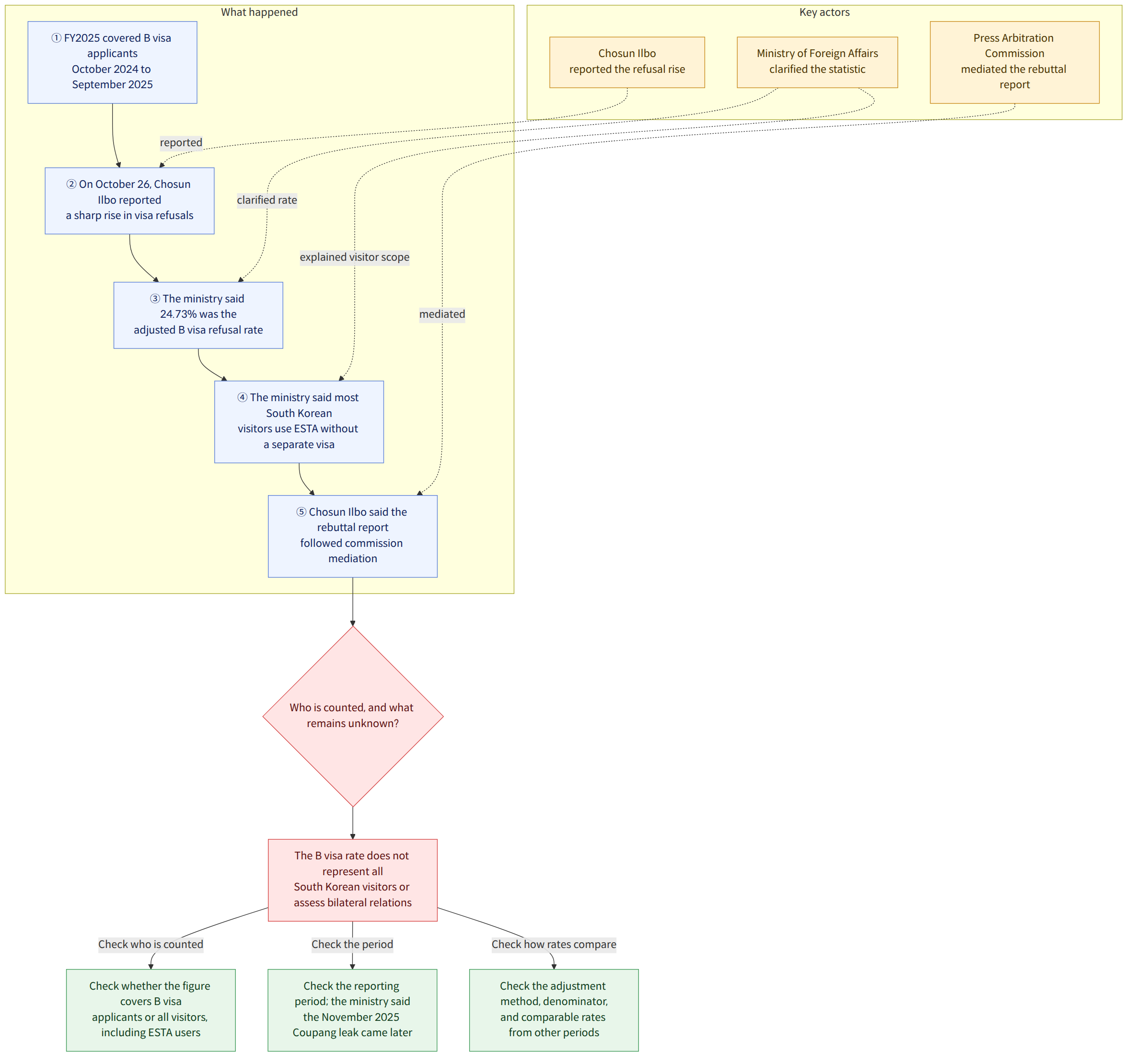
On October 26, Chosun Ilbo reported that the refusal rate for visas for South Korean nationals visiting the United States had risen sharply. The Ministry of Foreign Affairs later explained that the 24.73% cited in the article was the adjusted refusal rate for South Korean nationals applying for B visas in U.S. fiscal year 2025 (October 2024–September 2025). The ministry countered that this figure is not a direct indicator of the circumstances of all South Korean nationals visiting the United States or of South Korea–U.S. relations. Chosun Ilbo said the rebuttal report was made following mediation by the Press Arbitration Commission (언론중재위원회).
Background and context
First, it is important to distinguish the scope of the figure. The 24.73% rate concerns South Korean nationals who applied for B visas during that fiscal year; it is not a confirmed refusal rate for all South Koreans visiting the United States.
The Ministry of Foreign Affairs explained that most South Korean nationals visit the United States without a separate visa through the Electronic System for Travel Authorization (전자여행허가제, ESTA). Therefore, a rate covering only B visa applicants does not include people visiting under ESTA.
The report did not specify how the “adjusted refusal rate” was calculated or what its denominator was. It is also difficult to determine from this figure alone whether refusals increased compared with earlier or later periods.
What this news means
When reading visa statistics, it is important to consider not only the number itself but also who was included and what period it covers. Interpreting the B visa refusal rate as the refusal rate for all South Koreans seeking to visit the United States would extend the statistic beyond its scope. The Ministry of Foreign Affairs also said that this rate alone cannot directly assess issues affecting South Korean nationals visiting the United States or the state of South Korea–U.S. relations.
For example, if a traveler visits the United States using ESTA, that person is not included in the B visa applicant statistics presented here. Therefore, this figure alone cannot be used to assess that traveler’s chances of visiting or the conditions for visiting the United States.
The Ministry of Foreign Affairs explained that the Coupang personal information leak occurred in November 2025, after the statistical reporting period of October 2024 to September 2025. Therefore, according to the ministry’s rebuttal, the incident is not related to this statistic in terms of timing.
What is confirmed and what remains unknown
Confirmed facts
- On October 26, Chosun Ilbo reported that the refusal rate for visas for South Korean nationals visiting the United States had risen sharply.
- The Ministry of Foreign Affairs explained that 24.73% was the adjusted refusal rate for South Korean nationals applying for B visas in U.S. fiscal year 2025.
- The ministry said that most South Korean nationals visit the United States without a separate visa using ESTA.
- The ministry said the B visa refusal rate alone cannot directly assess issues affecting visits to the United States or the state of South Korea–U.S. relations.
- The ministry explained that the Coupang personal information leak, which occurred in November 2025, happened after the reporting period for the statistic.
What remains unknown
- How exactly was the 24.73% adjusted refusal rate calculated, and what was its denominator?
- What were the adjusted refusal rates for South Korean nationals applying for B visas before and after U.S. fiscal year 2025?
- Is there data that allows comparison of changes in the figure over time?
What readers should check
- When encountering visa statistics, first check whether they concern B visa applicants or all visitors to the United States.
- Check the period covered by the figure, and be careful not to link it to events from outside that period.
- To compare refusal rates across periods, check whether the calculation method, denominator, and figures for the periods being compared are all provided.
















