



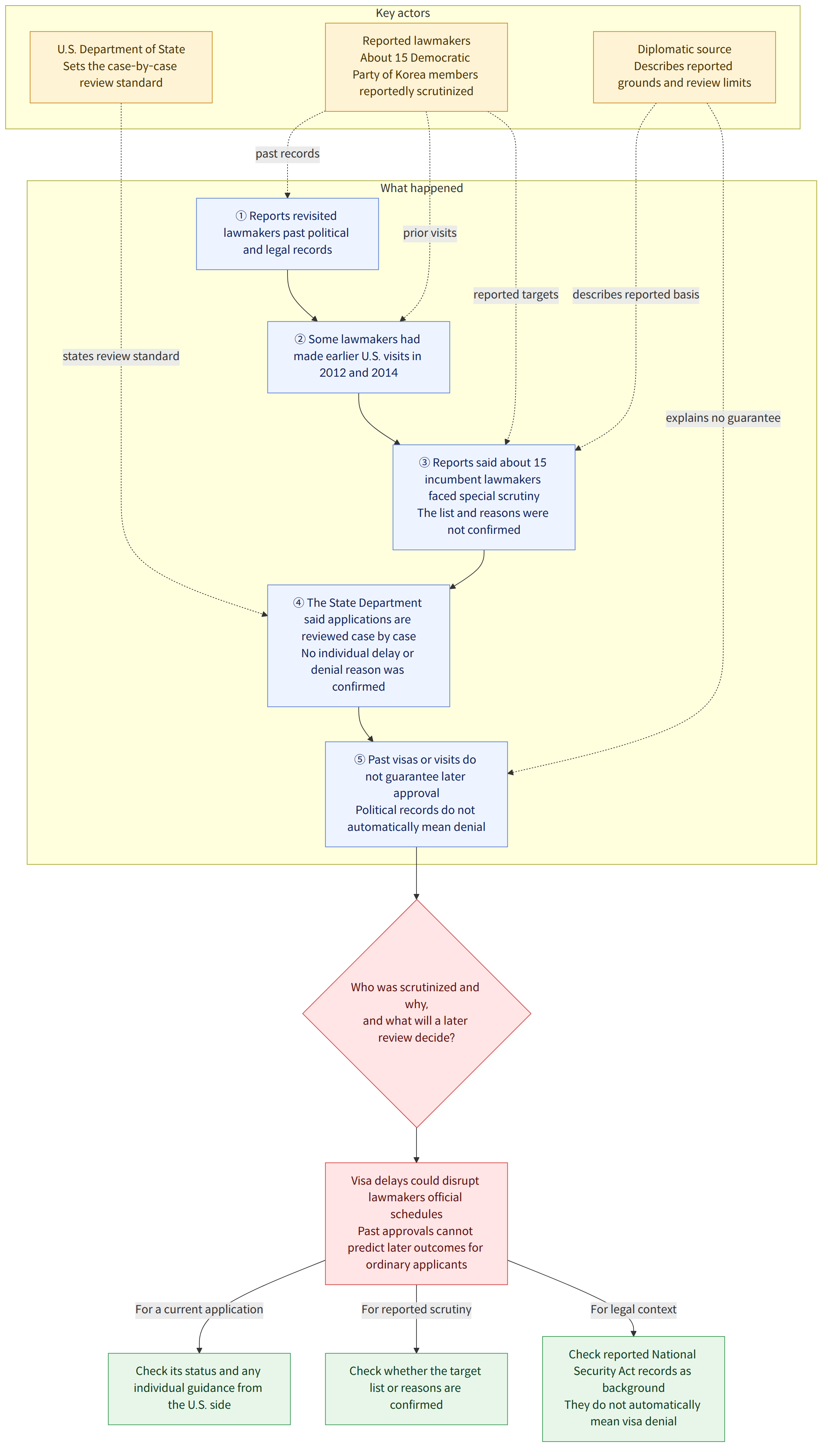
Reports said the U.S. government had identified about 15 incumbent lawmakers from the Democratic Party of Korea (더불어민주당) whom it considers potentially detrimental to security or the national interest, and was giving them special scrutiny when they applied for visas. A diplomatic source said the lawmakers had been identified based on past anti-American activities, such as campaigns to withdraw U.S. forces from South Korea, as well as their recent words and actions, and that their applications were being reviewed more closely. The exact list of those targeted has not been disclosed, and reports said some lawmakers from the People Power Party (국민의힘) and the Rebuilding Korea Party (조국혁신당) also appeared to be under special scrutiny.
At the heart of the controversy is the gap between reports about past records and the review principles made public by the U.S. government. The U.S. Department of State (미 국무부) said it reviews each visa application on a case-by-case basis. However, there has been no specific confirmation of why any particular lawmaker’s application was delayed or denied, or whether a special-scrutiny group actually exists.
Background and context
The reports revisited the past activities and records of punishment of several lawmakers. Jung Cheong-rae, a former leader of the Democratic Party, was sentenced to two years in prison in 1989, when he was a university student, for taking part in a sit-in occupation of the U.S. ambassador’s residence in South Korea. Jin Seong-jun, chair of the National Assembly’s National Defense Committee (국회 국방위원회), was reportedly sentenced in 1991 to three years in prison for violating the National Security Act (국가보안법), among other charges, including organizing the “Militia Association” (의병회) while serving in the military and advocating the withdrawal of U.S. forces from South Korea.
Rep. Shin Jeong-hun was punished over the 1985 occupation of the U.S. Cultural Center in Seoul, while Rep. Park Seon-won was reportedly arrested after working with the student movement leadership that planned the occupation. Democratic Party leader Kim Min-seok was also punished in connection with the student movement at the time, and lawmakers including Lee Hak-young, Lee In-young and Park Hong-keun reportedly have records of past punishment for violations of the National Security Act. These past facts alone, however, do not reveal the outcome of a current visa review or the reasons for the U.S. government’s decision.
A history of past visits to the United States does not mean that a later application will necessarily receive the same result. Jung visited the United States in 2012 and 2014 as a member of the National Assembly, and Jin also made an official visit to U.S. Pacific Command on March 19, 2014, as a member of the 19th National Assembly’s National Defense Committee. A diplomatic source said that even if someone has received a visa or visited the United States in the past, a later application may be subject to additional review or be denied.
What this news means
For politicians, a delay or denial of a visa may be more than a personal travel issue. Concerns have previously been raised that if visa processing affects official visit schedules, it could disrupt the National Assembly’s external activities. However, it has not been confirmed whether this concern actually applied to all the lawmakers mentioned in the reports, or whether the U.S. government had changed its policies.
For ordinary applicants, too, this case shows that it is difficult to predict the outcome of a subsequent application based solely on a past visa approval. A diplomatic source explained that having previously received a visa or traveled to the United States does not guarantee that a later application will be approved. That does not mean a visa is automatically denied to anyone with a history of political activity or punishment. The reports also said that past anti-American activities or related records do not automatically lead to a visa denial.
For example, if someone who has visited the United States in the past applies for a visa again, they should check the status of the current application and any individual guidance from the U.S. side rather than assume an outcome based only on the previous visit. This example is hypothetical and is intended not to offer a basis for predicting an individual review outcome, but to explain that a conclusion cannot be drawn from past records alone.
Points reported differently across news accounts
Reports differ on whether a specific lawmaker’s visa was “denied” or whether the U.S. government did not confirm a denial or its reasons. One report, citing a diplomatic source, described the special-scrutiny group and the review process, and presented the U.S. Department of State’s response as stating the principle that each application is reviewed individually. Another report said the Department had not confirmed whether Jin Seong-jun’s visa was denied or the specific reasons, and had stated that it does not comment on individual applications.
It is therefore necessary to distinguish between the general principle stated by the government and the actual outcome of an individual application. The explanation that applications are reviewed “individually” does not confirm the reports about a special-scrutiny group; conversely, reports of a visa denial or delay cannot establish the reasons in any individual case.
What is confirmed and what remains unknown
Confirmed facts
- Citing a diplomatic source, reports said that about 15 incumbent Democratic Party lawmakers were under special scrutiny during visa reviews.
- Reports said some lawmakers from the People Power Party and the Rebuilding Korea Party were also included, but the exact list has not been disclosed.
- The U.S. Department of State said it reviews each visa application on a case-by-case basis.
- It was reported that past visa issuance or visits to the United States do not guarantee the outcome of a later application.
- A lawmaker who attended the briefing said the director of the National Intelligence Service (국가정보원) reported that NIS employees whose assignments to the South Korean Embassy in Washington (주미 한국 대사관) had been delayed because their visas were on hold recently received visas, departed for the United States and were performing their duties as usual.
What remains unknown
- What is the exact list of lawmakers whom the United States reportedly placed under special scrutiny?
- What specific reasons were applied to the review, delay or denial of each lawmaker’s visa?
- It has not been confirmed whether the status of each lawmaker’s visa processing is related to a change in U.S. government policy or is the result of an individual application decision.
What readers should check
- When checking the visa outcome for a specific person, readers should distinguish between what has been reported and what the U.S. government has directly confirmed.
- Anyone who has applied for a visa should not predict the outcome based solely on a past visa approval, but should check the official status of the current application and any individual guidance.
- Claims that an official visit by a lawmaker or public institution was affected should be checked by separately verifying the visit schedule, the actual visa processing outcome, and any confirmation from the person or institution involved.
References
- Other coverage consulted: hani.co.kr
- Other coverage consulted: koreatimes.co.kr
















