


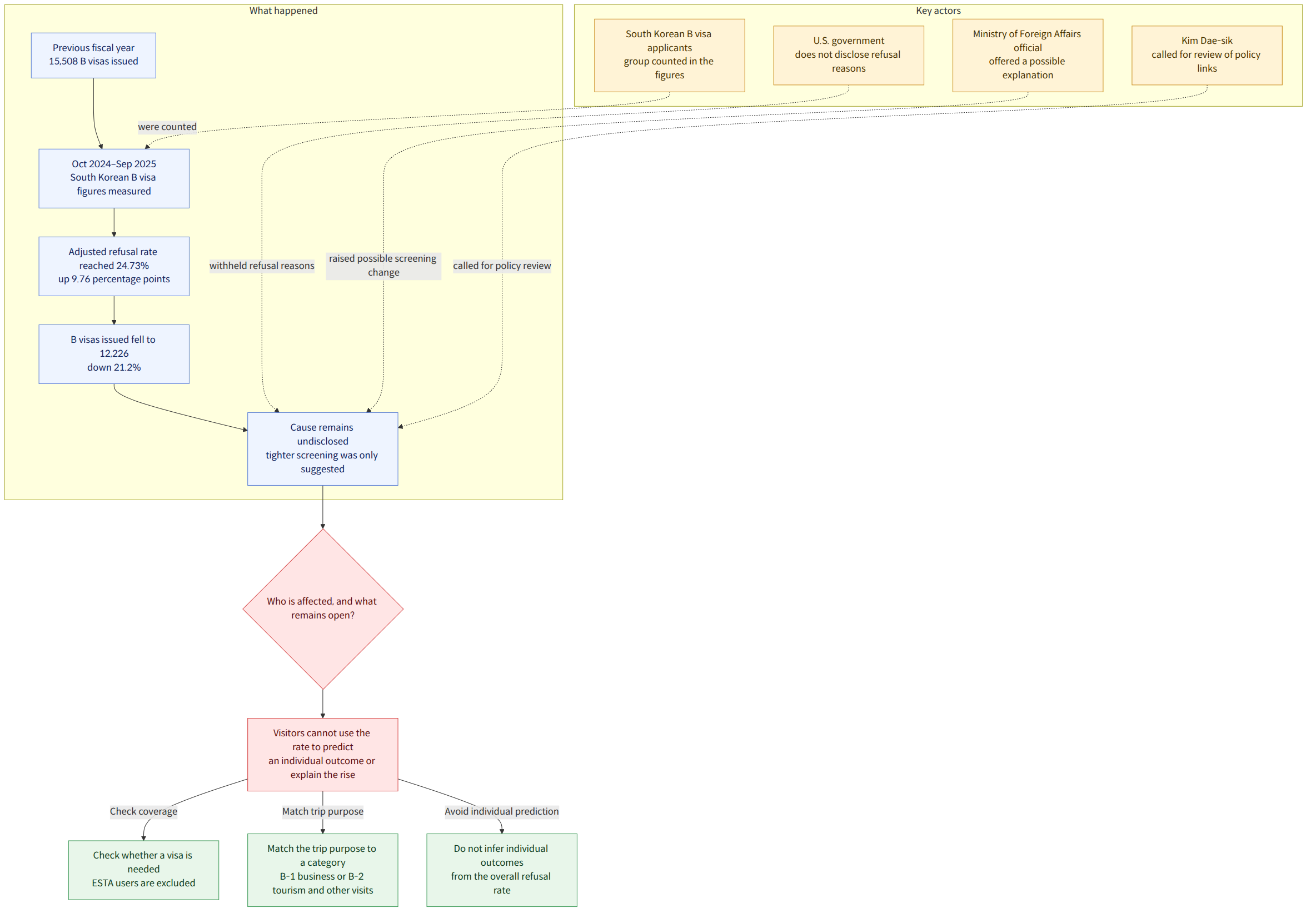
The adjusted refusal rate for U.S. B visas among South Korean nationals was 24.73% from October 2024 to September 2025. That was 9.76 percentage points higher than in the previous fiscal year. Over the same period, the number of B visas issued to South Korean nationals fell 21.2%, from 15,508 to 12,226.
However, these statistics do not cover all South Koreans seeking to visit the United States. They exclude South Koreans who visited without a visa under the Electronic System for Travel Authorization (ESTA; 전자여행허가제) and count only people who applied for B visas. The United States does not disclose specific reasons for visa refusals, so it is currently difficult to identify the cause of the increase in the refusal rate.
Background and context
B visas are divided into B-1 and B-2 categories, depending on the purpose of the visit. B-1 visas are for temporary business visits, while B-2 visas are for tourism, medical treatment, or visits to family and friends. The figures cover the refusal rate for South Korean nationals who applied for these two types of visitor visas.
According to the article, South Korea’s refusal rate was higher than the rates for the United Kingdom (20.44%), Japan (5.68%), France (9.67%), and Germany (12.22%). China’s rate fell from 25.37% to 20.21%, while India and Vietnam had rates of 22.05% and 22.08%, respectively. There is an important limitation to these comparisons: the people who need to apply for visas differ depending on whether a country participates in the Visa Waiver Program (비자면제프로그램), making it difficult to compare refusal rates across countries directly. In particular, the South Korean figures exclude ESTA users.
An official from the Ministry of Foreign Affairs (외교부) told Kim Dae-sik of the People Power Party (국민의힘) that it was difficult to determine the exact cause because the United States does not disclose visa refusal reasons. The official also suggested that visa screening may have tightened as immigration became a domestic political issue in the United States. This was presented as a possible explanation, not a confirmed cause.
Kim said it should be examined whether the South Korean government’s diplomatic and defense policies toward the United States, and changes in South Korea-U.S. relations, had affected visa refusals. However, remarks by Kang Kyung-wha, the U.S. ambassador to South Korea, about communications with the White House (백악관), and the postponement of Democratic Party of Korea (더불어민주당) leader Kim Min-seok’s visit to the United States, both occurred more than a year after the period covered by the statistics. No evidence was presented that these events caused the rise in the refusal rate.
What this news means
For people preparing for a leisure or business visit, these figures are less a guide to predicting the outcome of an application than a signal that the refusal rate for B visa applications by South Korean nationals was higher than in the previous fiscal year. The overall refusal rate cannot tell an individual how their application will turn out, and the publicly available information does not establish why the rate rose. This may make it more important for prospective visitors to check whether they need to apply and which visa category fits their purpose of travel.
For example, someone planning business-related activities in the United States can note that B-1 is for temporary business visits and check whether their purpose falls into that category. This example does not indicate the likelihood that any individual will be issued a visa. The article does not provide specific grounds used to assess individual applicants or determine their outcomes.
The decline in the number of visas issued also does not mean that travel demand or individual application outcomes changed by the same proportion. The article gives the number of visas issued and the share of applicants who were refused; these figures alone cannot further explain the reason for the decline. Nor is it possible to conclude that the rise in the refusal rate resulted from changes in South Korea-U.S. relations.
Related rules and support information
B-1 visas are for temporary business visits, while B-2 visas are for tourism, medical treatment, or visits to family and friends. South Koreans visiting without a visa under ESTA are excluded from these statistics, so the B visa refusal rate should not be treated as the refusal rate for all South Koreans visiting the United States.
When planning a visit, travelers should check which category—B-1 or B-2—relates to their purpose and whether they currently need a visa. This information does not establish eligibility to use ESTA, application procedures, or individual screening requirements, so these should not be inferred from it.
What is confirmed and what remains unknown
Confirmed facts
- From October 2024 to September 2025, the adjusted refusal rate for U.S. B visas among South Korean nationals was 24.73%.
- The refusal rate rose 9.76 percentage points from the previous fiscal year, while the number of visas issued fell 21.2%, from 15,508 to 12,226.
- The statistics cover B visa applicants and exclude South Koreans who visited without a visa under ESTA.
- A Ministry of Foreign Affairs official explained that it was difficult to determine the exact cause because the United States does not disclose refusal reasons.
What remains unknown
- It has not been established whether South Korea-U.S. relations or the South Korean government’s diplomatic and defense policies actually affected the rise in the refusal rate.
- The publicly available statistics do not show the likelihood that an individual applicant will be refused or the reason for a refusal.
What readers should check
- Distinguish whether the purpose of the U.S. visit is temporary business or tourism, medical treatment, or a visit to family or friends, and check the visa category suited to that purpose.
- Separately check the current official guidance to determine whether ESTA applies to you or whether you need to apply for a visa. Do not use these refusal-rate statistics alone to determine your eligibility.
- If planning a leisure or business visit, do not treat the increase in the refusal rate as an individual outcome; instead, check the latest guidance on your purpose of travel and the application.

















