



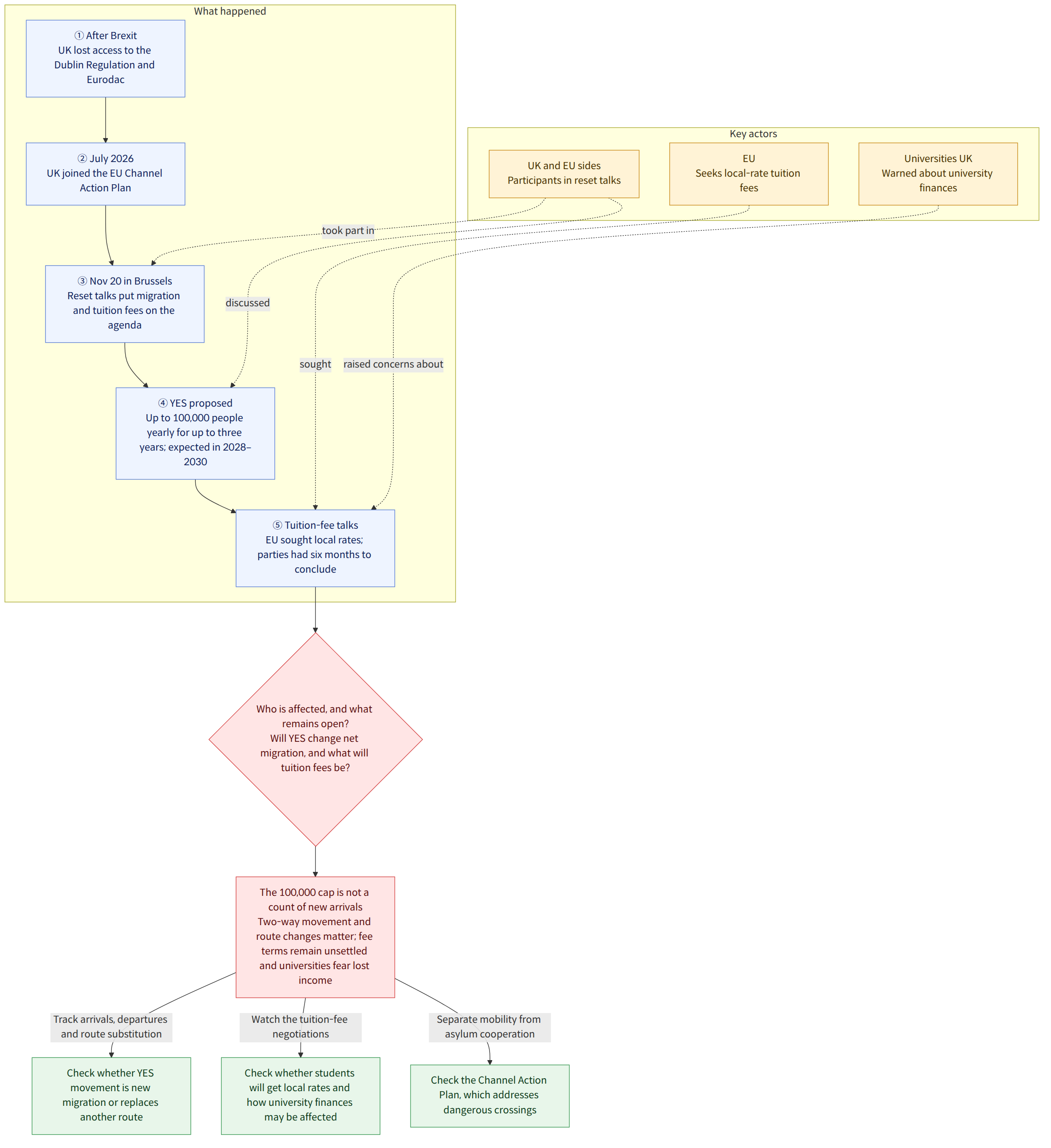
Migration was a major item on the agenda at the UK-EU “reset” talks held in Brussels on November 20. The main issues discussed were the Youth Experience Scheme (청년 경험 제도, YES), which would allow young people to work or study in the other jurisdiction, and negotiations over university tuition fees. If introduced, the scheme could change mobility opportunities and student costs, but a return to free movement or to the single market or customs union was not on the agenda.
Background and context
YES is a proposal to allow up to 100,000 people a year to move between the UK and the EU for up to three years to work or study. It would not begin immediately; the article expects it to be introduced sometime between 2028 and 2030. The scheme is expected to resemble existing youth schemes between the UK and some non-EU countries, including New Zealand and Canada.
However, “up to 100,000” does not mean the same thing as an increase in the number of people newly migrating. According to the article, only about 25% of the caps for the UK’s schemes with other countries are used, while the cap for an EU scheme could be reached. At the same time, some people who come to the UK through the scheme may previously have entered by another route.
Tuition fees are also a major issue in the negotiations. The EU wants UK and EU students to pay the same fees as local students when studying in the other jurisdiction. The article puts the UK’s current domestic student tuition fee at £9,790 a year and reports that the parties were given six months to conclude the tuition-fee negotiations. Under the current rules, EU students pay the full international student rate to study at UK universities.
UK universities are concerned about the financial impact of lower tuition fees. Vivian Stern, chief executive of the university group Universities UK, said that applying the domestic student rate to EU students in July 2026 would worsen the financial position of UK universities. The key issue in the negotiations, therefore, is that an agreement to reduce costs for students is linked to university income.
The migration discussion extends beyond youth and student mobility. According to the article, UK asylum applications rose from about 40,000 a year before the pandemic to 100,000 afterward, while the number of people crossing the English Channel in small boats increased from 1,800 in 2019 to more than 45,000 in 2022. After Brexit, the UK lost access to the Dublin Regulation (더블린 협약) and the Eurodac asylum database (유로닥 망명 데이터베이스).
What this news means
For young people who want to study or work in the UK or the EU, YES could provide a route to stay and take part in activities for an extended period. But the annual cap does not by itself indicate the actual number of arrivals or the increase in net migration. The article explains that the scheme could increase not only the number of people coming to the UK, but also the number of young people from the UK going to the EU. If the numbers moving in each direction are similar, the effect on the UK’s net migration could be very small, the analysis suggests.
For example, if a young person comes to the UK through YES instead of using another existing route, they would count as a scheme participant but would not necessarily represent a new migration. Conversely, movement by young people from the UK to the EU to work or study through the scheme must also be taken into account. Evaluating the scheme therefore requires distinguishing not only the number of arrivals, but also departures and the scale of movement shifting from existing routes.
For students, an agreement on tuition fees is a direct concern. If an agreement is reached on the terms the EU wants, the costs for EU students studying in the UK and for UK students studying in the EU could change, but no outcome has been announced. The potential for UK universities’ financial concerns to become an obstacle in the negotiations should also be considered.
Meanwhile, the article describes the talks as an opportunity for the UK and the EU to draw closer in the area of migration after Brexit. In July 2026, the UK joined the EU’s Channel Action Plan (채널 행동계획) to prevent dangerous crossings of the Channel, and the summit’s joint statement included a “structured migration dialogue.” This shows that a legal mobility scheme for young people and responses to asylum and irregular migration are separate issues, but are both being addressed within the framework of cooperation between the two sides.
The annual cap for YES is not the same as the actual number of new arrivals or the increase in net migration. Movement into the UK, movement out to the EU, and cases in which the scheme replaces an existing route need to be considered separately.
What is confirmed and what remains unknown
Confirmed
- YES is a proposal to allow up to 100,000 people a year to work or study between the UK and the EU for up to three years, and it will not begin immediately.
- The article expects YES to be introduced sometime between 2028 and 2030.
- The EU has called for students on both sides to pay the same fees as local students, and the parties were given six months to negotiate.
- Under current rules, EU students pay the full international student rate at UK universities.
- The UK joined the EU’s Channel Action Plan in July 2026, and the joint statement included a structured migration dialogue.
What remains unknown
- The article does not explain how the final eligibility requirements and application process for the Youth Experience Scheme will be set.
- No outcome is provided for the negotiations over tuition fees for UK and EU students.
- It is not known whether the UK will regain access to Eurodac or, if so, when and under what conditions.
- The number of people who will actually use YES, and the share of them who will be replacing an existing migration route, have not been confirmed.
What readers should check
- If you plan to study or work in the UK or the EU, note that the scheme will not begin immediately and distinguish this from the expected start date of sometime between 2028 and 2030.
- When comparing study costs, do not confuse the international student fees currently charged to EU students in the UK with the proposed domestic student rate that is under negotiation. Before an agreement is reached, do not treat £9,790 a year as the confirmed tuition fee for EU students.
- When assessing migration levels, look beyond the scheme’s cap and check how movement into the UK, departures to the EU, and movement switching from other routes are each counted.
















