



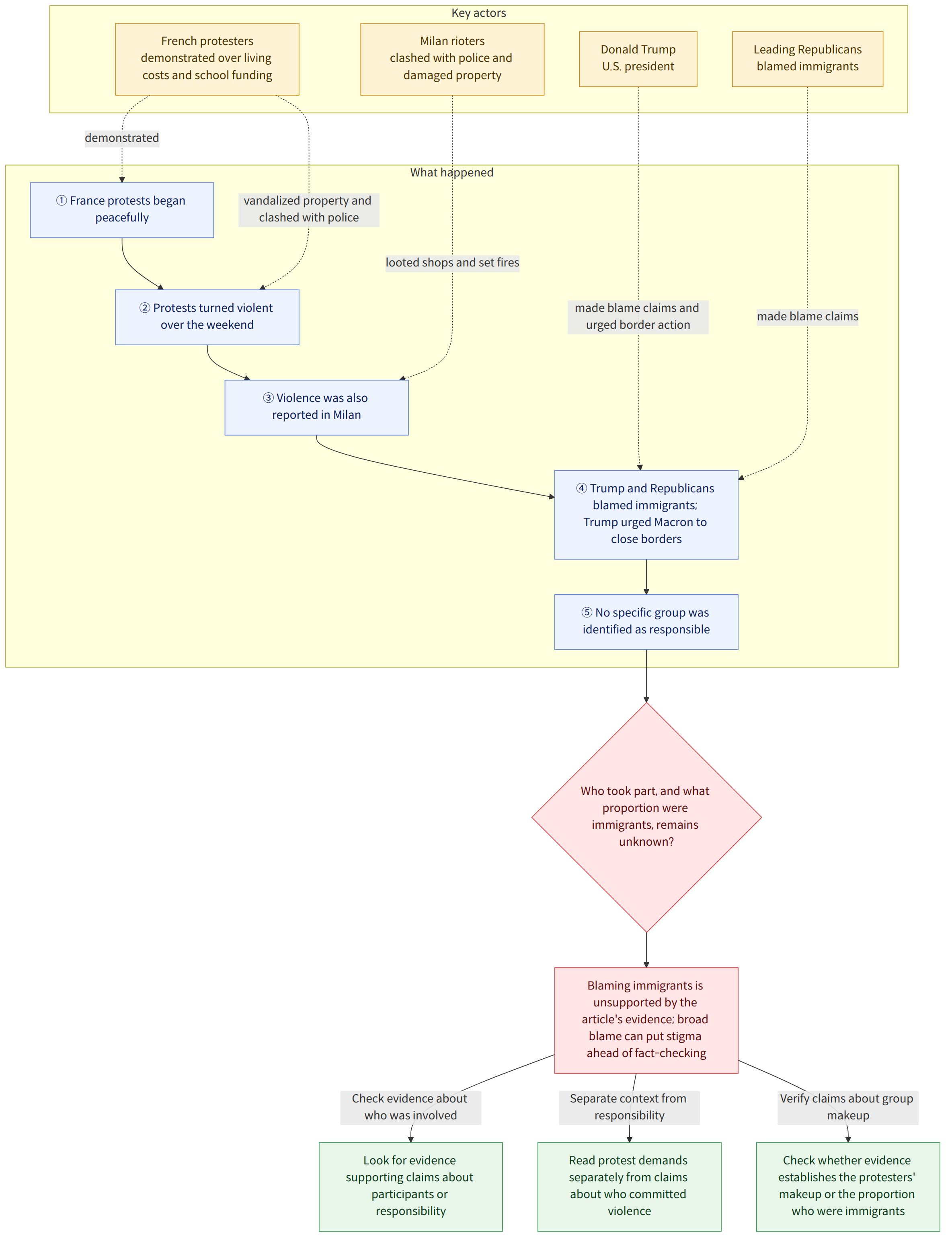
Nationwide protests in France against the rising cost of living and in support of students' complaints about underfunded schools turned violent over the weekend. Masked rioters vandalized property and clashed with police. The article reports that U.S. President Donald Trump and leading Republicans made unsubstantiated claims blaming immigrants for the unrest.
In Milan, Italy, rioters also clashed with police, looted shops and set fire to property on Saturday. But the article presents no evidence confirming that any particular group was responsible for the violence in France or Italy.
Background and context
According to the article, the protests in France began as peaceful demonstrations against the rising cost of living and in support of students' complaints about underfunded schools. Violence broke out over the weekend, with masked rioters vandalizing property and clashing with police. Clashes with police, looting and arson were also reported in Milan.
In response to these events, Trump urged French President Emmanuel Macron to “close the borders and get control before it’s too late.” The article explains that Trump and leading Republicans are seeking to use social unrest in Europe for political purposes ahead of the U.S. midterm elections. However, the specific makeup of those involved in the violence, or the proportion who were immigrants, has not been established.
What this news means
Statements blaming a particular group for protest violence should be distinguished from the question of who actually took part in the violence. According to the article, it is difficult to determine the protesters' exact sociological makeup, and no specific group has been identified as responsible for the violence. Therefore, the claim that immigrants were the main perpetrators of the violence is not supported by the facts presented in the article.
This distinction is not the same as denying or minimizing the violence itself. Vandalism, clashes with police and looting were reported in France and Milan, but the evidence about who carried out those acts must be assessed separately. The point matters because portraying an entire group as responsible without sufficient evidence can put stigma ahead of fact-checking.
For example, if someone claims, based on these events, that Muslim immigrants committed most of the violence, it is worth checking whether evidence about the actual makeup of those involved has been presented before accepting that claim as a fact confirmed by the article.
What is confirmed and what is still unknown
Confirmed facts
- Nationwide protests were held in France against the rising cost of living and in support of students' complaints about school funding.
- The peaceful protests in France turned violent over the weekend, and masked rioters vandalized property and clashed with police.
- In Milan, rioters clashed with police, looted shops and set fire to property on Saturday.
- Trump urged President Macron to close the borders and take control.
- According to the article, it is difficult to determine the protesters' exact sociological makeup, and no specific group has been identified as responsible for the violence.
What is still unknown
- What was the actual makeup of the people involved in the violent acts?
- What proportion of those involved were immigrants?
- Is there separate evidence to support the article's mention of claims blaming immigrants?
What readers should check
- Check whether claims explaining the violent incidents are accompanied by evidence supporting assertions about who was involved or responsible.
- Read about the background to the protests separately from questions of responsibility for the violent acts. What demands the protests began with and who took part in the violence are different questions.
- Distinguish statements that generalize about an entire group, such as “immigrants were most of them,” from confirmed facts and claims for which no evidence has been presented.

















