



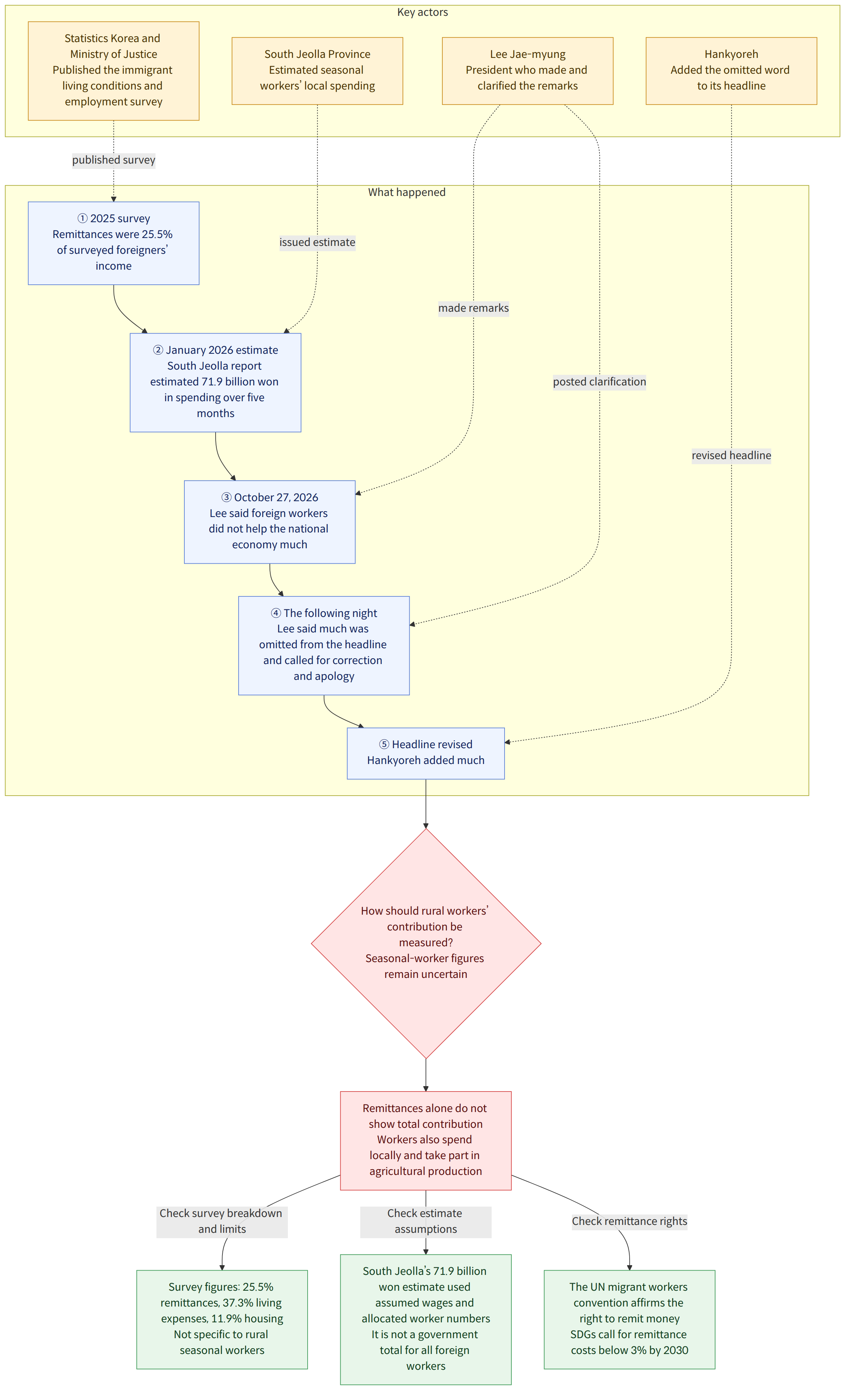
After President Lee Jae-myung said at a Cabinet meeting on October 27, 2026, that foreign workers in rural areas “do not help the national economy much” and send “all” their wages back home, criticism followed over the accuracy of his remarks and the workers’ economic contribution. The following night, the president posted on X, pointing out that the word “much” had been omitted from the headline of the initial report and demanding a correction and an apology. He explained that he had been making a comparison: foreign workers contribute to the domestic economy, but not “as much” as Korean workers. Hankyoreh (한겨레) added “much” to its headline.
The debate is about more than a single word in a headline. It has also raised questions about whether remittances really account for all of workers’ income, how to assess the economic contribution of wages spent domestically and labor used in agricultural production, and whether policies to address rural labor shortages are realistic.
Background and context
According to the 2025 “Survey on Immigrant Living Conditions and Employment” (이민자 체류실태 및 고용조사) by Statistics Korea (국가데이터처) and the Ministry of Justice (법무부), remittances to domestic and overseas destinations accounted for 25.5% of foreigners’ total income as of May last year. Living expenses accounted for 37.3%, and housing costs for 11.9%. The survey figures therefore differ from the claim that workers send all their wages back home. However, these figures show how surveyed foreigners’ income is spent; they cannot be taken as figures specifically for seasonal workers in rural areas.
Money spent in South Korea is also at issue. An analysis report on the effects of foreign seasonal workers in agriculture and fisheries, released by South Jeolla Province (전남도) in January 2026, used an average monthly wage of 2.09 million won per person to estimate remittances of 1.15 million won and spending of 690,000 won on housing, food, and other expenses. Using the 20,838 workers allocated to South Jeolla Province in 2025, the report then estimated that they generated 14.3 billion won in spending during their stay per month, or 71.9 billion won over a five-month season. This is an estimate based on the report’s assumptions about wages and allocated worker numbers, not a government-calculated total for the economic contribution of foreign workers as a whole.
Criticism of claims about foreign workers’ contribution also concerns agricultural production and labor shortages, not just spending. The Korean Women’s Political Network (한국여성정치네트워크) said in a commentary that migrant workers have helped fill labor and production gaps in rural areas, where Korean workers have avoided poor working conditions. Based on a South Jeolla Province research finding that the average monthly labor cost for Korean workers in agriculture is 3.8 million won, the network also calculated that paying them 5 million won would require an additional 1.2 million won per person. Jang Young-wook, a research fellow at the Korea Institute for International Economic Policy (대외경제정책연구원), noted that if subsidies are provided, self-employed farmers or unpaid family workers could shift to paid employment, increasing the fiscal burden.
What this news means
In policy debates, remittances are not the opposite of contributing to the domestic economy. Even if some wages are sent overseas, the survey figures also show spending on living and housing costs, and the South Jeolla Province report separately estimated seasonal workers’ spending during their stay. Moreover, seasonal workers take part in agricultural work such as growing and harvesting crops. The controversy has therefore highlighted how difficult it is to assess workers’ overall contribution to the domestic economy using remittances alone.
Migrant workers’ remittances are also a matter of rights. The UN Convention on the Rights of Migrant Workers (유엔 이주노동자 권리협약), as described in the source text, affirms migrant workers’ right to remit money and the obligation of countries involved to facilitate remittances. The UN Sustainable Development Goals (지속가능발전목표) call for reducing remittance costs to less than 3% of the amount sent by 2030. In light of these standards, treating the act of sending wages home as evidence of a lack of economic contribution requires separate consideration of rights and costs.
It is also difficult to reach a conclusion about rural labor policies based on a single figure. Raising wages for Korean workers could increase agricultural workers’ incomes, but according to the research findings cited, paying 5 million won would require an additional 1.2 million won per person per month. As Jang Young-wook noted, the fiscal burden could also change if support were extended to existing self-employed farmers or unpaid family workers. This does not mean subsidies are impossible; it is an analysis pointing to the need to assess who would receive them and what they would cost.
For example, if a farm is considering both hiring seasonal workers and providing wage support for Korean workers, it would need to look beyond foreign workers’ remittance rates and separately assess their spending during their stay, on-site labor needs, who would be eligible for subsidies, and the additional costs. Rather than treating migrant workers’ labor conditions and the need to secure workers for domestic agriculture as opposing issues, this case raises the question of whether both can be addressed together.
Relevant systems and support information
According to in-house materials, Seasonal Work (계절근로, E-8) is a status of stay for foreigners seeking work in crop cultivation and harvesting, related primary processing, or primary processing of fishery products. Local governments allocate workers and handle the visa application process on their behalf. A stay of up to eight months may be granted at a time, and the total period of stay cannot exceed eight months.
Eligibility varies by referral route. For example, E-8-1 and E-8-3 are for agricultural and fisheries workers recommended by foreign local governments that have signed a memorandum of understanding with a local government in South Korea. Relatives within the fourth degree of kinship who live overseas and are recommended by Korean marriage migrants, along with those relatives’ spouses, may qualify for agricultural E-8-2 or fisheries E-8-4. Other categories include international students inviting their parents, so applicants should first check which category applies to them and which fields of work are permitted.
E-8 visas are issued only on the basis of a Certificate of Visa Issuance. The head of a local government at the basic level submits the application through the Visa Portal, and processing may take about 10 days from the date of application. Required documents include a standard employment contract, evidence of efforts to recruit Korean workers, a copy of the passport, documents supporting the relevant referral category, and a form detailing the accommodation to be provided. Applicants should confirm the documents actually required and the application timing with their local government, taking account of the worker category and work season.
Activities and workplaces are also restricted during the stay. Seasonal workers must perform permitted seasonal work at their assigned farm, fishing operation, or other designated workplace. They cannot obtain permission to engage in activities outside their status of stay, and they are not permitted to add workplaces. In certain cases, such as when a contract is terminated early for reasons attributable to the employer, workers may apply to change workplaces if they meet the requirements.
Applicants should pay attention to the timing when seeking an extension of their stay. They must apply to the local government 60 to 40 days before their stay expires. If fewer than 40 days remain before the expiration date, they must first obtain a recommendation from the local government and then apply in person at the competent immigration office. Documents required for an extension include an employment contract, passport and Residence Card, and confirmation of residence and accommodation provision; the fee is waived. However, the total period of stay cannot exceed eight months.
What is known and what remains unknown
What is known
- At the Cabinet meeting on October 27, 2026, the president discussed foreign workers’ economic contribution and remittances to their home countries. The following day, he demanded a correction and an apology over a headline that omitted the word “much.”
- Hankyoreh accepted the president’s criticism and added “much” to its headline.
- The 2025 Survey on Immigrant Living Conditions and Employment found that remittances to domestic and overseas destinations accounted for 25.5% of foreigners’ total income, while living expenses accounted for 37.3% and housing costs for 11.9%.
- The South Jeolla Province report estimated that seasonal workers generated 71.9 billion won in spending during one season of stay, based on the number of workers allocated in 2025.
- The UN Convention on the Rights of Migrant Workers and the Sustainable Development Goals address, respectively, the right to remit money and the facilitation of remittances, and the goal of reducing remittance costs.
What remains unknown
- The materials provided do not establish whether the government has separately calculated the overall economic contribution of foreign workers, including their domestic spending and contribution to production.
- The source text does not say whether the president apologized to migrant workers.
- The materials provided do not show how closely South Jeolla Province’s 71.9 billion won estimate matches actual spending, or what the combined effect would be across other regions and agricultural sectors.
What readers should check
- Foreign workers preparing for seasonal work and their employers should check the referral category, permitted duties, assigned workplace, and period of stay with the local government.
- Check in advance the standard employment contract, evidence of recruitment efforts, accommodation documents, and other materials required for the Certificate of Visa Issuance application, and allow for the possibility that processing may take about 10 days when planning the work schedule.
- If an extension of stay is needed, check the application deadline based on the expiration date. If fewer than 40 days remain, applicants must first obtain a recommendation from the local government and then apply in person at the competent immigration office.
If you are dealing with a similar issue, attorney Ji-sun Ahn of Ijun Law Firm can review your current immigration status, the notice or application for the procedure at issue, and records of eligibility with you. These details can help clarify which options apply to your situation.
References
- Seasonal Worker (E-8) Visa — Eligibility, Period of Stay, and Application and Extension Documents
- Other coverage consulted: koreatimes.co.kr
- Other coverage consulted: chosun.com

















