



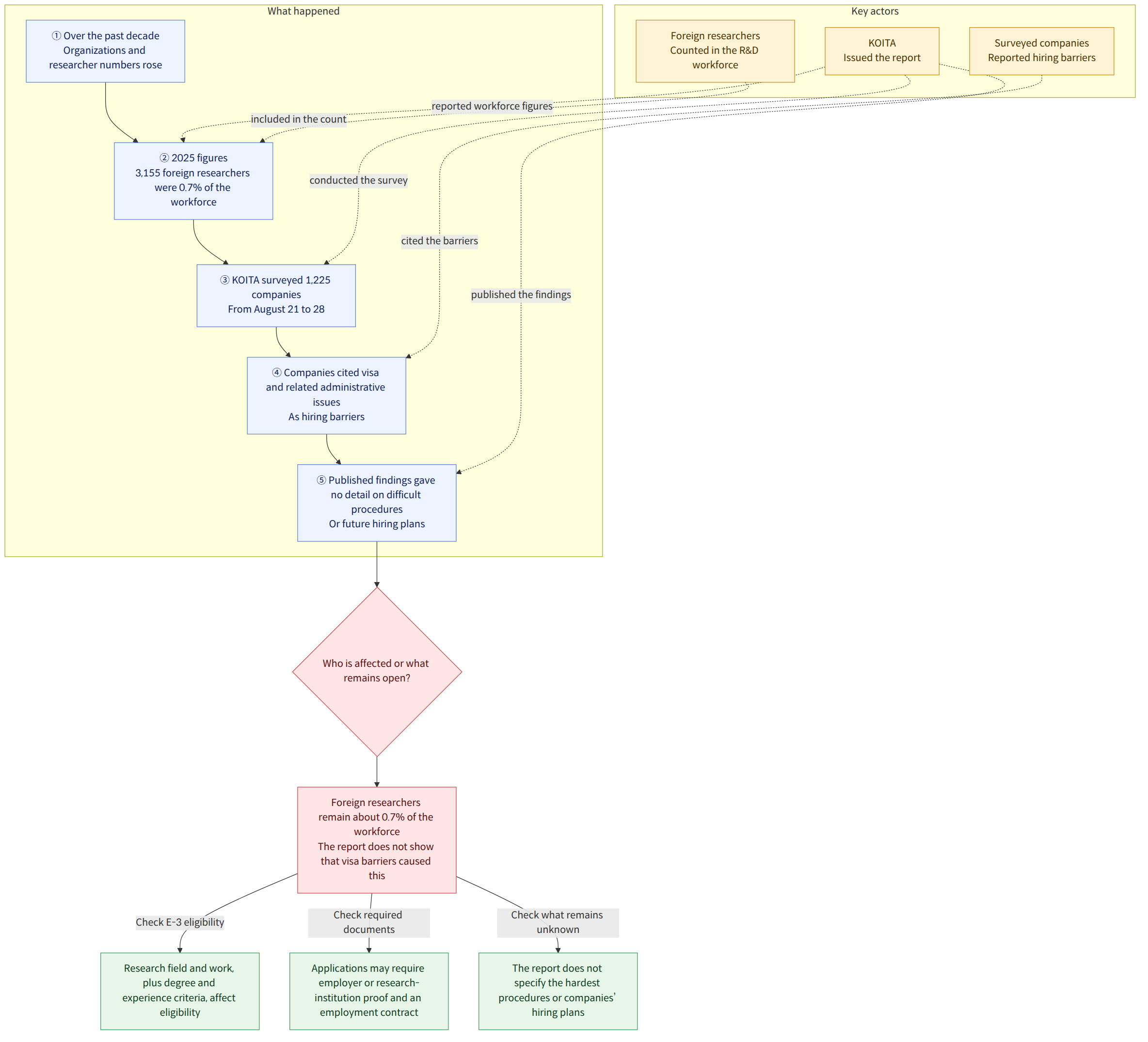
According to a report released Tuesday by the Korea Industrial Technology Association (한국산업기술협회; KOITA), 1,945 of the 72,224 corporate R&D organizations registered with the association in 2025 employed foreign researchers, representing 2.7% of the total. Foreign researchers accounted for 3,155 of the people working in corporate R&D, or 0.7% of the overall workforce. Over the past 10 years, the number of organizations employing foreign researchers rose 57.9% and the number of foreign researchers rose 21.4%, but their share of the overall research workforce remained nearly unchanged at about 0.7%.
Background and context
The figures in the report show that the absolute number of foreign researchers and the number of organizations employing them have increased. But that growth did not translate into an increase in their share of the overall research workforce. The increases in both the number of organizations and the number of researchers alone do not show which fields or companies are hiring foreign researchers, or whether hiring demand is being met.
The report also surveyed 1,225 companies from August 21 to 28 to examine their experience hiring foreign researchers and their hiring plans. According to the article, companies cited visa and related administrative issues as the biggest obstacle to hiring foreign researchers. However, the published information did not provide findings on which procedures were particularly difficult or whether companies planned to increase or reduce hiring in the future.
What this means
For companies, intending to hire a foreign researcher may not be enough to complete the process: they may also need to consider which immigration status applies to the research and whether the research institution and applicant meet the relevant requirements. The identification of visa and administrative issues as barriers is notable because checking qualifications and documents may be important to moving a hiring process forward. However, this report alone cannot establish that visa procedures are the reason foreign researchers’ share has remained low.
For foreign researchers, the available immigration status and required documents may vary depending on the research field, the actual work, and the employer’s requirements. For example, someone planning to conduct research in natural sciences or advanced industrial technology under a contract with a corporate-affiliated research institute may need to check the institution’s requirements and the degree and work-experience criteria, and prepare documents such as an employment contract and proof of the institution’s status. This is a hypothetical example; actual eligibility must be checked based on the individual’s qualifications, the institution, and the work involved.
Related rules and support information
According to the In-house Visa Guide, Research (E-3) status (연구(E-3) 체류자격) is for foreign nationals seeking to conduct research in natural sciences, research and development in advanced industrial technology, or research in social sciences, humanities, arts, and sports. Scientists and engineers conducting research in natural sciences or advanced industrial technology under a contract with a corporate-affiliated research institute or similar institution may also qualify. The general education and experience requirements are a doctoral degree, or a master’s degree and at least three years of experience. The experience requirement may be waived for some master’s graduates of Korean universities or in cases meeting designated criteria. Therefore, not all foreign researchers qualify for E-3 status.
When applying for a visa or a Certificate of Visa Issuance, applicants may be required to submit an application form, a passport and photo, documents related to the establishment of the employer or proof of the research institution, and an employment contract or confirmation of planned appointment. Where applicable, applicants may also need to prepare a master’s or higher degree certificate and proof of work experience, an employment recommendation, confirmation of expected graduation or the degree-award date, or evidence that they authored an outstanding academic paper. During the review process, a diplomatic mission or immigration office may request additional documents or adjust some requirements.
The guide lists a fee of 100,000 won for permission to change status of stay and 60,000 won for permission to extend the period of stay. The fee for issuing an alien registration card is listed as 35,000 won. The maximum period of stay granted at one time for E-3 status is five years; the actual period granted may vary according to eligibility and the employment contract, among other factors. If the place of work is changed or added, the change must be reported to the relevant immigration office within 15 days of the date the reason arises. The guide says there is no fee for this report.
Eligibility and required documents may vary depending on the research field, institution, degree, and work-experience requirements. Before applying, applicants should check their own immigration status and the requirements for the research institution.
What is confirmed and what remains unknown
What is confirmed
- In 2025, 72,224 corporate R&D organizations were registered with the association.
- Of these, 1,945 organizations, or 2.7% of the total, employed foreign researchers.
- There were 3,155 foreign researchers among corporate R&D staff, accounting for 0.7% of the total.
- Over the past 10 years, the number of organizations employing foreign researchers increased by 57.9%, and the number of foreign researchers increased by 21.4%.
- In a survey of 1,225 companies, visa and related administrative issues were identified as the biggest obstacle to hiring.
What remains unknown
- The published information does not reveal the specific visa or administrative difficulties companies said they had encountered.
- The available information does not show what the survey found about companies’ plans to hire foreign researchers.
- The data make it difficult to determine how much visa issues contributed to foreign researchers’ share remaining at about 0.7%.
What readers should check
- Companies seeking to hire foreign researchers can first check whether the research and institution qualify for E-3 status, and what degree, work-experience, and institutional proof documents are required.
- Applicants should identify which procedure applies to their situation—visa issuance, a change of status, or an extension of stay—and check the required documents and fees for that procedure.
- Anyone changing or adding a place of work under E-3 status should make sure not to miss the 15-day deadline from the date the reason for reporting arises.

















