
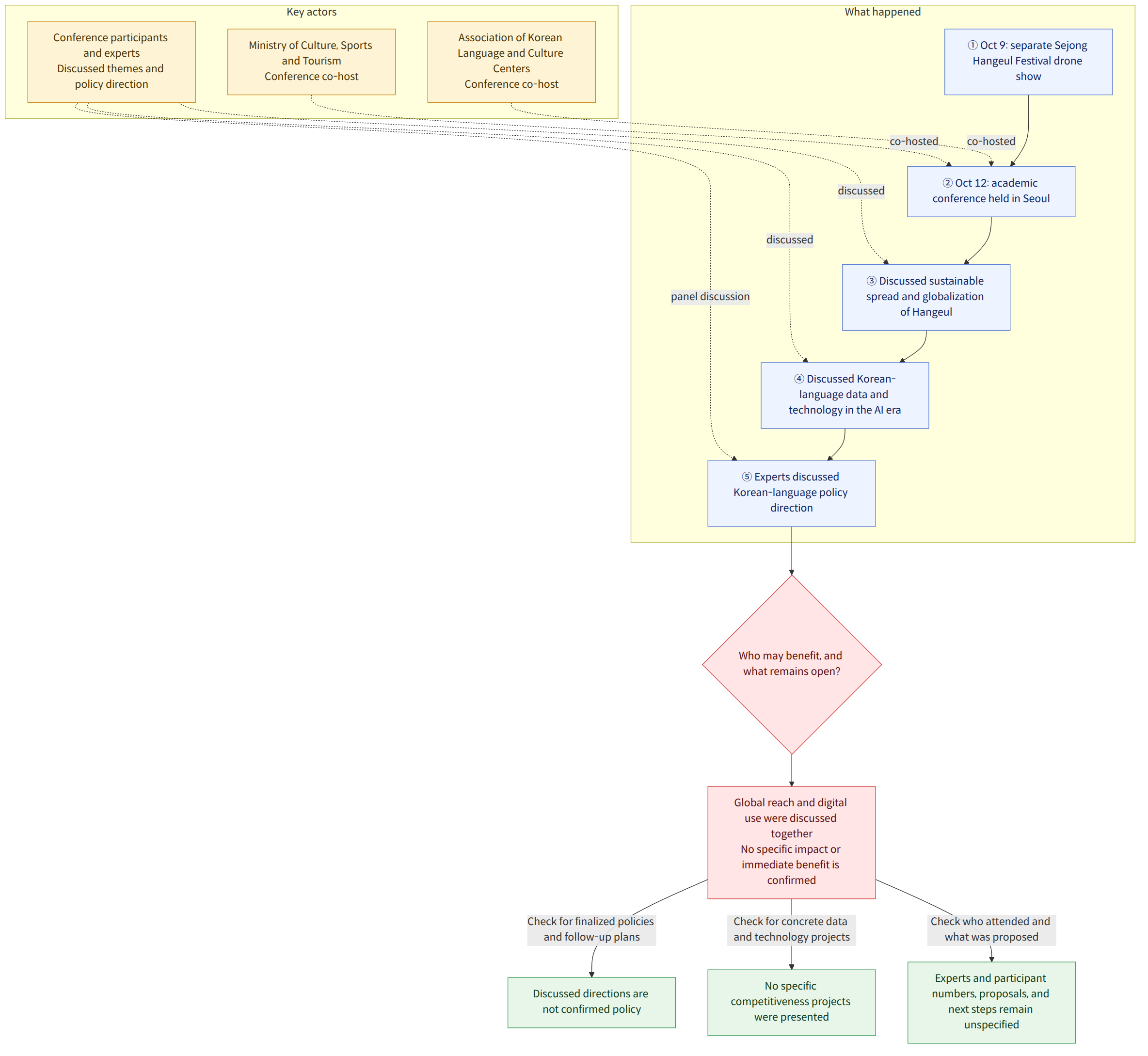
An academic conference marking the 100th anniversary of Hangeul Day was held on October 12, 2026, at the Daloreum Theater (달오름극장) at the National Museum of Korea (국립중앙박물관) in Seoul. Co-hosted by the Ministry of Culture, Sports and Tourism (문화체육관광부) and the Association of Korean Language and Culture Centers (한국어문화원연합회), the conference discussed the direction Hangeul and the Korean language should take over the next 100 years. Participants considered strategies for spreading Korean as a global language alongside the competitiveness of Korean-language data and technology in the age of artificial intelligence.
Background and context
The conference discussions were organized around two themes. The first, “The Next 100 Years of Hangeul: Beyond Borders, to the World,” addressed sustainable frameworks and globalization strategies for expanding the reach of Hangeul. The second theme examined Hangeul and the Korean language in the era of large-scale artificial intelligence, discussing ways for Korean to emerge as a major language in the digital ecosystem.
Language data here refers to materials such as text and speech that artificial intelligence uses to process language. The competitiveness of these materials and the technologies used to handle them may be connected to how broadly Korean can be used in digital environments. The conference’s decision to address globalization alongside data and technology is notable because it treated the spread of Korean not only as a matter of cultural interest but also as a question of its use in digital environments.
The article also mentioned a drone show at an evening program of the Hangeul Festival in Sejong City (세종시 한글축제), separate from the conference. According to the description, 2,000 drones depicted King Sejong (세종대왕) and the process of creating and promulgating Hangeul on October 9. This was a scene from a festival celebrating Hangeul, not an indication of policies or outcomes decided at the academic conference.
What this news means
Strategies for globalizing Korean address how to expand the number of people who learn or use the language and the places where it is used. Meanwhile, language data and technology in the AI era relate to the foundations for using Korean within digital services and ecosystems. The fact that the two topics were discussed together can be interpreted as showing that the spread of the language and its use in digital environments were not treated as entirely separate challenges.
The potential scope of impact is also broad. For people learning Korean, the details of globalization strategies could affect learning opportunities and environments; for those developing or using technologies that handle Korean, discussions of data and technological competitiveness could be relevant. However, there is no confirmation that the conference approved any specific support or program, so it is not possible to conclude that any particular group will immediately benefit or experience change.
For example, if the range of digital learning tools available to Korean learners were to grow, that could be one instance of Korean-language globalization and AI technology intersecting in the learning environment. This is a hypothetical scenario; it does not mean that the conference announced plans to develop or distribute such tools.
What is confirmed and what remains unknown
What is confirmed
- The academic conference was held on October 12, 2026, at the Daloreum Theater at the National Museum of Korea in Seoul.
- It was co-hosted by the Ministry of Culture, Sports and Tourism and the Association of Korean Language and Culture Centers.
- Discussions covered the sustainable spread and globalization of Hangeul, and the competitiveness of Korean-language data and technology in the AI era.
- Experts discussed the direction of Korean-language policy in a panel discussion.
- The article’s description said that 2,000 drones depicted scenes related to Hangeul at the Hangeul Festival in Sejong City on October 9.
What remains unknown
- The reported information does not identify the experts and participants who attended or state how many there were.
- It is not known what policies were proposed or finalized, or whether there is a follow-up schedule for putting them into effect.
- No specific projects or initiatives to improve the competitiveness of Korean-language data and technology were presented.
What readers should check
- If plans are announced after the conference, it will be important to distinguish the directions discussed from policies that have actually been finalized.
- For follow-up information related to Korean-language data and technology, readers can look at whether the organizations responsible and the tasks to be carried out are specified.
- If a globalization strategy is announced, checking who it is intended for and how it aims to spread Korean can help determine whether the discussions at this conference have led to an actual plan.