



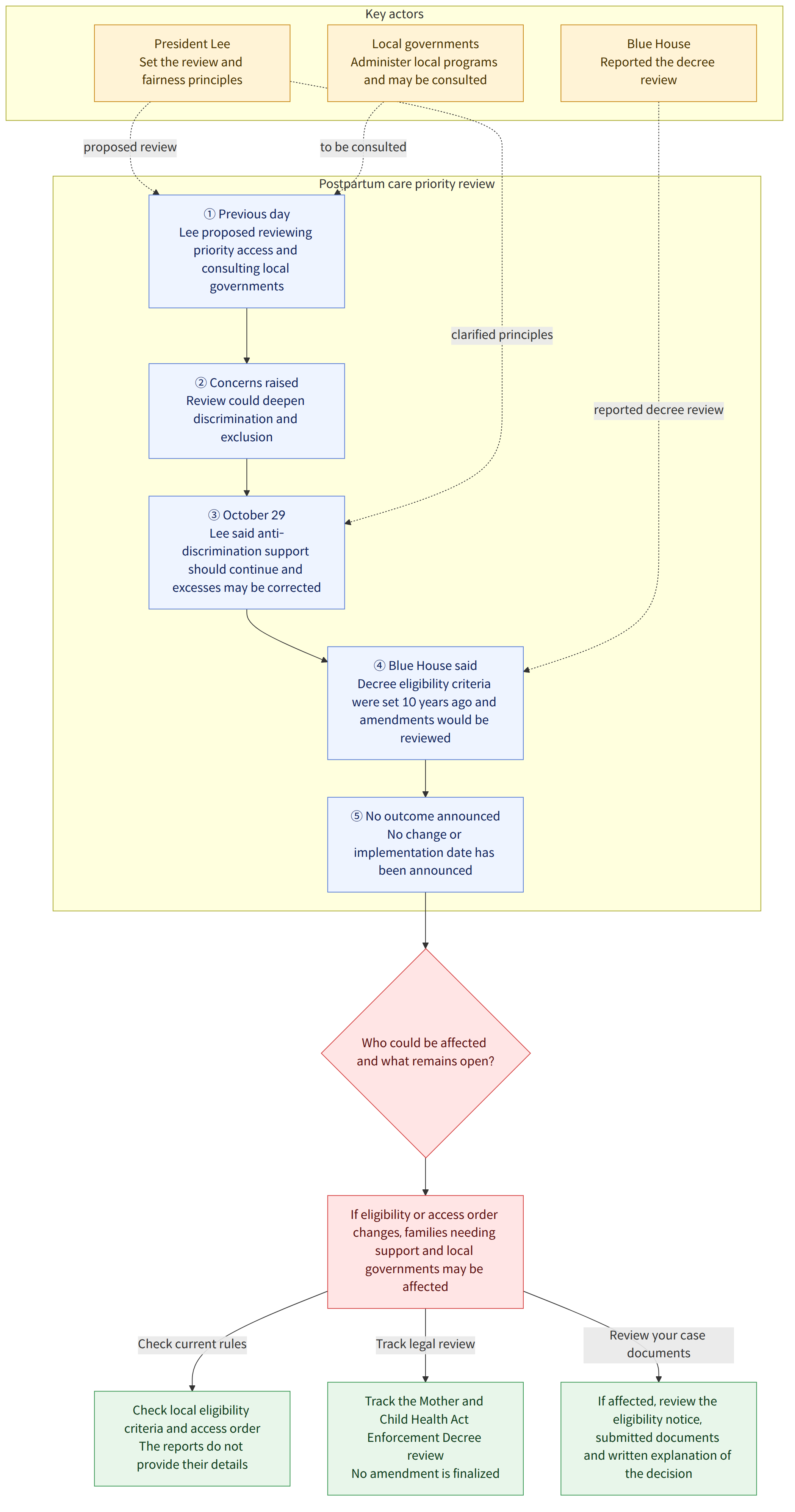
On October 29, 2026, President Lee Jae Myung wrote on X that policies to ensure multicultural families are not discriminated against compared with Korean families are necessary and should continue. At the same time, he said some policies should not stray from their original purpose and become excessive preferential treatment or lead to reverse discrimination against Korean families. He was reiterating his position, following the previous day’s proposal to review preferential access to postpartum care centers for multicultural families, that both the need for support and the fairness of the policy should be considered.
Background and context
The previous day, Lee shared a post on FM Korea (에펨코리아), a conservative online community, about preferential access to postpartum care centers for multicultural families. He wrote that he would consult local governments on whether the policy was necessary or should be abolished, and review it, including possible amendments to the enforcement decree. After concerns were raised that this could intensify discrimination and exclusion of socially disadvantaged groups, the president explained the next day that the purpose of support was to make up for shortfalls and restore equality.
The president set out two principles. Support to ensure that multicultural families are not discriminated against should continue, but if a specific policy goes beyond its intended purpose and becomes unjustified preferential treatment, it should be possible to correct it. He said excesses in policy should be rectified promptly if identified, regardless of who raised the issue. This can be read as a position that does not deny the need for support while proposing a fresh review of how individual policies are designed and applied.
Questions were also raised about whether it is appropriate to speak of “multicultural families” and “Korean families” as opposing categories. Ahn Geon-su, director of the Migrant Workers’ Human Rights Center (이주민노동인권센터), said the policy supports not migrants, but the children of people who came to Korea through marriage—that is, Korean citizens. The issue highlights the importance, in policy discussions, of how the beneficiaries of a program are defined and what purpose the support is intended to serve.
What this means
If the way people qualify for postpartum care center support or the order of access changes, it could affect families who need the support and local governments that administer the policy. However, the reports so far do not establish that any changes have actually been decided. A review and the possibility of amending the enforcement decree have been mentioned, but no outcome or implementation date has been announced.
To assess whether a policy is fair, it is necessary to consider not only “who receives preferential treatment,” but also what shortfall the support is intended to address and whether the criteria for setting priorities serve that purpose. Lee explained that the goal of supporting socially disadvantaged groups is to make up for what they lack relative to the average and restore equality. If discussions move forward, the issue may therefore be how to assess both the purpose of the support and the reasonableness of access priorities, rather than treating the question as a binary choice between retaining and abolishing the support.
For example, if a family wants to find out whether it qualifies for priority access to a postpartum care center, it first needs to know the current eligibility criteria and order of access to judge what changes might actually affect it. However, the reports do not provide the details of the current criteria, so it is not possible to say here whether a particular family qualifies.
If the issues discussed under “What this means” apply to your situation, attorney Ji-sun Ahn of Ijun Law Firm can review the local program’s eligibility notice, the documents you submitted, and any written explanation of the decision with you to help clarify your options.
Related policies and support information
According to reports, the Blue House said the criteria in the Enforcement Decree of the Mother and Child Health Act (모자보건법 시행령), which defines the groups eligible for priority access to postpartum care centers, were established 10 years ago, and said it would review amendments to the decree. The direction outlined by the Blue House is to ensure that priority access to postpartum care centers benefits mothers who need it most. This was reported as a plan to review the policy, not as a finalized amendment.
The Hankyoreh (한겨레) reported that the Blue House initially said in a media notice that the gist of the president’s remarks was to “review whether there are aspects that amount to reverse discrimination,” but later removed the term “reverse discrimination” and revised its explanation to say he had raised the need to improve the support system by making priority access to postpartum care centers fairer and more reasonable. Therefore, what readers can confirm at this stage is that a review of the criteria and possible amendments to the enforcement decree have been mentioned; it has not been confirmed whether any amendments will be made or what new eligibility criteria or priorities might be.
Differences in how reports covered the issue
The reports agree that the president acknowledged the need to support multicultural families while warning against excesses in some policies. However, they differ in how they discuss the Blue House’s explanation and the background to the policy review.
The Hankyoreh highlighted that the Blue House removed the term “reverse discrimination” from its notice and revised its explanation to focus on making priority access to postpartum care centers fairer and more reasonable. The Chosun Ilbo (조선일보) gave specific details of the Blue House’s explanation that the criteria in the Enforcement Decree of the Mother and Child Health Act were established 10 years ago, and of its review of amendments to the decree defining the groups eligible for priority access to postpartum care centers. The two reports can be seen as placing different emphasis on the wording changes in the Blue House’s notice and the background to the policy review, rather than presenting conflicting facts.
What is confirmed and what remains unknown
Confirmed facts
- Lee said policies to ensure that multicultural families are not discriminated against are necessary and should continue.
- He said some policies should not become excessive preferential treatment or amount to reverse discrimination against Korean families.
- Regarding preferential access to postpartum care centers for multicultural families, the president mentioned a review that would include consultation with local governments and possible amendments to the enforcement decree.
- The Blue House said the criteria in the Enforcement Decree of the Mother and Child Health Act, which defines the groups eligible for priority access to postpartum care centers, were established 10 years ago, and announced that it would review amendments.
What remains unknown
- What are the specific eligibility criteria and priorities for preferential access to postpartum care centers for multicultural families?
- Will consultation with local governments or a review of amendments to the enforcement decree lead to actual policy changes, and what is the timeline?
- If eligibility or priority rules change, how will the changes apply to families already receiving support?
What readers should check
- Families seeking support for priority access to postpartum care centers should check with their local government about the eligibility criteria and order of access currently in effect in their area. The reports do not provide the detailed criteria.
- Rather than assuming that amendments to the enforcement decree have been finalized, readers should check whether consultations with local governments and the review of amendments lead to actual changes. The reports so far have only described a plan to review the policy and have not announced a timeline or finalized details.
- Since the term “reverse discrimination” was removed from the relevant notice and an explanation referring to “fairness and reasonableness” was provided, readers should look beyond the policy’s label or the controversy surrounding it and check whether the purpose of the support and the criteria for its actual application are disclosed together.
References
- Other coverage consulted: chosun.com
- Other coverage consulted: en.yna.co.kr

















