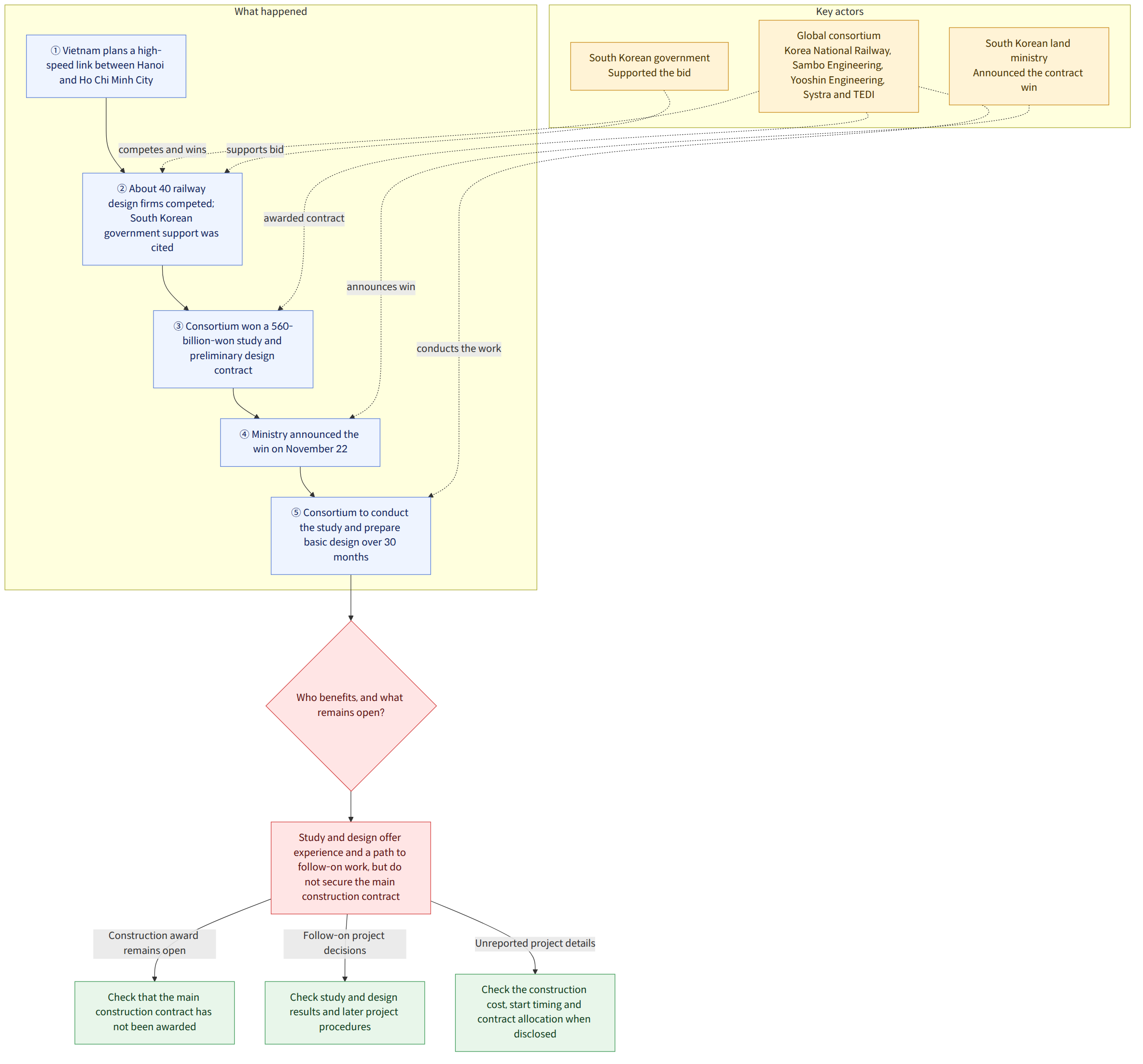
A global consortium involving South Korean companies and institutions has won a 560-billion-won contract to conduct a feasibility study and preliminary basic services for Vietnam’s North–South High-Speed Railway. The Ministry of Land, Infrastructure and Transport (국토교통부) announced on November 22 that the consortium had won the contract the previous day. It is the largest contract South Korea has secured in overseas railway planning and design.
The project involves building a high-speed railway linking the capital, Hanoi, with Ho Chi Minh City, the economic center of the south. The target maximum speed is 350 km/h. Over the next 30 months, the consortium will conduct a feasibility study (an assessment of a project’s need and viability) and prepare the project’s basic design.
Background and context
The consortium includes Korea National Railway (한국철도공단), Sambo Engineering (삼보기술단), Yooshin Engineering (유신엔지니어링), France’s Systra and Vietnam’s TEDI. The work on the project’s initial stage has been awarded not to South Korean companies alone, but to a consortium formed by institutions and companies from several countries.
Around 40 railway design companies from around the world competed for the contract. The Ministry of Land, Infrastructure and Transport cited sustained, comprehensive support from the South Korean government—including summit diplomacy, a personal letter from the president and meetings at ministerial and vice-ministerial levels—as factors in the successful bid.
However, the only work confirmed so far is the feasibility study and preliminary basic services. Winning this contract does not mean that South Korean companies or the consortium have secured the main railway construction contract. The stage of assessing the project’s feasibility and preparing its design must be distinguished from the stage of actually building the railway.
What this news means
For South Korean companies, participating in the initial stage of a major railway project in Vietnam offers an opportunity to gain experience in project assessment and basic design and to demonstrate their competitiveness in subsequent projects. Hong Ji-seon, the minister of land, infrastructure and transport, said the ministry would actively support South Korean companies in demonstrating their competitiveness in follow-on projects, including the main construction work, building on the successful completion of this project. This indicates an intention to support participation in subsequent projects, but it does not guarantee that the companies will win the main construction contract.
For Vietnam, the study and design work will help develop its plans for a high-speed railway linking Hanoi and Ho Chi Minh City. However, this announcement alone does not reveal how or when the project will proceed after the 30 months of work, or which companies will take part in the main construction.
For example, if a South Korean railway company considers participating in a follow-on project, it should assess the opportunity based on the results of the study and design and the subsequent project procedures, rather than on the contract award alone. The contract could pave the way for follow-on work, but it is important to note that it does not confirm participation in the main construction.
What is confirmed and what is not yet known
Confirmed facts
- On November 22, the Ministry of Land, Infrastructure and Transport announced that a global consortium had won the contract the previous day.
- The contract is worth 560 billion won and covers a feasibility study and preliminary basic services for Vietnam’s North–South High-Speed Railway.
- The consortium consists of Korea National Railway, Sambo Engineering, Yooshin Engineering, France’s Systra and Vietnam’s TEDI.
- The consortium is expected to conduct a feasibility study and prepare the basic design over 30 months.
- The Ministry of Land, Infrastructure and Transport said the contract is the largest South Korea has secured in overseas railway planning and design.
What is not yet known
- The announcement does not state the total cost of the main North–South High-Speed Railway construction project or when construction will begin.
- It has not been confirmed how the 560-billion-won contract amount will be divided among the consortium members.
- It is not yet known what schedule and procedures will govern the main construction after the feasibility study and basic design, or whether South Korean companies will win the construction contract.
What readers should watch for
- Those interested in participating in follow-on projects should check whether updates and results from the feasibility study and basic design are made public.
- When assessing the possibility of taking part in the main construction, it is important to distinguish this contract from an actual construction contract and to check whether the companies and procedures for subsequent projects will be determined separately.
- In addition to the contract value, readers should watch for disclosure of how the contract is divided among the participating organizations, as well as the main construction project’s cost and start date.