
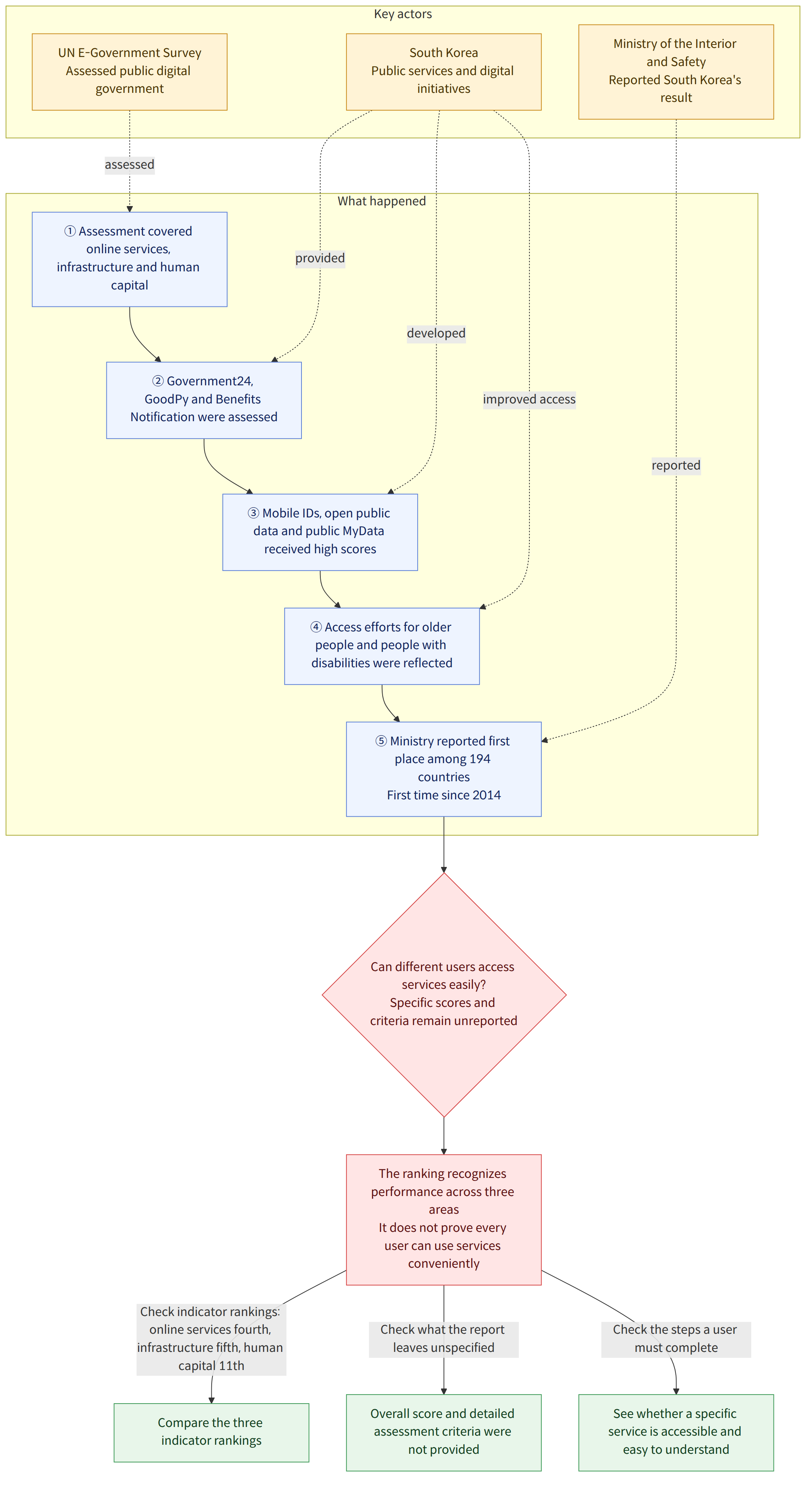
South Korea ranked first among 194 countries in the UN E-Government Survey (유엔 전자정부 조사). The Ministry of the Interior and Safety (행정안전부) said on November 20 that South Korea had ranked first for the first time since 2014. Among the three indicators used to assess e-government, it ranked fourth in online services, fifth in telecommunications infrastructure, and 11th in human capital.
The result cannot be explained by the performance of a single digital service. South Korea’s overall first-place ranking reflects an assessment of all three areas.
Background and context
A closer look at the rankings for each indicator reveals areas of strength as well as points to consider. South Korea ranked fourth in the Online Services Index, while its ranking in the Telecommunications Infrastructure Index rose one place from sixth the previous year to fifth. Its Human Capital Index ranking rose six places from the previous year to 11th.
The Ministry of the Interior and Safety said that Seoul’s AI-based public services and efforts to strengthen digital infrastructure received high marks. However, the rankings for the three indicators alone do not show how much each initiative contributed to the overall ranking. The information provided does not include South Korea’s overall score or the specific rankings of other countries in this assessment.
In the online services category, integrated services tailored to individuals’ life stages and circumstances, centered on Government24 (정부24), were evaluated positively. The assessment also included GoodPy (굿파이), a virtual assistant service for the public, and the Benefits Notification service (혜택알림 서비스).
In the telecommunications infrastructure category, initiatives such as mobile ID cards, open public data, and the integration of information through the public MyData system (공공 마이데이터 시스템) received high scores. The article states that efforts to make public services easier to access for digitally vulnerable groups, including older people and people with disabilities, produced visible results in the human capital category. The ranking therefore indicates that the assessment considered not only the expansion of digital infrastructure but also the conditions that enable people to use services built on it.
What this news means
The first-place finish in an international assessment is significant because South Korea’s digitalization of public services was evaluated across online services, telecommunications infrastructure, and the conditions for using those services. Initiatives such as Government24’s customized integrated services and mobile ID cards relate to how people find and use public services. Since improvements in access for vulnerable groups were also reflected in the assessment, the performance of digital public services may depend not only on whether services are offered, but also on whether different people can actually use them.
However, the first-place result alone does not establish that every user can access services conveniently. The rankings differ across indicators, and specific scores and detailed assessment criteria were not provided. In particular, the 11th-place ranking in the Human Capital Index shows that this area’s performance needs to be considered separately from the overall ranking. This does not necessarily mean that improvement efforts have been inadequate, but it does suggest that the overall ranking alone cannot fully explain users’ experiences.
For example, if an older person or a person with a disability is trying to use a public service online, the fact that the assessment noted efforts to improve access for vulnerable groups can be viewed positively. However, whether a particular user can access the service they need and whether the process is easy to understand must be checked through the specific steps involved in using each service. International rankings and individual user experiences are related, but they do not answer the same question.
What is confirmed and what remains unknown
Confirmed facts
- South Korea ranked first among 194 countries in the UN E-Government Survey (유엔 전자정부 조사).
- The Ministry of the Interior and Safety (행정안전부) said on November 20 that South Korea had ranked first for the first time since 2014.
- South Korea ranked fourth in the Online Services Index, fifth in the Telecommunications Infrastructure Index, and 11th in the Human Capital Index.
- The assessment included customized services centered on Government24 (정부24), GoodPy (굿파이), the Benefits Notification service (혜택알림 서비스), mobile ID cards, and public MyData (공공 마이데이터).
- The article states that efforts to improve access to public services for digitally vulnerable groups, including older people and people with disabilities, produced results in the human capital category.
What remains unknown
- South Korea’s overall score and the rankings of countries in second place and below were not provided.
- The assessment scores for each indicator and the detailed scoring criteria have not been confirmed.
- It is not known how much each initiative mentioned in the article contributed to the assessment results.
What readers should check
- To better understand the significance of the e-government ranking, readers should check whether overall scores, country rankings, indicator scores, and assessment criteria have been published.
- When using public services, readers can check whether services such as Government24 (정부24) offer integrated services or benefits notifications suited to their circumstances.
- If a service is difficult to use, readers should check whether information about support they need is available in connection with improvements to online-service accessibility, and review the service’s procedures and scope.