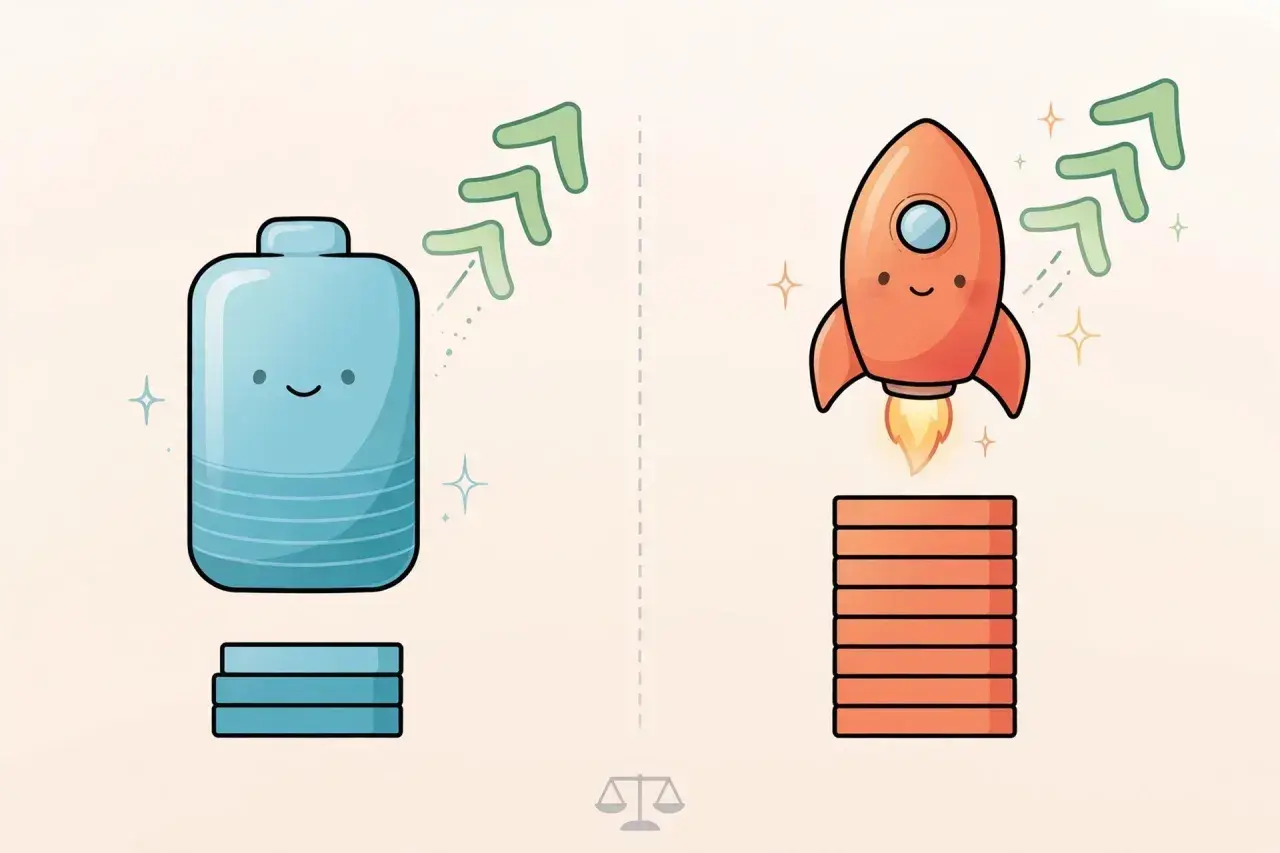
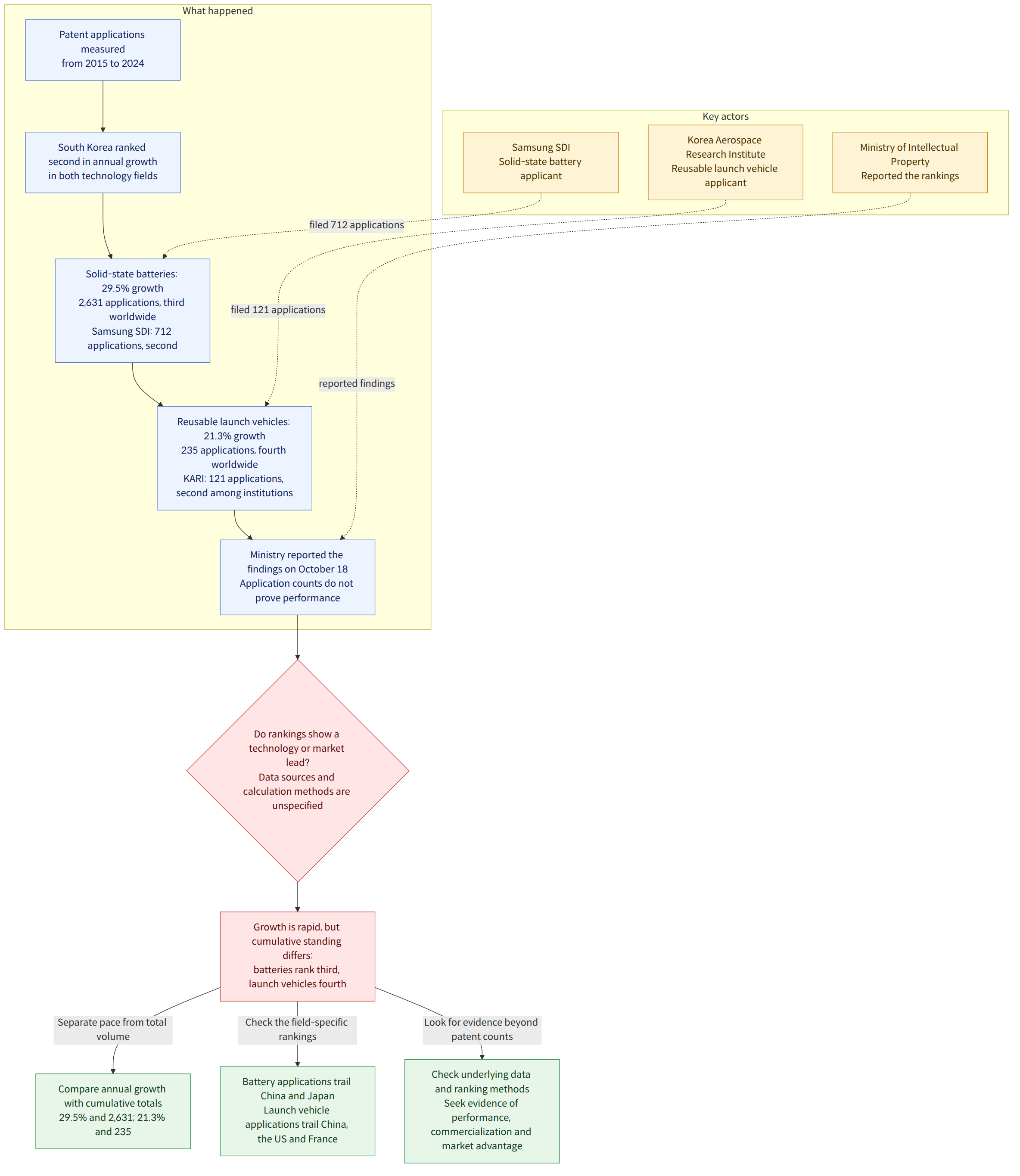
The Ministry of Intellectual Property (지식재산처) said on October 18 that South Korea ranked second worldwide in the average annual growth rate of patent applications for solid-state batteries and reusable launch vehicles from 2015 to 2024. However, South Korea ranked third in cumulative applications for solid-state batteries and fourth for reusable launch vehicles. The rankings show both that patenting activity in these fields is growing rapidly in South Korea and that the total number of applications filed to date differs between the fields.
Background and context
Solid-state batteries were described as next-generation batteries that replace flammable liquid electrolytes with solid electrolytes. According to the article, the aim of this change is to reduce the risk of fires and explosions and significantly extend the driving range of electric vehicles. Patent applications in this area can therefore serve as one indicator of research and efforts to secure intellectual property rights in battery technology.
South Korea has filed a cumulative total of 2,631 solid-state battery patent applications, ranking third worldwide after China and Japan. Its average annual growth rate was 29.5%, the second-highest after China. By applicant, Samsung SDI ranked second with 712 applications, and LG Energy Solution ranked third with 525. Samsung Electronics ranked fifth with 327, and Hyundai Motor ranked sixth with 284.
Reusable launch vehicle technology refers to technology for using a launch vehicle again. The article says that the technology could help usher in an era of privately led space exploration by lowering launch costs. South Korea has filed 235 applications cumulatively, ranking fourth after China, the United States and France. Its average annual growth rate, however, was 21.3%, the second-highest worldwide and higher than that of the United States. The Korea Aerospace Research Institute ranked second worldwide among institutions, with 121 applications.
What this news means
Ranking second in growth rate in both fields means that related patent applications have increased rapidly in South Korea. But the growth rate measures the pace of change over a period, while the cumulative number of applications shows how many have been filed over time. Solid-state batteries rank third in cumulative applications, whereas reusable launch vehicles rank fourth. The second-place growth-rate ranking should not be taken to mean that the two fields have the same overall level of competitiveness.
Patent application counts show efforts to secure rights related to a technology, but by themselves they do not establish technological performance, the degree to which products have been commercialized, or market advantage. It is therefore more appropriate to read these rankings as an indication of the direction and pace of growth in South Korea’s technology activity. Il-gyu Kim, director general of the Intellectual Property Policy Bureau (지식재산정책국) at the Ministry of Intellectual Property, said that patent competitiveness in key technologies such as solid-state batteries is directly linked to a country’s future industrial leadership, and that the ministry would provide researchers with timely patent analysis materials.
For example, a researcher reviewing patent application rankings in the solid-state battery field could consider not only South Korea’s 29.5% growth rate but also its cumulative total of 2,631 applications and its position behind China and Japan. Such a comparison shows that growth rate and cumulative volume provide different information, but does not, by itself, establish which country has superior technology.
What is known and what remains unclear
Confirmed facts
- From 2015 to 2024, South Korea ranked second worldwide in the average annual growth rate of patent applications for both solid-state batteries and reusable launch vehicles.
- South Korea had 2,631 cumulative solid-state battery applications, ranking third, and an average annual growth rate of 29.5%, ranking second.
- South Korea had 235 cumulative reusable launch vehicle applications, ranking fourth, and an average annual growth rate of 21.3%, ranking second.
- Samsung SDI ranked second among solid-state battery applicants, with 712 applications, and the Korea Aerospace Research Institute ranked second among institutions in reusable launch vehicle applications, with 121.
What remains unclear
- The original article does not specify which data were used to compile patent applications by country or how the rankings were calculated.
- It does not provide the difference between South Korea’s and China’s average annual growth rates for solid-state battery patents.
- Application counts alone cannot establish the performance of each technology, the extent to which products have actually been commercialized, or market outcomes.
What readers should check
- When reviewing patent rankings, distinguish cumulative application counts from average annual growth rates. The two indicators convey different information.
- When comparing the rankings of companies or research institutions, check whether the data cover the same field and period. The period cited in this report is 2015–2024.
- Do not equate patent application rankings with technological or market performance; check whether there is separate evidence about the performance of relevant products or whether they have been commercialized.