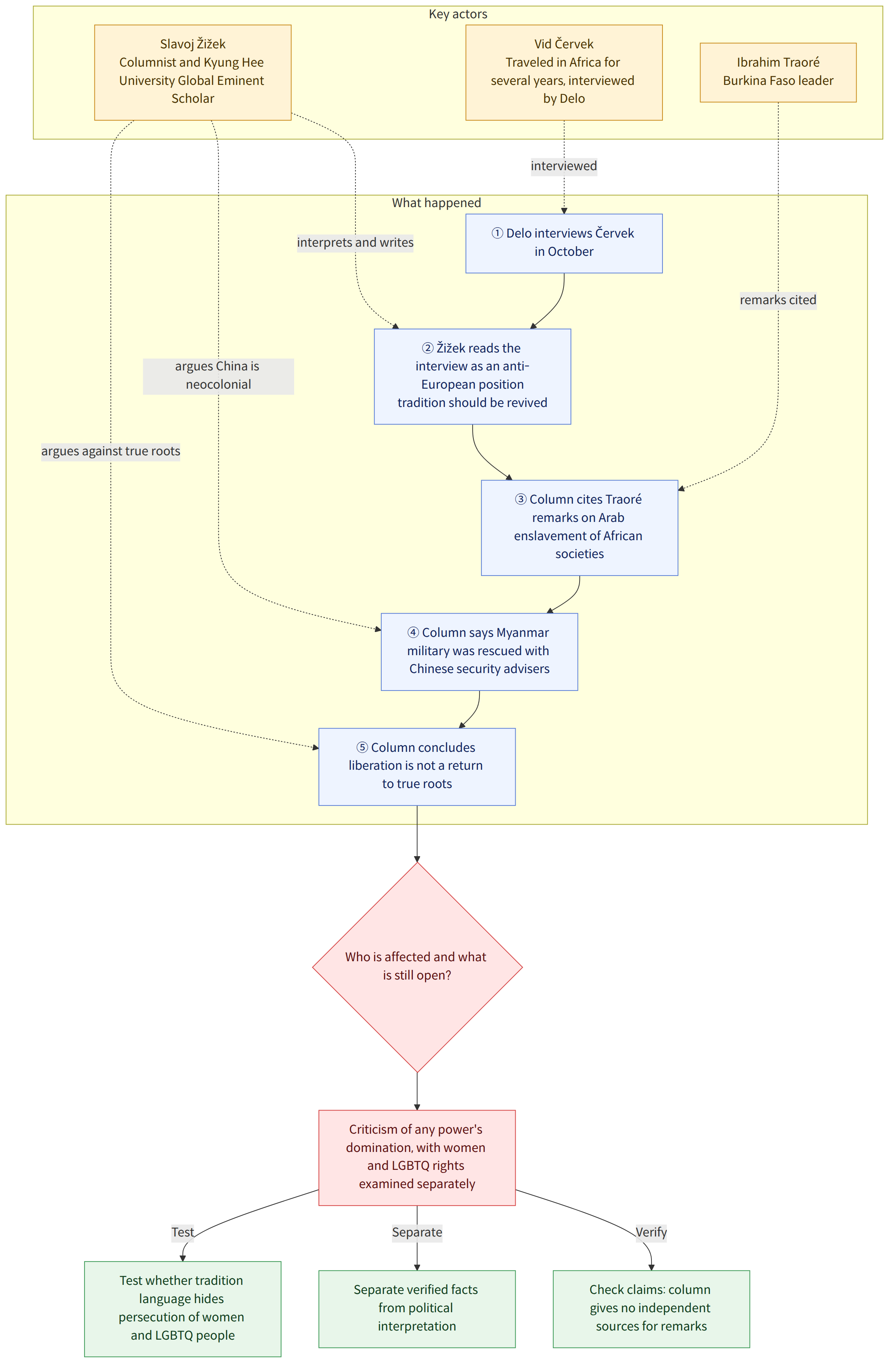
In his column, Slavoj Žižek, a Kyung Hee University Global Eminent Scholar (경희대 글로벌 석학), questions the view that links anti-colonialism with the restoration of tradition. He argues that African independence requires correcting the historical record and that, even while criticizing Western colonialism, people should not ignore violence by other powers or discrimination within cultures. The column’s central questions are whether opposing colonialism necessarily means restoring traditional ways of life, and how liberation can be considered alongside universal rights.
Background and context
The column says that the Slovenian daily Delo (델로) interviewed Vid Červek, who had traveled in Africa for several years, in October. Žižek interprets the interview as reflecting an anti-European position widespread among African intellectuals and political elites. According to the explanation he offers, this position centers on the idea that Western democracy and individualism have damaged Africa’s plural social relationships and traditional ways of life, and that tradition should therefore be revived rather than following European-style modernization.
After referring to the usual focus on the transatlantic slave trade conducted by Western empires, the column cites remarks by Burkina Faso leader Ibrahim Traoré to the effect that the history of Arab powers enslaving African societies for centuries should also be discussed openly. However, the evidence provided does not include sources that independently verify the remarks or the historical interpretation presented in the column.
This passage is also a starting point for understanding Žižek’s argument. He believes that if anti-colonialism confines itself to holding the West accountable while leaving domination or violence by other powers uncriticized, it is difficult to address history in full. The column can therefore be read not as denying Western colonialism or absolving it of responsibility, but as arguing that the same standards of criticism should be applied to other powers.
What this means
Žižek also questions the view that China’s economic activity in Africa is simply a different and better alternative to Western colonialism. The column argues that a neocolonialism lies behind the positive image of China building roads and railways and respecting local customs. It then says that Myanmar’s military regime was rescued during protests with the help of Chinese security advisers, and that China gained freedom to develop resources. These, too, are claims made by the column.
The question this argument poses for readers is whether a country’s influence can be placed on the side of liberation simply because it is anti-Western. According to the column’s reasoning, criticizing Western domination and scrutinizing China’s economic and political influence are not mutually exclusive choices. However, the column does not provide independent sources to support this assessment, so it is important to distinguish between verifying specific facts and evaluating political interpretations.
Žižek applies the same issue to debates over rights related to gender and sexual orientation. He acknowledges the criticism that Western feminism and individual rights can sometimes be used as tools of neocolonialism. At the same time, he argues that the Western left should not accept a “strategic compromise” that tolerates the persecution of women and LGBTQ people in the name of anti-imperialism. He also sees a risk that multicultural anti-colonialism can obscure conflicts within cultures and justify violence, sexism, and racism as expressions of a particular culture.
Imagine, for example, a political movement that criticizes outside interference while also claiming that the persecution of women or LGBTQ people is part of its tradition. From the column’s perspective, criticism of outside interference alone cannot justify that persecution; the two issues must be examined separately. This is not a call to reject all tradition, but rather to consider whether the language of tradition or culture is being used to conceal conflicts and harms within it.
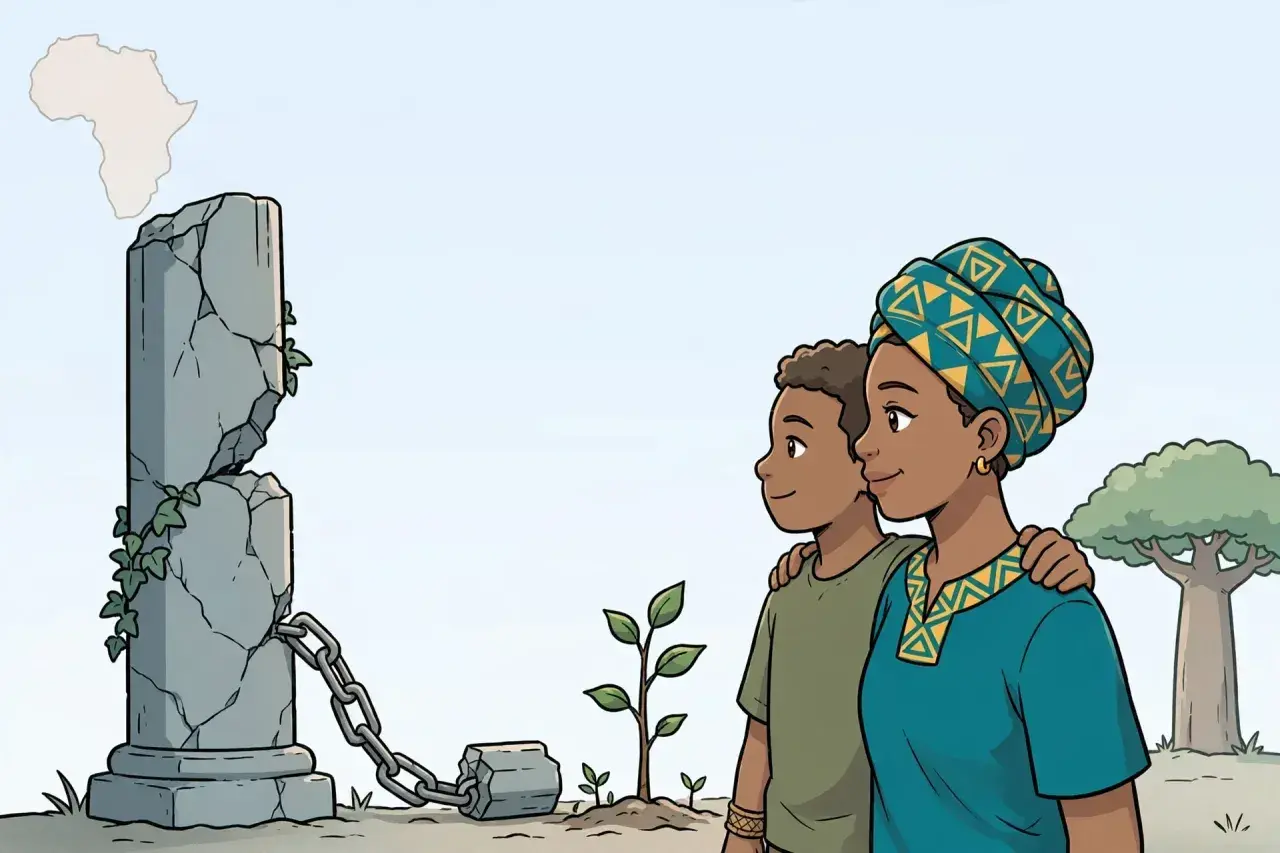
The column’s conclusion is that liberation should not be equated with returning to one’s “true roots.” Drawing on Marx’s account of capitalism breaking down local and national isolation and creating an interdependent world, Žižek says the path to liberation lies in confronting the reality of capitalism destroying roots. His challenge can therefore be summed up not as a call to choose between anti-colonialism and universal rights, but as an argument for criticizing domination by any power while considering how different struggles for liberation are connected.
What is confirmed and what remains unknown
What is confirmed
- The column was written by Slavoj Žižek, who is identified as a Kyung Hee University Global Eminent Scholar (경희대 글로벌 석학).
- The column reports that Delo (델로) interviewed Vid Červek, who had traveled in Africa for several years, in October.
- Žižek argued that the historical record must be corrected for Africa to achieve genuine independence.
- He questioned the view that China’s economic activity in Africa is simply an alternative to Western colonialism and criticized anti-imperialist compromises that tolerate the persecution of women and LGBTQ people.
What remains unknown
- What evidence supports the column’s view that it represents the positions of African intellectuals and political elites?
- What independent sources verify Traoré’s remarks and the account concerning Myanmar’s military regime?
- What objections have been raised to the column’s interpretation of African history and society?
What readers can check
- When citing the column’s argument, readers can distinguish Žižek’s interpretation from independently verified facts.
- Readers can bear in mind that the remarks by Traoré and the account concerning Myanmar are claims made by the column, and check whether independent sources are available to verify them.
- When a statement refers to African societies or an entire culture, readers can examine what evidence the column offers for claiming that the view is representative.