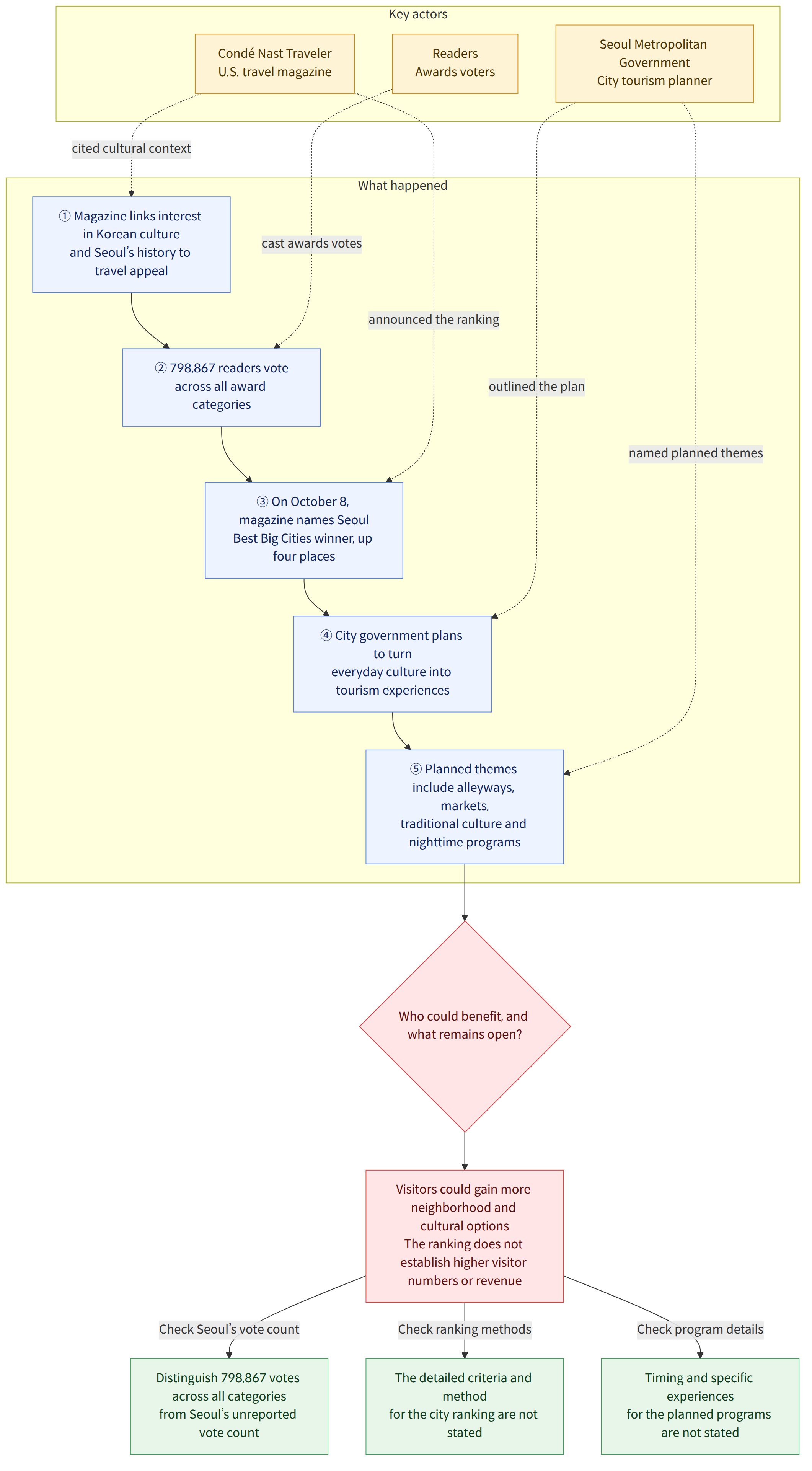
Seoul took first place in the “Best Big Cities” category of the Readers’ Choice Awards (리더스 초이스 어워즈), announced on October 8 by the U.S. travel magazine Condé Nast Traveler. It moved up four places from fifth last year. The Seoul Metropolitan Government said Seoul received the honor in the reader-voted awards from the New York-based magazine.
Tokyo ranked second this year, followed by Phnom Penh, Cambodia, in third, Shanghai in fourth, and Sydney in fifth. A total of 798,867 readers voted across all categories, including cities, hotels, and resorts. That figure represents participation across the awards as a whole; it does not indicate Seoul’s vote count or the number of votes cast in the city category.
Background and context
The recognition comes as Seoul’s image as a travel destination expands alongside interest in South Korean popular culture. Condé Nast Traveler said global interest in South Korea’s cultural and physical exports, including K-pop, K-beauty, and K-dramas, has helped make Seoul a popular vacation destination. It also highlighted the city’s complex history, which spans more than 2,000 years.
The magazine described Seoul as a global center for beauty, wellness (a field focused on health and balance in everyday life), art, and cuisine, as well as a capital with something for a wide range of travelers. The assessment presents Seoul’s appeal as encompassing experiences across multiple fields, rather than being limited to any one cultural phenomenon.
Interest in Seoul has not been reflected only in this ranking. In August, Seoul was named the “world’s most preferred city among global millennials and Gen Z” in a survey by U.S. travel outlet Trazy Travel (트라지 트래블). Last month, British culture and travel website Time Out named the Jongno 3-ga area of Seoul one of its “coolest neighborhoods in the world” this year. These selections, however, come from different outlets and surveys, so they should not be interpreted as rankings measured using the same criteria.
What this news means
First place in a reader poll can be seen as a sign that Seoul is attracting attention as a travel destination. However, the ranking alone does not establish that visitor numbers or tourism revenue have increased. The number of participants covers all award categories, and published evidence does not show how many votes Seoul received or how the city category was tallied.
The plan announced by the Seoul Metropolitan Government focuses on turning this interest into real experiences in the city. It aims to diversify tourism offerings by drawing on elements of everyday life, such as alleyways, markets, food experiences, and cultural spaces, and to showcase experiences unique to Seoul, including traditional culture activities and nighttime programs. Visitors could have more opportunities to experience neighborhood life and cultural spaces, in addition to well-known attractions. For the city government, the challenge may be to turn cultural interest into tangible tourism content.
For example, if travelers visiting Seoul want itineraries that include markets, alleyways, and cultural spaces rather than only major tourist attractions, the city’s planned diversification of offerings could provide those options. However, the available information does not say when any programs will begin or what experiences they will offer in practice.
The 798,867 figure is the number of people who voted across all award categories. It has not been confirmed how many votes Seoul received or what share of the city-category vote it accounted for.
Confirmed facts and what remains unknown
Confirmed facts
- Seoul was named first in Condé Nast Traveler’s “Best Big Cities” category, climbing four places from fifth last year.
- A total of 798,867 readers voted across all award categories this year.
- The magazine cited both interest in South Korea’s cultural and physical exports and Seoul’s long history.
- The Seoul Metropolitan Government plans to use alleyways, markets, food, cultural spaces, traditional culture activities, and nighttime programs as tourism resources.
What remains unknown
- How many votes did Seoul receive, and what share of the total city-category vote did it represent?
- What detailed criteria and methods were used to calculate the “Best Big Cities” ranking?
- What are the schedule and specific details of the tourism programs the Seoul Metropolitan Government plans to introduce?
What readers should check
- When citing or comparing the ranking, distinguish the number of participants across all categories from Seoul’s individual vote count.
- Readers planning to use the Seoul Metropolitan Government’s tourism programs should check when details about the plans and their actual operating schedules and contents are made public.
- When planning a trip, checking whether alleyways, markets, cultural spaces, traditional culture activities, and nighttime programs are actually available can help distinguish between plans and experiences visitors can access.