
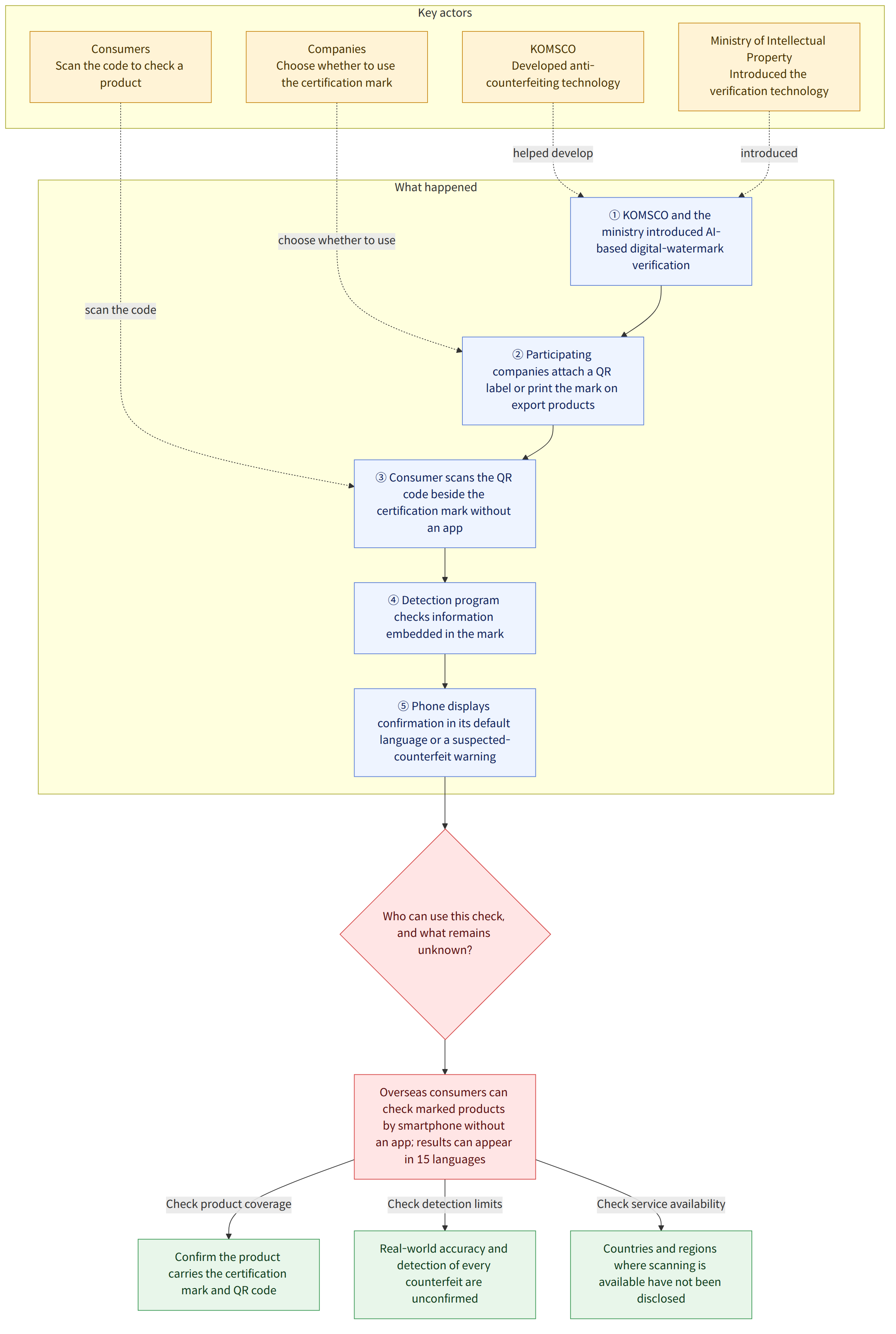
The Korea Minting and Security Printing Corporation (한국조폐공사; KOMSCO) and the Ministry of Intellectual Property (지식재산처) introduced artificial intelligence (AI)-based authenticity verification technology using digital watermarks on October 10. For products covered by the K-Brand Government Certification System (K-브랜드 정부인증제도), consumers can start the verification process by scanning, with a smartphone, the QR code next to the certification mark. A key feature is that consumers can check whether a product is genuine without installing a separate app.
If the product is verified as genuine, a confirmation message appears in the language set as the smartphone’s default. The message is available in 15 languages, including Korean, English, Chinese and Japanese. If the product is suspected of being counterfeit, including because its certification mark has been copied, a “Suspected counterfeit” warning appears on the smartphone screen.
Background and context
The technology is based on a digital watermark applied to the certification mark. A digital watermark embeds invisible information in an irregular shape or pattern, which a smartphone camera can read and verify. The national certification mark uses anti-counterfeiting technology developed by KOMSCO.
Consumers scan the QR code next to the certification mark. The QR code activates a digital-watermark detection program, which checks the information embedded in the mark and displays the result on the screen. The system is therefore designed to do more than let consumers visually inspect a product’s exterior: it lets them use a smartphone to check the information contained in the mark.
However, use of the technology is conditional. Companies in Korea can choose whether to use the certification mark. Companies that opt to use it can attach a label with a QR code to their products or print the mark directly on products intended for export. The verification method is not automatically applied to every product made in Korea.
What this means
The process of verifying a product’s authenticity could become more convenient for consumers overseas. They can scan a QR code with a smartphone without installing a separate app and see the result in their own language. A “Suspected counterfeit” warning could also inform a purchase decision, particularly when a consumer is unsure whether the certification mark on a product is genuine.
For example, an overseas consumer considering a product with a certification mark and QR code can scan the code and check whether a confirmation message or warning appears. However, the scope of the result should be kept in mind. The fact that the system provides a confirmation message means it is designed to assess a product’s authenticity, but the information provided does not establish how accurately it works in real-world settings or whether it can detect every instance of counterfeiting.
Companies can choose whether to adopt the certification mark, and the described options for those that do are to attach a label or print the mark directly on products intended for export. Conversely, there is no basis in the information provided to conclude that this QR-code and watermark verification process can be used for products that do not carry the mark. Rather than assuming that this verification feature is available simply because a product was made in Korea, consumers should check whether the product actually has a certification mark and QR code.
What has been confirmed and what remains unknown
Confirmed facts
- KOMSCO and the Ministry of Intellectual Property introduced digital-watermark-based AI technology on October 10.
- The products covered are those protected by the K-Brand Government Certification System.
- Scanning the QR code activates a digital-watermark detection program without requiring a separate app to be installed.
- The authenticity confirmation message is displayed in one of 15 languages, according to the smartphone’s default language setting; if the product is suspected of being counterfeit, a “Suspected counterfeit” warning appears.
- Companies can choose whether to use the certification mark and can attach a label or print it directly on products intended for export.
What remains unknown
- The companies and products currently using the certification mark have not been identified.
- The system’s accuracy in detecting counterfeit products in real-world settings has not been confirmed.
- The countries and regions where the smartphone scanning service is available have not been disclosed.
What readers should check
- Check whether the product you intend to buy has a national certification mark and a QR code next to it. Because companies can choose whether to use the mark, its absence alone does not establish whether a product is genuine.
- Scan the QR code and check the confirmation message or “Suspected counterfeit” warning displayed on the screen. Interpret the message only as the verification result indicated by this technology.
- If you intend to use the service overseas, you will need to check separately whether scanning works in that country or region. The information provided does not specify where the service is available.