


The Ministry of Employment and Labor (고용노동부) received 35 reports of violence against migrant workers from January to July 2026, already exceeding the 34 reports recorded for all of last year. Five violence cases during the same period were indicted, reportedly the highest number since 2021. Meanwhile, inspections of workplaces employing foreign nationals grew more slowly than the number of such workplaces, bringing prevention and on-site oversight into focus alongside the handling of reports.
Background and context
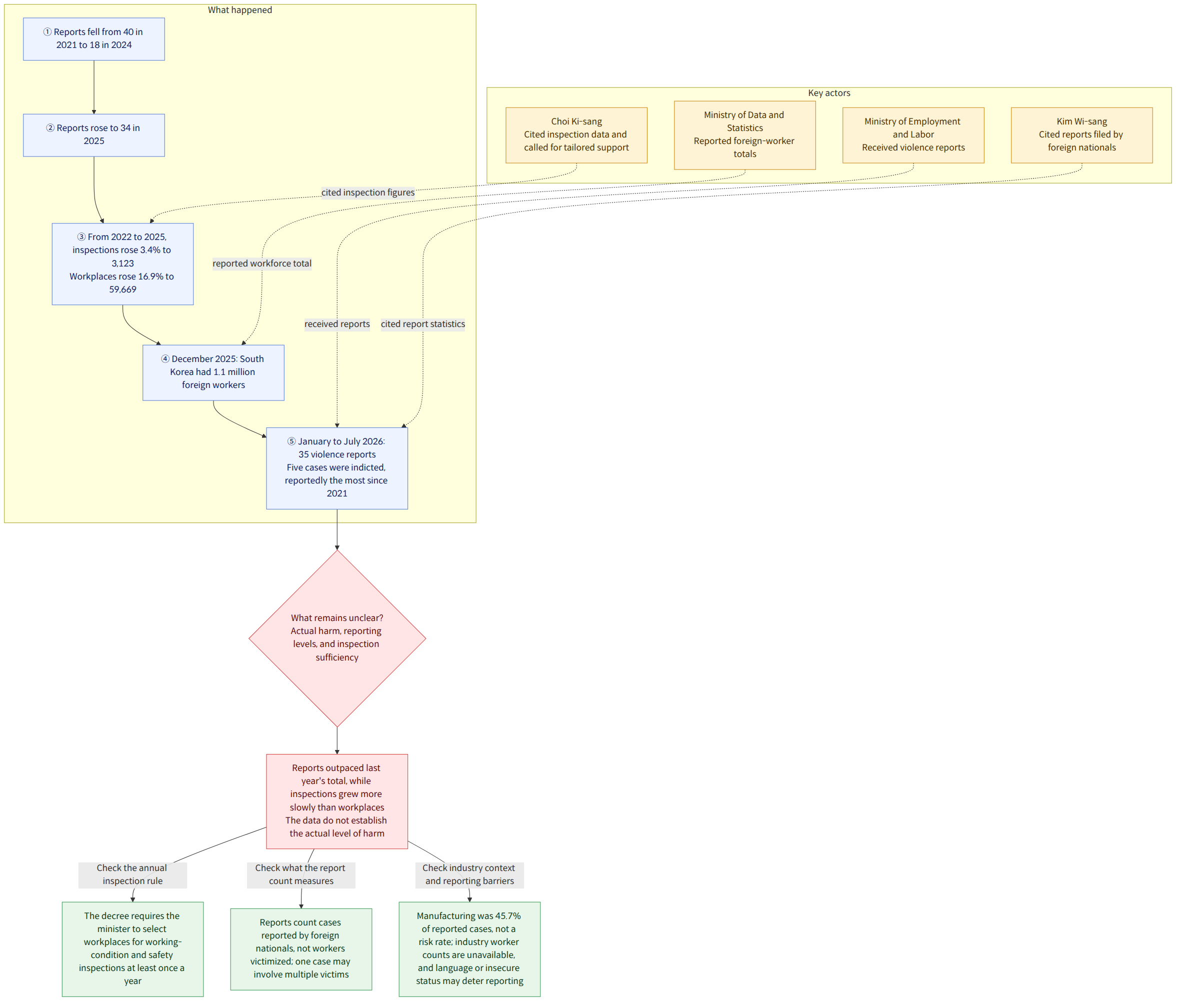
Reports of violence declined from 40 in 2021 to 18 in 2024, then rose to 34 in 2025. In 2026, reports for January through July alone exceeded the previous year's full-year total. This is a comparison of the number of reports, however, not a direct comparison of the actual rate of victimization.
By industry, manufacturing accounted for the largest share of reported cases from January to July 2026, at 45.7%. Agriculture, forestry and fishing accounted for 22.9%, and accommodation and food services for 17.1%. These percentages show how reported cases were distributed across industries. Since no denominator—the number of foreign workers or people employed in each industry—is provided, it is not possible to conclude that workers in a particular industry face a higher risk of violence than those in another.
According to the Ministry of Data and Statistics (통계데이터처), there were 1.1 million foreign workers in South Korea in December 2025. That was more than the 843,000 in 2022 and the 863,000 in 2019, before the COVID-19 pandemic. News reports said the number of foreign workers is expected to grow further as employers in manufacturing, agriculture and services struggle to recruit. As the workforce grows, the number of people who need to be covered by protective systems may also increase, making it important to consider labor supply and the management of working conditions together.
What this news means
The increase in reports leaves two possibilities open: the number of actual incidents of violence may have risen, or more reports may have been filed. The available data cannot show how much each possibility contributed. In particular, the statistics cited by lawmaker Kim Wi-sang count only cases reported by foreign nationals, and an incident may involve multiple victims. Therefore, 35 reports should not be read as 35 victimized workers. The actual number of workers affected may be higher, but the total is unknown.
Inspection and reporting statistics also point to different issues. According to lawmaker Choi Ki-sang, the number of inspections of workplaces employing foreign nationals rose by 3.4% from 2022 to 2025, reaching 3,123. Over the same period, the number of workplaces employing foreign nationals increased by 16.9%, to 59,669. The fact that the number of workplaces grew faster than the number of inspections provides grounds to examine whether the scope of preventive oversight is keeping pace with workplace growth. These figures alone, however, do not show how many times each workplace was inspected or whether inspections were sufficient.
Reports of workplace harassment also rose, from 130 in 2022 to 366 in 2025. Reports of violence and reports of harassment are separate statistics and cannot be added together to estimate the scale of harm. Lawmaker Choi Ki-sang said that small businesses may have difficulty accessing occupational safety and health experts and financial resources, and called for inspections and support tailored to workplace conditions. It was also noted that language barriers and insecure employment and immigration status may prevent workers from reporting labor-law violations or human rights abuses.
For example, suppose a foreign worker at a manufacturing workplace reports violence. The fact that manufacturing accounts for 45.7% means only that it makes up that share of reported cases; it does not tell us the worker’s probability of experiencing violence. Whether the workplace was inspected and what circumstances made reporting difficult must be established separately. Distinguishing the scope of the statistics from an individual’s circumstances is one way to avoid exaggerating or understating what the numbers show.
Relevant laws and support information
Under the Enforcement Decree of the Act on the Employment, etc. of Foreign Workers (외국인근로자의 고용 등에 관한 법률 시행령), the Minister of Employment and Labor must select workplaces employing foreign nationals for inspections of working conditions and safety at least once a year. This should be distinguished from saying that every workplace must actually be inspected every year. The obligation described in the source materials is to select workplaces for inspection; the selection criteria and actual inspection results were not provided.
When considering violence-related harm under the law, assault and injury (harm to bodily functions or health) can be distinguished. According to an in-house legal guide, assault involves applying physical force to a person, while injury means impairment of bodily functions or harm to health. Even when no visible wound is present, a person may have sustained an injury if their physiological functions were impaired—for example, if they fainted as a result of assault or threats. Conversely, an extremely minor bruise of the kind that can occur in everyday life may not be considered harm to health and could be judged as assault.
Self-defense is assessed by considering whether there was a reasonable basis for an act intended to protect one’s own or another person’s legally protected interests against an ongoing, unlawful infringement. If the force used exceeds what was necessary for the defense, excessive self-defense may be at issue, and the conclusion can vary depending on the circumstances. The number of reported cases alone therefore cannot determine the charge in an individual case or whether self-defense applies. This guide explains legal distinctions that may be relevant when reviewing violent incidents; it does not determine the outcome of any individual case.
What is confirmed and what remains unknown
Confirmed facts
- There were 35 reports of violence from January to July 2026, exceeding the 34 reports recorded for all of last year.
- As of July 2026, five violence cases had been indicted, reportedly the highest number since 2021.
- From 2022 to 2025, the number of workplaces employing foreign nationals grew by 16.9%, while the number of workplaces inspected rose by 3.4% over the same period.
- Reports of workplace harassment increased from 130 in 2022 to 366 in 2025.
- The report statistics count cases reported by foreign nationals, and an incident may involve multiple victims.
What remains unknown
- How many workers in total were actually victimized in the reported cases of violence?
- What criteria are used to select workplaces employing foreign nationals for inspection, and what were the results of inspections at individual workplaces?
- What follow-up measures does the Ministry of Employment and Labor plan to take to expand inspections or remove barriers to reporting?
- To what extent are changes in the number of reports related to changes in actual harm, as opposed to changes in access to reporting?
What readers should check
- When assessing harm from violence, it is useful to consider not only whether there are visible wounds but also whether bodily functions or health were affected. The legal guide explains that whether conduct constitutes assault or injury can depend on the severity of the harm and the circumstances.
- If there was a response or counterattack, do not assume that self-defense applies simply because both parties fought. Consider whether the infringement was ongoing, whether the act was intended as defense, and how forceful the response was.
- When checking whether a workplace was inspected, distinguish between the obligation to select workplaces for inspection and whether every workplace was actually inspected. The materials currently available do not include specific selection criteria or inspection results.
If you are dealing with a similar issue, attorney Ji-sun Ahn of Ijun Law Firm can review your employment contract, records of the incidents or complaints, and any requests for interpretation or other assistance with you. These details can help clarify which options apply to your situation.

















