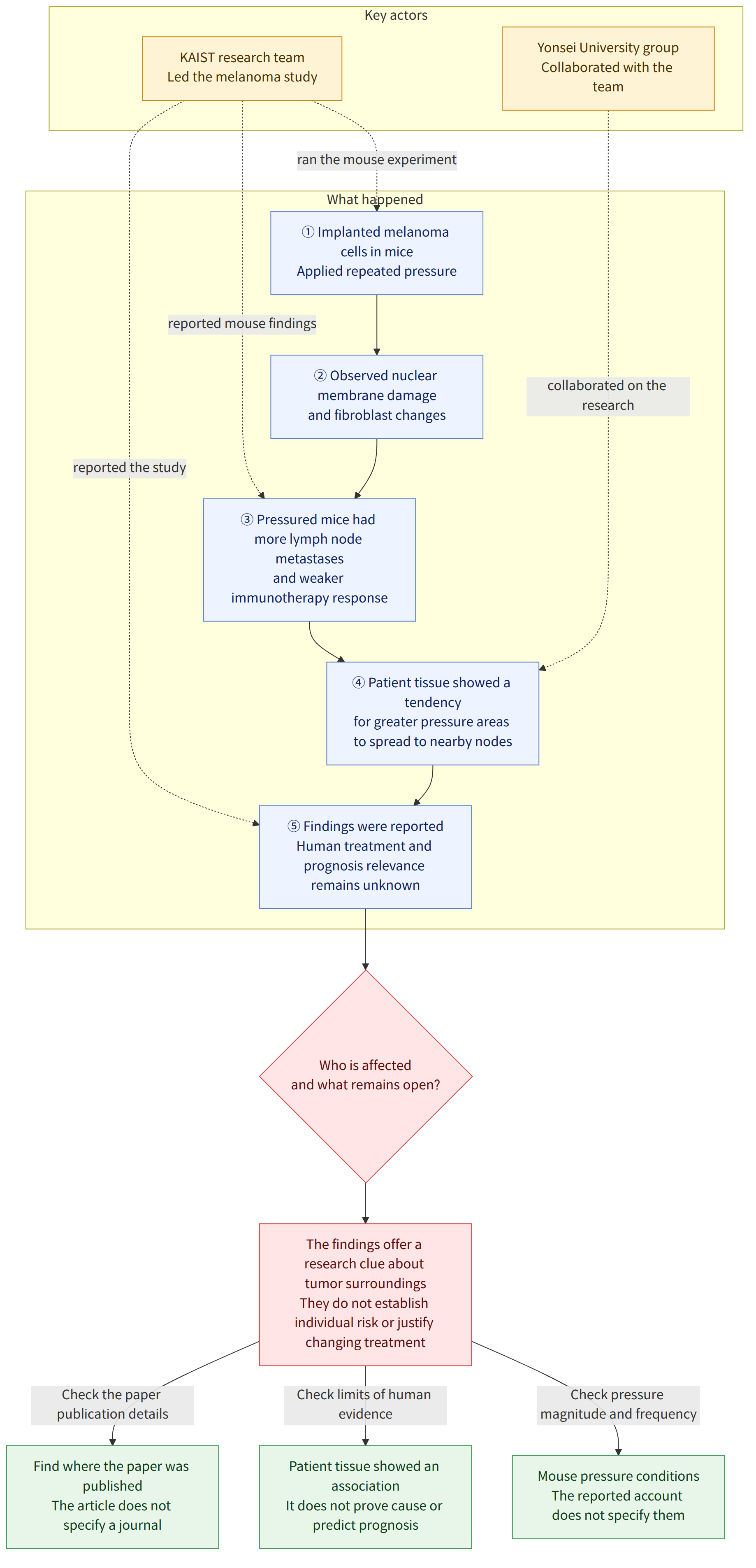
A research team at the Korea Advanced Institute of Science and Technology (한국과학기술원; KAIST) has reported findings suggesting that repeated physical pressure may affect melanoma metastasis and response to immunotherapy. On November 22, 2026, KAIST announced findings by a team led by Professor Jun Kim and Professor Jong-Eun Park of the Graduate School of Medical Science, and Professor Hyungsoon Park of the Department of Mechanical Engineering. The study was reported by Korea.net on November 23. The team collaborated with a group led by Professor Mi-Ryeong Noh of Yonsei University (연세대학교) Gangnam Severance Hospital (강남세브란스병원).
Background and context
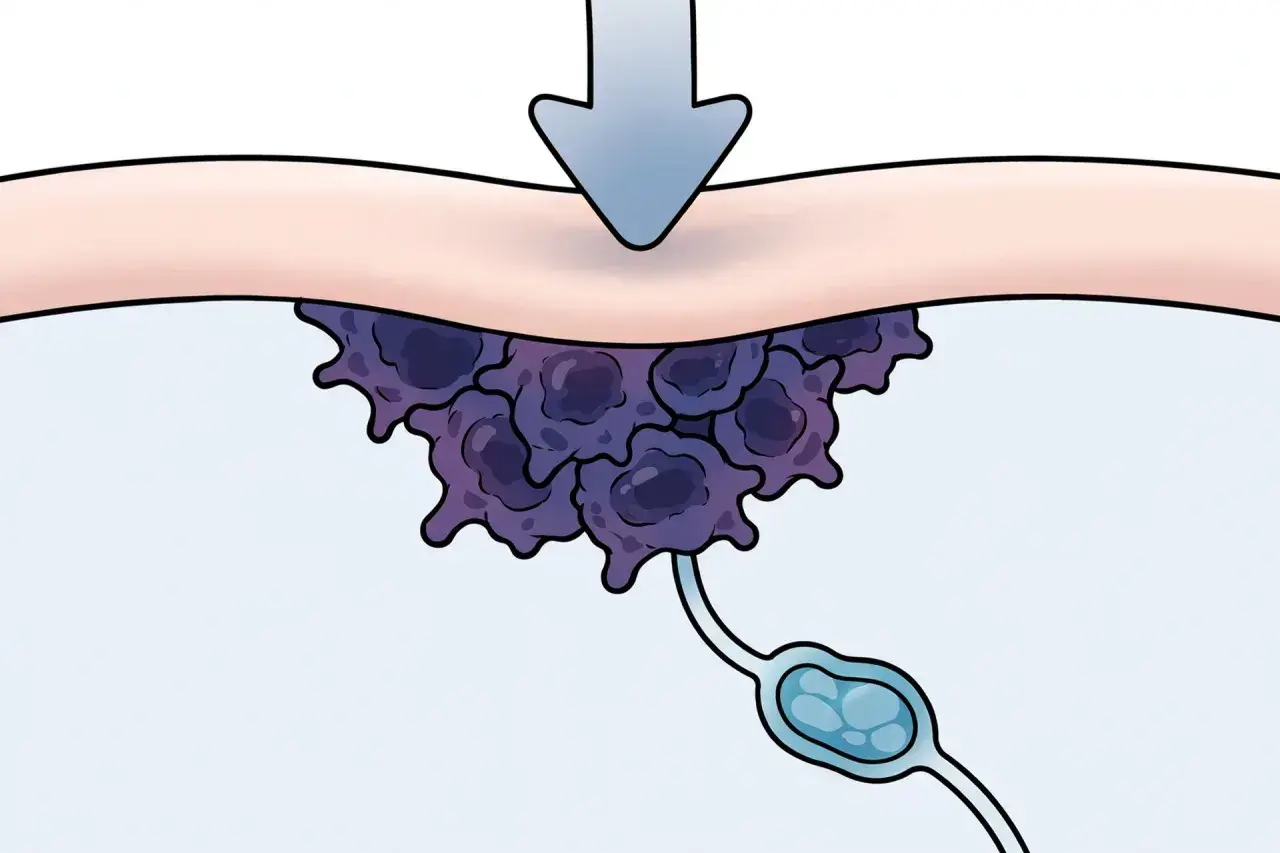
The researchers implanted melanoma cells in the feet of mice and then applied repeated pressure. In the process, they observed damage to the cancer cells’ nuclear membranes (the membranes surrounding the cell nuclei) and changes in the state of fibroblasts (cells found in tissue). They also found that myofibroblasts (fibroblasts with contractile properties) contributed to damage to the cancer cells’ nuclear membranes.
Mice exposed to pressure had more lymph node metastases (the spread of cancer cells through the lymphatic system to the lymph nodes). Their response to immunotherapy also declined. The study therefore suggests that pressure may be linked not only to cancer cells themselves, but also to their interactions with surrounding cells, metastasis and treatment response.
However, results from mouse experiments must be distinguished from treatment effects in people. The researchers also analyzed tissue samples from melanoma patients and found a tendency for tumors in areas under greater pressure to spread more readily to nearby lymph nodes. This is an association observed in human tissue, but it does not establish that pressure causes metastasis or provide a basis for directly predicting an individual patient’s prognosis.
What this news means
The significance of this finding is that it offers a clue to consider the physical environment around a tumor, as well as the characteristics of tumor cells, when studying how cancer spreads. In particular, the fact that repeated pressure, increased lymph node metastasis and a reduced response to immunotherapy were observed together in mice may be relevant to the direction of future research into treatment strategies. Professor Kim said the study would offer a clue for developing cancer treatment strategies.
However, these findings alone do not justify advising patients to avoid pressure or change their current treatment. The reported account does not specify the magnitude or frequency of the pressure used in the experiments, either. More research is needed to determine how repeated pressure affects melanoma progression or the effectiveness of immunotherapy in people.
For example, even if a melanoma patient feels repeated pressure on the tumor site, this study alone cannot establish that the pressure caused their cancer to metastasize. The findings offer a clue for investigating that possibility, but they have not been validated as a basis for determining individual risk or treatment plans.
What is known and what remains unknown
What is known
- The research team implanted melanoma cells in the feet of mice and applied repeated pressure.
- In the mice, the team observed damage to cancer-cell nuclear membranes and changes in fibroblasts, and found that myofibroblasts contributed to the membrane damage.
- Mice exposed to repeated pressure had more lymph node metastases and a reduced response to immunotherapy.
- Analysis of patient tissue samples found a tendency for tumors in areas under greater pressure to spread more readily to nearby lymph nodes.
What remains unknown
- The magnitude and frequency of the pressure applied in the mouse experiments
- How these findings might apply to melanoma treatment or prognosis in people
- Which academic journal published the research paper
What readers should check
- If you are undergoing treatment for melanoma, do not decide to avoid pressure or change your treatment based on this study alone. You can ask your healthcare provider whether the findings apply to your situation.
- When citing the findings or considering them as a basis for treatment choices, it is important to check the pressure conditions used, whether the research involved human participants, and where the paper was published.