



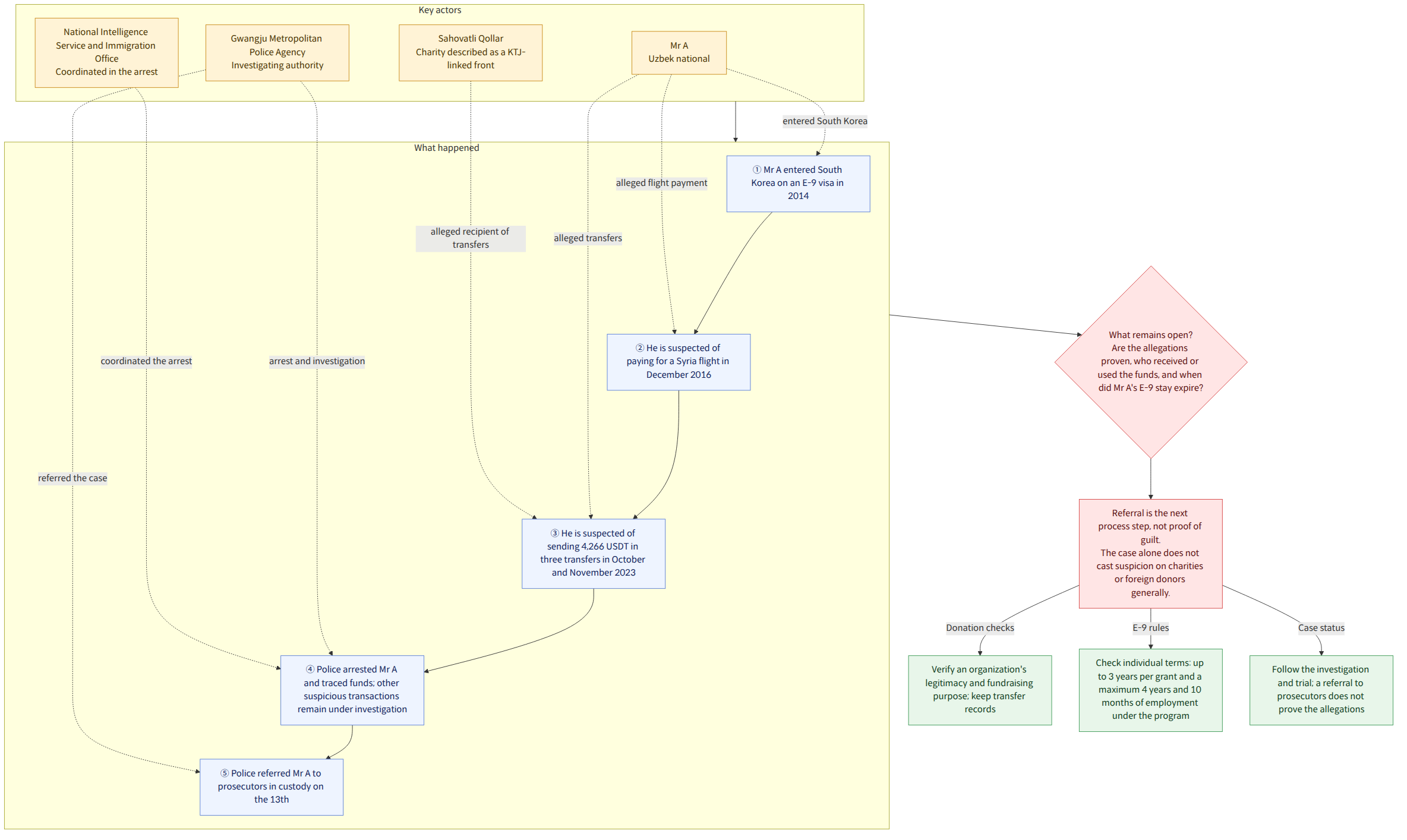
The Gwangju Metropolitan Police Agency (광주경찰청) said on the 13th that it had referred Mr. A (33), an Uzbek national, to prosecutors while in custody on suspicion of violating the Act on Prohibition against Financing for Offenses of Public Intimidation (테러자금금지법), the Immigration Control Act (출입국관리법) and other laws. Police said Mr. A is suspected of sending 4,266 USDT in cryptocurrency on three occasions between October and November 2023 to “Sahovatli Qollar,” a front charity said to be operated by members of the KTJ organization. The amount was valued at 5.9 million won in the news report at the time.
Mr. A is also suspected of paying 590,000 won for a flight to Syria in December 2016, with the aim of recruiting an Uzbek national into KTJ. Being referred to prosecutors while in custody does not mean the allegations have been proven; it means police have sent the case on to the next stage of the process.
Background and context
According to the report, KTJ was formed to intervene in the Syrian civil war, overthrow the government and establish an Islamic theocratic state—a state governed according to religious principles—in Central Asia. The report described it as an organization designated a terrorist group by the United Nations, the United States and several other countries.
“Sahovatli Qollar” means “Merciful Hands” in Uzbek. The report said it was known as a KTJ-affiliated front charity established ostensibly to provide supplies for war orphans. Police are investigating the possibility that the terrorist organization raised funds from foreign nationals living in South Korea in the form of donations while posing as a charity.
Police said they arrested Mr. A in coordination with the National Intelligence Service (국가정보원), the Immigration Office (출입국외국인사무소) and other agencies. They also said they plan to investigate other suspicious transactions identified while tracing the funds. However, the available reporting does not establish the size of those transactions, who was involved or where the money was actually used.
What this news means
The case has drawn attention because money collected in the name of charity can still be examined to determine who actually received it and how it was used. Police are investigating allegations of fundraising in the form of donations, but this case alone is not grounds for suspicion of charities in general or of donation activities by foreign nationals living in South Korea. The truth of the allegations and the nature of each organization and transaction must be established through the investigation and trial.
For example, if a foreign national living in South Korea plans to donate to an organization they encountered online, it is prudent to check that the organization is legitimate and verify the purpose of the fundraising, while keeping records of the transfer. This does not mean that any particular donation is illegal; it is a general precaution reflecting the fact that, as in this case, it may be difficult to identify the actual recipient based only on a name or stated purpose.
Mr. A’s immigration history is a separate issue. The report said he entered South Korea in November 2014 on an E-9 visa and remained in the country as an undocumented migrant after his period of stay expired in 2018. However, the same passage says that his “seven-year period of stay” had expired, which does not align with the stated entry date. The report alone does not make it possible to determine the exact date his period of stay expired.
Relevant rules and support information
According to a visa guide based on the Ministry of Justice (법무부) manual, the E-9 is a status of stay for people working in South Korea on the condition that they are employed by a business owner who has received permission to hire them. Uzbekistan is among the countries selected for the Employment Permit System (고용허가제), and permitted sectors include manufacturing, construction, agriculture and livestock, and fishing. However, actual eligibility and the applicable sectors depend on whether the requirements in the manual are met.
Under the guide, a period of stay of up to three years may be granted at a time, and the maximum period of employment permitted under the Employment Permit System is four years and 10 months. Therefore, it is difficult to interpret the report’s reference to a “seven-year period of stay” as the standard E-9 period of stay. The guide alone cannot establish the period of stay that applied to Mr. A or his actual expiration date.
E-9 workers who need to change workplaces or extend their period of stay must check the applicable reasons and procedures. The manual says that workers should apply to an employment center for a workplace change within one month of the end of their employment contract, and obtain permission to change workplaces from the relevant immigration office or other authority within three months of applying. An application to extend a period of stay requires documents including an application form, passport and alien registration card, employment permit, and standard labor contract. A separate confirmation document is required for an additional extension based on re-employment.
Regarding detention procedures, a legal guide explains that a suspect detained during the investigation stage, as well as certain family members and other related parties, may ask a court to review the legality of the detention. After charges have been filed, a defendant may apply for bail; the court decides whether to grant it and what conditions to impose after considering the specific circumstances. The report does not state what stage Mr. A’s case has reached or whether any such application has been made, so this guidance should not be mistaken for information about the progress of his case.
What is known and what remains unclear
Known facts
- The Gwangju Metropolitan Police Agency said it had referred Mr. A to prosecutors while in custody on suspicion of violating the Act on Prohibition against Financing for Offenses of Public Intimidation, the Immigration Control Act and other laws.
- Mr. A is suspected of sending 4,266 USDT to a front charity on three occasions between October and November 2023.
- He is also suspected of paying 590,000 won for an Uzbek national’s flight to Syria in December 2016.
- Police said they arrested Mr. A in coordination with the National Intelligence Service, the Immigration Office and other agencies, and plan to investigate other suspicious transactions.
What remains unclear
- The report does not say whether Mr. A admitted to the allegations or how the investigation and trial proceeded after he was referred to prosecutors in custody.
- The size of the other suspicious transactions identified by police and the people involved have not been disclosed.
- It has not been established where the cryptocurrency was ultimately sent or how it was used.
- The article’s stated entry date and description of the period of stay do not establish the exact date Mr. A’s E-9 period of stay expired.
What readers should check
- If you are an E-9 worker, check your period of stay and the procedures for changing workplaces or extending your stay against your alien registration card and relevant permit documents. Note that workplace changes have both an application deadline and a separate deadline for obtaining permission.
- If you plan to donate, check that the organization is legitimate and verify the purpose of the fundraising; keep records of the transfer and any information provided. An organization’s name or charitable purpose alone does not establish who actually operates it or how the money is used.
- If a family member has been detained, first confirm whether the case is at the investigation stage or whether charges have been filed. A review of the legality of detention and bail apply at different stages and to different parties, and the court decides whether someone is released. It is therefore important to check the procedure with a lawyer or another qualified person using the case records.
If you are dealing with a similar issue, attorney Ji-sun Ahn of Ijun Law Firm can review your current immigration status, the notice or application for the procedure at issue, and records of eligibility with you. These details can help clarify which options apply to your situation.

















