


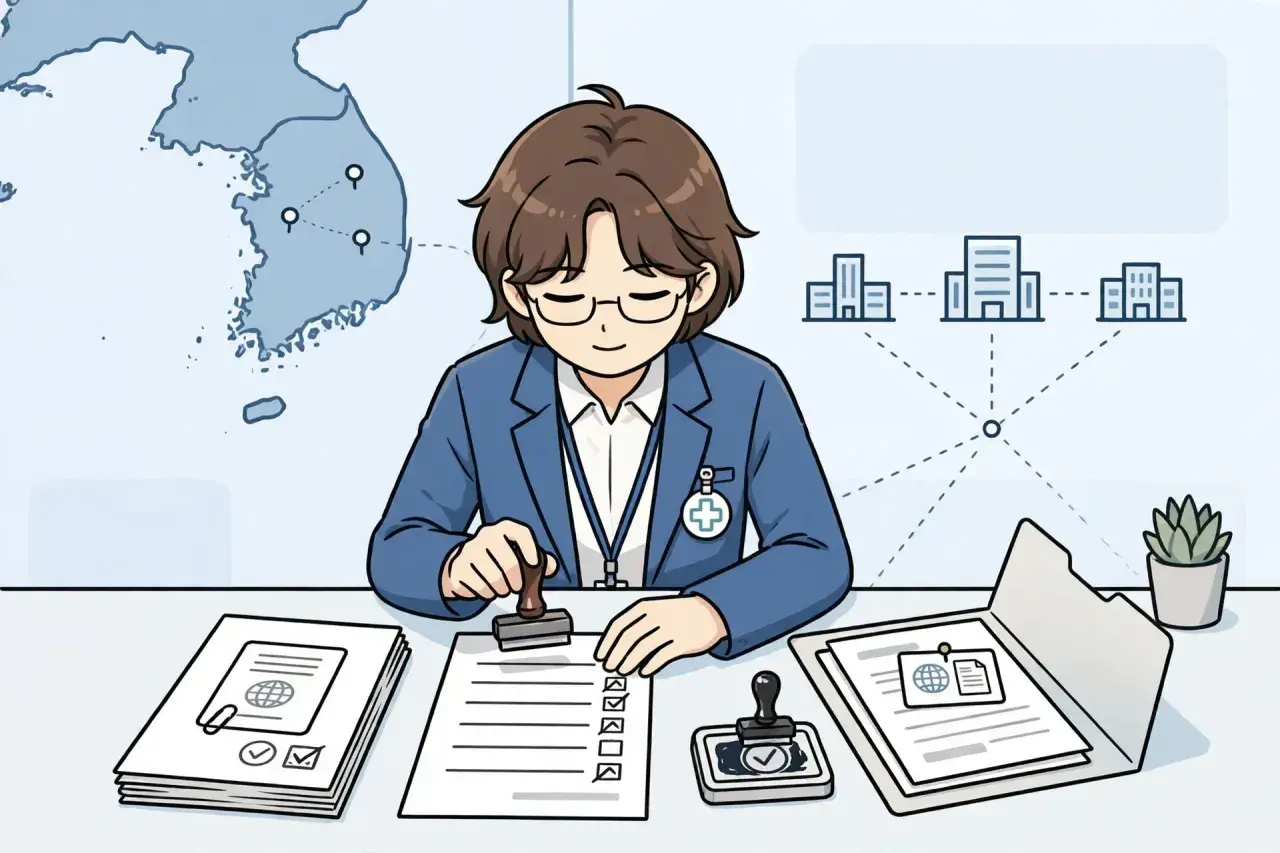
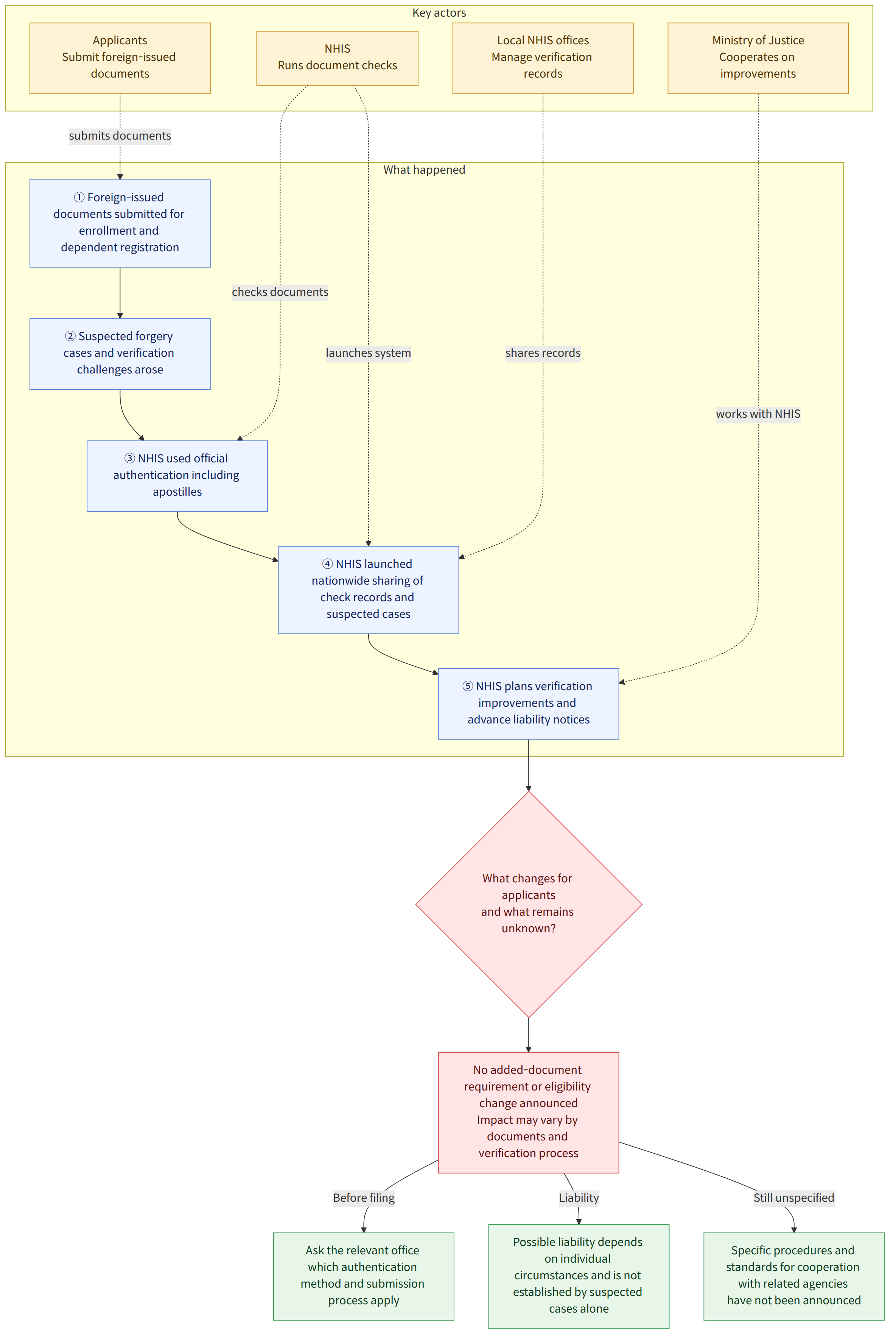
The National Health Insurance Service (국민건강보험공단, NHIS) is supplementing how it checks foreign-issued documents submitted for foreigners’ health insurance enrollment and dependent registration. The service said it will launch a system on Wednesday through which offices nationwide share suspected forgery cases and records of document checks. The system covers foreign-issued documents used for enrollment applications and dependent registration.
Background and context
The service said there have recently been cases in which documents submitted by some foreigners were suspected of being forged. To verify the authenticity of documents issued overseas, such as family relationship certificates and marriage certificates, it has used official authentication procedures, including apostilles (certification that verifies the authenticity of public documents when they are used in another country).
The service says that differences between countries in document formats and issuance and authentication procedures, as well as an increase in remote submissions, have made it harder to verify authenticity. The new system is not intended to eliminate existing verification procedures. Its aim is to supplement verification work by enabling local offices to manage and share records of document checks.
The service said it also plans to improve document verification methods in cooperation with the Ministry of Justice (법무부) and related agencies. The reports do not make clear what specific procedures or standards this cooperation will lead to.
What this news means
However, the service has not announced that the new system will require applicants to provide additional documents.
For example, an applicant submitting a family relationship document issued overseas can check with the relevant office before filing to find out what authentication method and submission procedures are required for that document. This means applicants should find out in advance which procedures they can verify; it does not mean that the new system necessarily requires additional documents.
No change to eligibility requirements has been announced, either. This measure concerns the verification and record management of documents used to check eligibility, so the extent to which it affects applicants may vary depending on their application documents and the verification process.
Related legal and regulatory issues
The service plans to inform applicants in advance about civil and criminal liability that may follow the submission of forged documents, so they can report their eligibility accurately. However, the reports do not specify the nature of that liability or the conditions under which it would apply. The existence of suspected cases alone should therefore not be taken to mean that any particular applicant is liable.
A legal guide on offenses involving documents explains that the mere fact that a document’s contents are untrue does not establish that forgery of a document or making a false document has occurred. The point is that the circumstances must be considered together, including who was authorized to create the document, its form and evidentiary function, and what changes were made. The guide introduces provisions and examples concerning private-document forgery and alteration, as well as the use of forged documents, under the Criminal Act (형법), but this alone cannot determine the legal liability arising from a particular act of submitting a foreign-issued document.
The service’s announcement also says only that it plans to provide advance notice about possible civil and criminal liability; it does not announce new rules on the scope of liability or the procedures involved. Whether liability applies in a particular case must be assessed based on individual circumstances, including who was authorized to create the document, its condition, and the act of submitting it.
Confirmed facts and what remains unknown
Confirmed facts
- The system will launch on Wednesday, and NHIS offices nationwide will share document-check records and suspected forgery cases.
- The documents covered are foreign-issued documents submitted for foreigners’ health insurance enrollment and dependent registration.
- The service has used official authentication procedures, including apostilles, and the new system supplements existing verification procedures.
- The service plans to improve verification methods with the Ministry of Justice and other related agencies, and to provide advance notice about possible liability for submitting forged documents.
What remains unknown
- What specifically is the civil and criminal liability for submitting forged documents, and what are the conditions for applying it?
- What standards and procedures will the service use to determine whether documents are authentic?
- Will applicants have to submit additional documents or complete additional verification procedures because of the new system?
- What is the specific scope of the records shared between offices, and how will they be managed?
What readers should check
- Before submitting a document issued overseas, check with the relevant NHIS office about the authentication method and submission procedures required for your type of application.
- Ask which document requirements have already been communicated to you and whether there are any additional verification requests. Based on the information currently available, no new obligation to submit additional documents can be established.
- If you are told that a document is suspected of being forged or are given notice about liability, find out which document and circumstances are at issue. Legal assessments may depend not only on whether the document’s contents are untrue, but also on who was authorized to create it and whether it was altered.
If you are dealing with a similar issue, attorney Ji-sun Ahn of Ijun Law Firm can review your identity and residence documents, any verification request, and the institution’s written response with you. These details can help clarify which options apply to your situation.

















