
A group that reads together does not necessarily have to read the same book or discuss it. Conversation is optional, and people can attend alone. These groups offer another option for readers who want to be around other people but spend their reading time on their own.
Being together at these gatherings does not necessarily mean talking; it means sharing time spent reading separately in the same space.
Background and context
Traditional book clubs generally choose a book to read together and discuss it. In these groups, by contrast, participants do not need to read the same book. They share the activity of reading, but each person decides what to read.
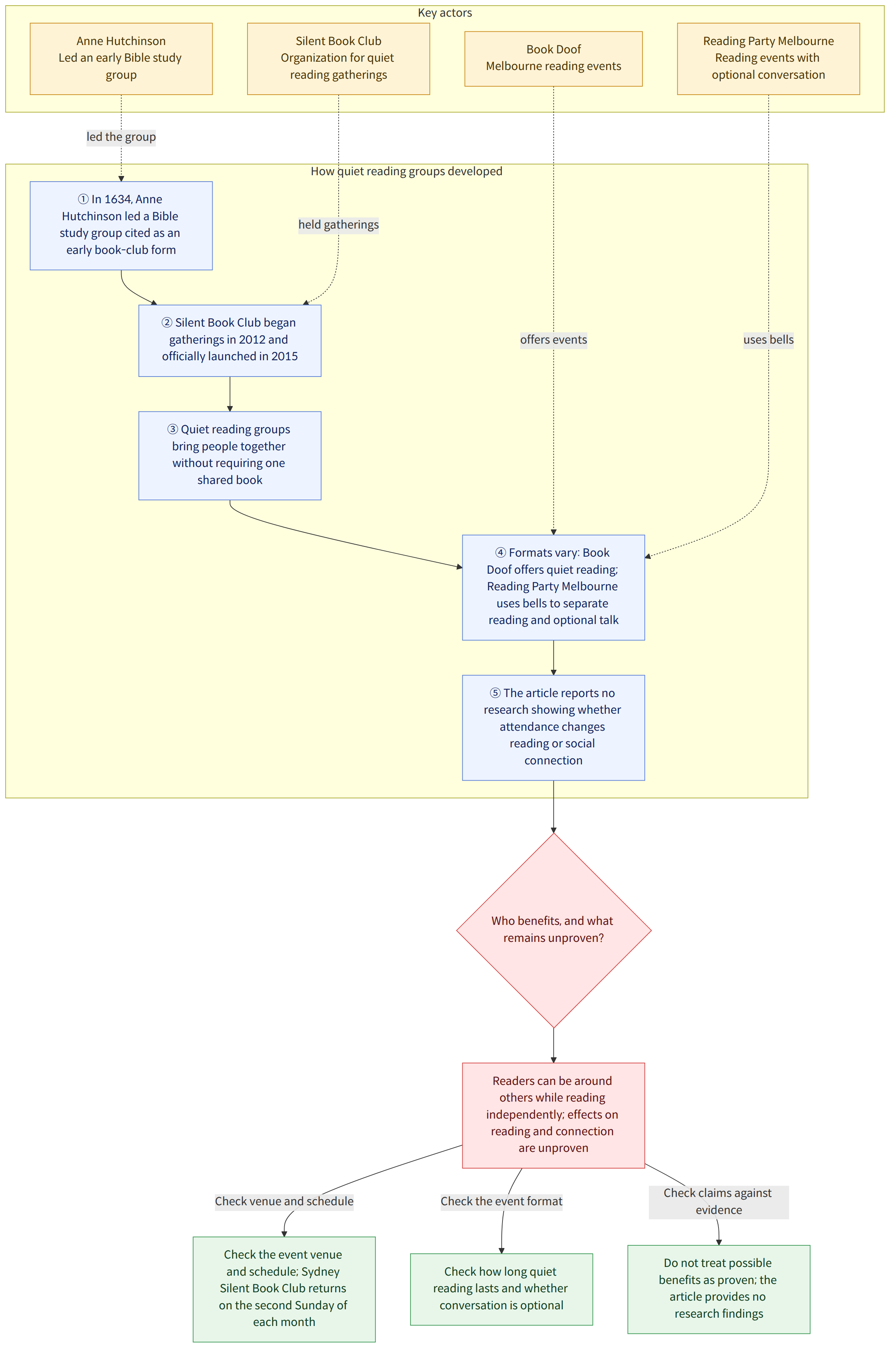
Groups centered on reading are nothing new. According to the article, one example regarded as an early form of the modern book club is a Bible study group led by Anne Hutchinson in the Massachusetts Bay Colony in 1634. Readers have since gathered around books in a range of places, including homes, libraries, pubs and literary societies. Today’s quiet reading groups can be seen as part of that tradition, with the shared experience of reading at their center rather than discussion.
Silent Book Club has held gatherings where people read different books since 2012. It was started in San Francisco by friends Guinevere de la Mare and Laura Gluhanich, and officially launched as an organization in 2015. According to the article, it now has more than 2,000 chapters in over 60 countries.
The groups’ formats vary somewhat. Melbourne’s Book Doof has held events at Fed Square and Abbots Yard, where participants can bring a book and read alongside fellow readers for up to four hours. In Canberra, it held a sold-out event with support from the Canberra Writers Festival.
At Reading Party Melbourne, participants bring a book and read in a comfortable spot at a boutique bar or restaurant. A drink is usually included with the ticket. When the first bell rings, participants read for an hour. After the second bell, they can talk if they wish or keep reading.
The Offline Club, founded in Amsterdam in 2024, holds quiet reading parties in several countries. According to the article, it first came to Australia last year through an event at Illuminate Adelaide. The Sydney Silent Book Club event was held at Darling Square Library last weekend and returns on the second Sunday of every month.
What this news means
The main idea behind these groups is to ease the pressure of having to choose between reading and socializing. Participants do not need to keep a conversation going or demonstrate their knowledge of books. As the article explains, people can come alone and take part simply by being in the same space as others. This approach does not tie a sense of belonging in a reading group to speaking or discussion skills.
For example, if talking to new people feels daunting but you want to make time to read outside the home, a gathering where conversation is optional may lower the barrier to taking part. However, the article does not provide research findings showing whether attending such a gathering actually changes how much people read or how connected they feel to others. It is important to distinguish between the possibility that the format can make such an experience possible and a claim that its effects have been demonstrated.
It also matters to participants that the atmosphere and schedule vary from one group to another. The formats differ, as with Book Doof, where people read quietly for up to four hours, and Reading Party Melbourne, which separates reading time from conversation time using bells. So the label “reading group” does not mean that every event offers the same experience.
What has been confirmed and what remains unknown
Confirmed facts
- The four groups were described as bringing people together to read independently without a set book.
- Conversation is optional, and people can attend alone.
- Book Doof has held events in Melbourne and, with support, a sold-out event in Canberra.
- Silent Book Club has held gatherings since 2012 and officially launched in 2015; it has more than 2,000 chapters in over 60 countries.
- Reading Party Melbourne uses bells to distinguish reading time from optional conversation time, and the Sydney Silent Book Club returns on the second Sunday of every month.
What remains unknown
- The average attendance and participant makeup of each group were not provided.
- No research findings were available showing whether participants read more or feel more socially connected after attending.
What readers should check
- Check the venue and schedule for the event before attending. The Sydney Silent Book Club returns on the second Sunday of every month, but schedules for other groups may vary by event.
- Check whether you need to bring a book, how long the reading period lasts and when conversation is allowed. This can help you choose the format that suits you.
- Some events, such as Reading Party Melbourne, include a drink with the ticket, so check what is included before booking.