



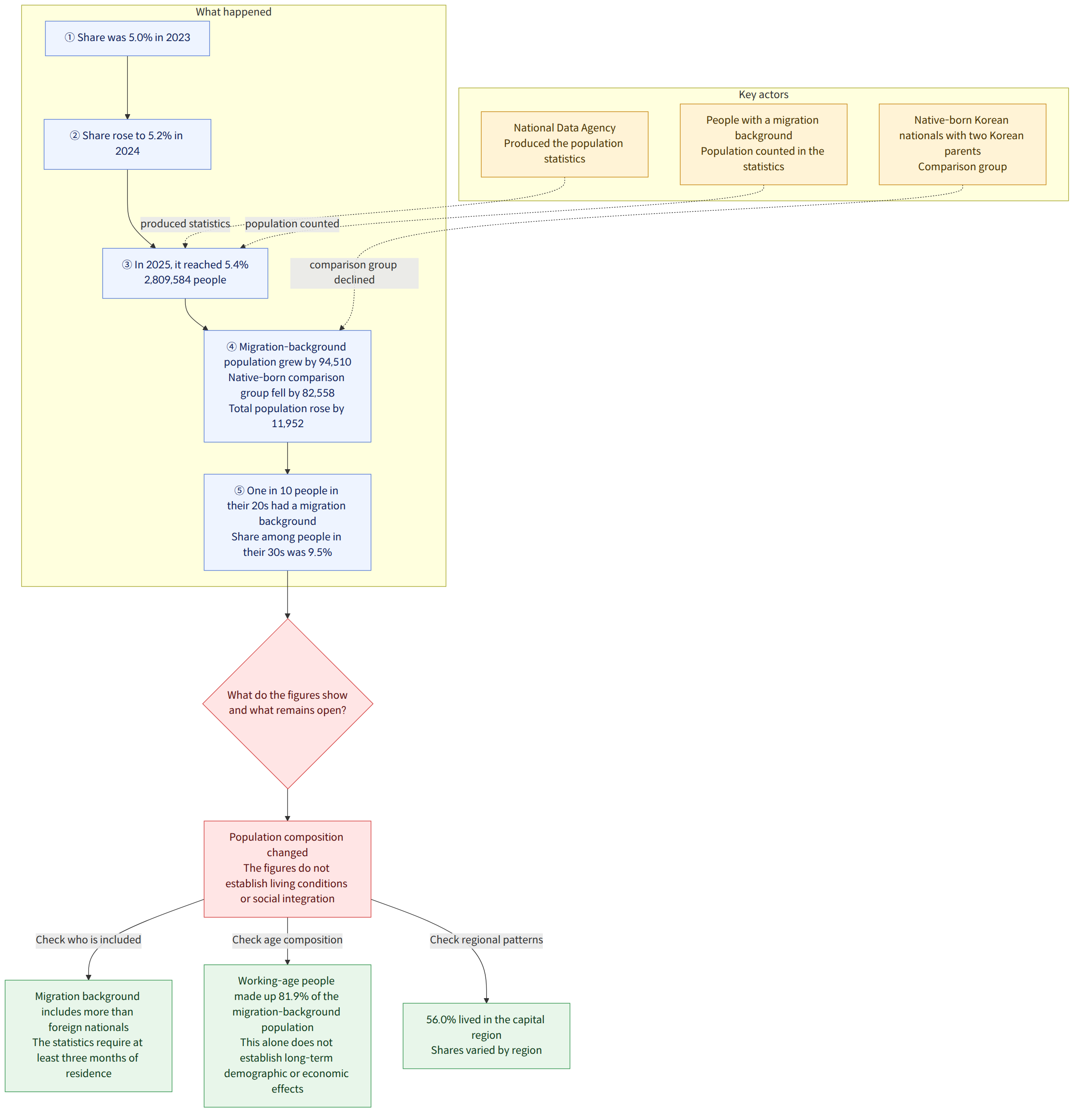
In 2025, South Korea had 2,809,584 people with a migration background, accounting for 5.4% of the total population. That was 94,510 more than a year earlier. According to reporting citing the National Data Agency (국가데이터처)’s “2025 Statistics on the Population with a Migration Background” (2025년 이주배경인구 통계), the figures cover people who had lived in South Korea for at least three months as of November 1, 2025.
The change in population composition may seem gradual when viewed only as a share of the overall population, but the differences are clear across age groups. One in 10 people in their 20s, and 9.5% of those in their 30s, have a migration background. This measure shows the extent to which people with a migration background make up South Korean society, while also revealing that population changes vary by age and region.
Background and context
In the reporting, the population with a migration background is defined as people who themselves or at least one of their parents have a migration background. It includes not only foreign nationals, but also naturalized persons and persons who acquired nationality through recognition, second-generation immigrants with one naturalized or foreign-national parent, North Korean defectors and their children, among others. Reading this statistic as if it meant the same thing as the foreign-national population would therefore give an incomplete picture of its scope.
Foreign nationals made up the largest share of the total population with a migration background, at 75%, followed by second-generation immigrants at 14.1% and naturalized persons and persons who acquired nationality through recognition at 9.1%. The reference date was November 1, 2025, and the figures also included the condition that people had lived in South Korea for at least three months. This is why the definition of “migration background” and the residency criterion both need to be considered when interpreting the share.
The increase in the population with a migration background was also notable in the population changes. In 2025, there were 49,007,915 native-born Korean nationals with two Korean parents, down 82,558 from the previous year. In contrast, the population with a migration background grew by 94,510, and the total population increased by 11,952 to 51,817,499. Comparing the figures in the reporting shows that changes in these two groups played an important role in determining whether the total population increased or decreased.
The share of the population with a migration background rose from 5.0% in 2023 to 5.2% in 2024 and 5.4% in 2025. However, this increase alone cannot determine people’s or regions’ living conditions or the degree of social integration. What these statistics directly show is a change in the size and composition of the population.
What this news means
The fact that the share of people with a migration background is higher among young people than in the population overall is notable when examining changes in population composition in the labor market and education. There were 607,000 people with a migration background in their 20s, equal to 10% of that age group, and their share rose by 1.0 percentage point from the previous year. The share among people in their 30s was 9.5%. Combined, the two age groups had 1.27 million people with a migration background out of a population of 13.08 million, or 9.7%.
Of the total population with a migration background, 81.9% were of working age (15–64). The working-age population made up 69.2% of the total population, a difference of 12.7 percentage points from the population with a migration background. Conversely, people aged 65 and over accounted for 5.8% of the population with a migration background and 20.7% of the total population. This difference means that the age composition of the population with a migration background differs from that of the overall population; it does not, by itself, establish long-term demographic effects or the economic activity of individuals.
The regional distribution was also uneven. A total of 56.0% of people with a migration background lived in the capital region, although that share was down from 56.8% the previous year. Among provinces and metropolitan cities, South Chungcheong Province had the highest share relative to its total population, at 8.3%. Among cities, counties and districts, Yeongam County in South Jeolla Province recorded 22.7%, and Eumseong County in North Chungcheong Province recorded 20.3%. The reporting cited the large number of foreign workers in Yeongam’s shipbuilding-centered industrial complex and in Eumseong’s industrial complexes as contributing factors.
For example, a high share of people with a migration background in a region does not, by itself, establish how much demand for schools or jobs in that region has changed. It does, however, suggest the need to examine population shares and age composition alongside regional education and labor conditions.
What is confirmed and what remains unknown
Confirmed facts
- As of November 1, 2025, there were 2,809,584 people with a migration background who had lived in South Korea for at least three months, accounting for 5.4% of the total population.
- The population with a migration background grew by 94,510 from the previous year, and the total population increased by 11,952.
- The number of native-born Korean nationals with two Korean parents fell by 82,558 from the previous year.
- People with a migration background made up 10% of those in their 20s and 9.5% of those in their 30s.
- The population with a migration background includes not only foreign nationals, but also naturalized persons and persons who acquired nationality through recognition, second-generation immigrants, North Korean defectors and their children, among others.
What remains unknown
- The reporting did not specifically explain which data sources and statistical procedures were used for the detailed counts.
- The figures provided do not show the population with a migration background by nationality or residence status, or the individual circumstances of people’s residence and employment.
- The effect of these population changes on the future total population and the population composition of individual regions cannot be determined from these statistics alone.
What readers should check
- When comparing these figures with other population statistics, check whether they use the same reference date and the same condition of “at least three months’ residence.”
- Keep in mind that “population with a migration background” does not mean only foreign nationals, and compare the definitions and scope of the statistics being considered.
- When assessing a region or age group, it is helpful to look not only at the overall share but also at the size and composition of the population in that region or age group.
References
- Other coverage consulted: hani.co.kr

















