


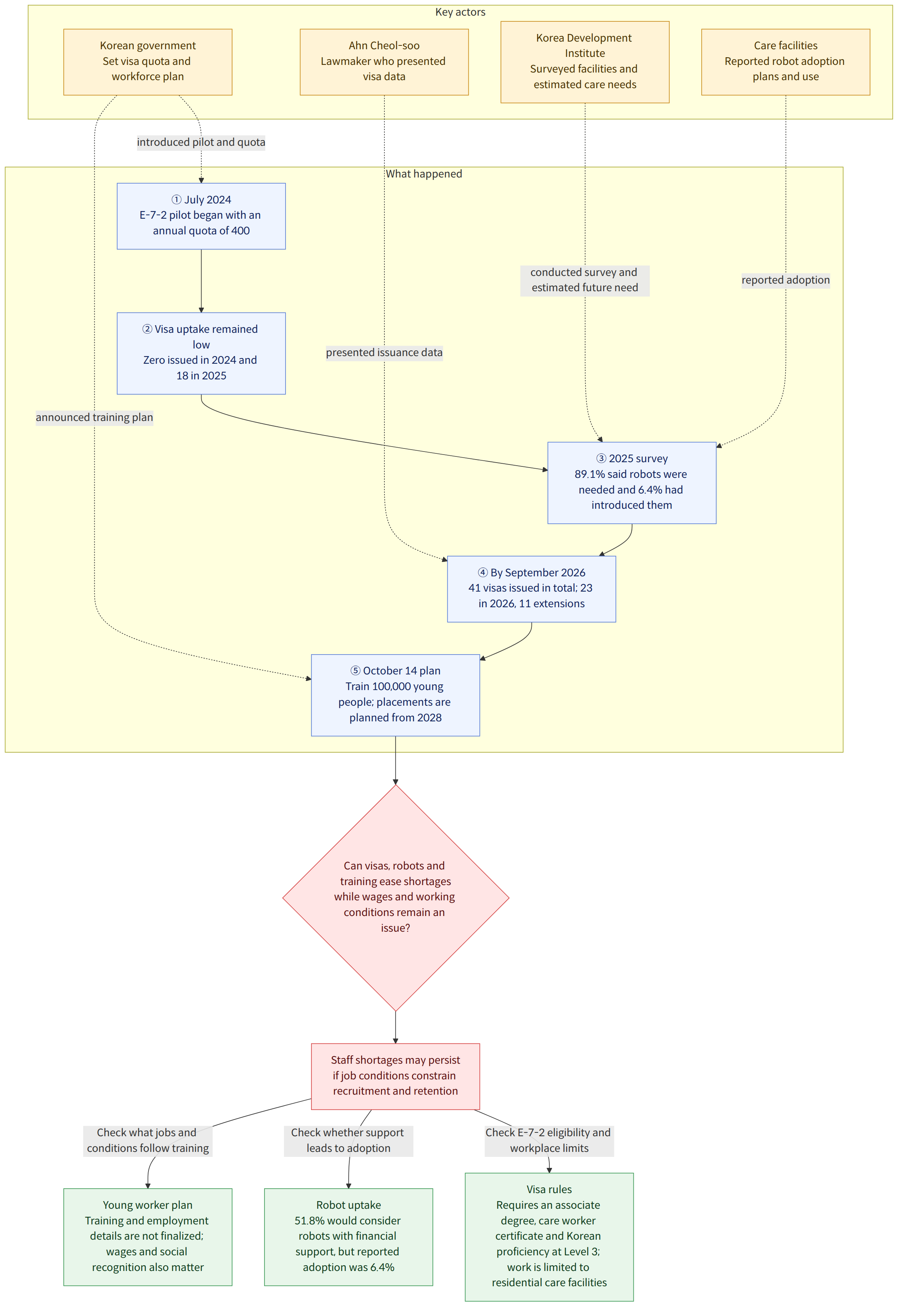
The Korean government set an annual quota of 400 for the E-7-2 visa, introduced on a pilot basis in July 2024 to secure workers for elderly care. But only 41 visas had been issued by September 2026. According to data presented by Ahn Cheol-soo, a lawmaker from the People Power Party (국민의힘), no visas were issued in 2024, 18 were issued in 2025, and 23 from January through September 2026. All 41 visa holders continued working at the facilities where they first took jobs, and 11 received permission to extend their stay.
With use far below the quota, the government is also pursuing care robots and training young workers as potential solutions. But whether technology adoption and plans to increase the workforce can actually ease staff shortages in care settings depends in part on wages and working conditions.
Background and context
The E-7-2 visa was established to allow graduates who earned at least an associate degree from a Korean junior college or university, hold a care worker certificate, and have at least Level 3 Korean proficiency to work as care workers at residential care facilities for older people. However, eligible workplaces are limited to residential facilities; visa holders cannot work for home-care service providers. While all visa holders have been confirmed to have remained at their first facility, the limited range of workplaces is also relevant to understanding the scope of jobs available under the program.
How many qualified foreign nationals have actually entered the care workforce also remains an issue. According to the data, of the 26,596 foreign nationals with care worker certificates, 18,973, or 71.3%, had no recorded employment status or workplace. The data alone do not establish why no record exists, but they show a wide gap between the number of people holding certificates and the number of workers whose employment can be confirmed.
Demand for workers could grow further over the long term. The Korea Development Institute (한국개발연구원, KDI) estimated that an additional 990,000 care workers would be needed by 2043 to keep each worker’s workload at its 2023 level. This suggests that the labor shortage could be a challenge too large to solve through short-term hiring increases alone.
What this news means
There is a gap between interest in care robots and their actual adoption. In a 2025 survey of 330 care facilities with a capacity of at least 80 people, the Korea Development Institute found that 89.1% said robots were needed and 51.8% said they would consider adopting them if financial support were available. By contrast, just 6.4% said they had actually introduced robots. Given that recognition of the need has not translated directly into adoption, it is worth examining the factors impeding adoption as well as the availability of financial support.
On October 14, the government announced a plan to train 100,000 young people to use robots and artificial intelligence in elderly care. The plan includes assigning young workers to areas with declining populations starting in 2028, but details of the training and employment arrangements have not yet been finalized. The plan’s impact should therefore be assessed not just by its target number, but also by following how the training and the jobs it leads to are fleshed out.
Wages and social recognition are also cited as important conditions for securing workers. According to estimates from the Presidential Committee on Ageing Society and Population Policy, which is directly under the president (대통령 직속 저출산고령사회위원회), care workers earn 24 million to 35 million won a year, compared with the median annual salary of 34.17 million won for Korean workers in 2024. Experts have said that low pay and limited social recognition make care work unattractive to potential workers. This suggests that even as foreign recruitment and technology adoption proceed, unchanged job conditions could continue to constrain recruitment and retention.
For example, even if a care facility considers adopting robots, the high level of need identified in the survey may not lead to actual adoption if the facility cannot afford the cost. Similarly, even if young people receive training, it is still difficult to judge how many will enter the field if the employment arrangements and job conditions after training have not been determined.
Relevant rules and support information
According to an in-house visa guide, E-7 (Specific Activities) (특정활동) is a status of stay for foreign nationals who intend to work in an occupation designated by the Ministry of Justice under a contract with a public or private institution in Korea. E-7-2 covers semi-professional occupations in office and service work, and holding E-7 status alone does not authorize someone to work in every occupation. Applicants must check the authorized occupation and employment contract, the qualifications for that occupation, and the employer’s eligibility.
The requirements for this pilot program for care workers are an associate degree or higher from a Korean junior college or university, a care worker certificate, and at least Level 3 Korean proficiency. These are the requirements stated for this particular pilot program. The guide lists general eligibility routes for E-7, including a master’s degree or higher in a related field; a bachelor’s degree in a related field plus at least one year of experience in that field; or at least five years of work experience in a related field. In practice, applicants must check the requirements for the specific occupation.
The application documents listed in the guide include an application form, a copy of a passport, a photo, an employment contract, documents related to the employer’s establishment, and evidence of qualifications, such as a degree certificate, employment history certificate, or professional certificate. Depending on the occupation, applicants may need to provide evidence of the need to hire them, such as a letter of employment recommendation or a plan for utilizing foreign workers. For an application to extend the period of stay, the guide lists documents including an employment contract and proof of personal income. Applicants should check which documents are required based on their application type and occupation.
E-7-2 care workers may work only at residential facilities and cannot work for home-care service providers. The visa category and authorized workplace determine the actual scope of permissible employment.
What is confirmed and what is still unknown
Confirmed facts
- The E-7-2 visa was introduced on a pilot basis in July 2024, with an annual quota of 400.
- By September 2026, 41 visas had been issued, and all recipients had continued working at the facilities where they first took jobs.
- Among foreign nationals holding care worker certificates, 71.3% had no recorded employment status or workplace in the data.
- In the Korea Development Institute survey, 89.1% of facilities said robots were needed, but only 6.4% said they had introduced them.
- The government announced a plan to train 100,000 young people to use robots and artificial intelligence in care work and assign them to areas with declining populations starting in 2028.
What is still unknown
- No specific reasons were given for why the number of visas actually issued was low compared with the annual quota of 400.
- The training content and post-training employment arrangements for the 100,000 young people have not yet been finalized.
- No specific government measures to improve the wages and working conditions of care workers at residential facilities have been confirmed.
- The materials do not specify how much financial support for robot adoption will be provided or how it will be delivered.
What readers should check
- Anyone considering E-7-2 employment should check the requirements for education in Korea, a care worker certificate, and Korean proficiency, as well as the restriction to employment at residential facilities.
- When entering into an employment contract or completing procedures related to status or period of stay, applicants should check the documents required for their occupation and the employer’s requirements. Depending on the occupation, changing or adding a workplace may require prior permission or a subsequent report; according to the guide, reports required after the fact must be filed within 15 days of the reason arising.
- Facilities and job seekers interested in the youth training plan or support for robot adoption should check whether the training and employment arrangements, eligibility requirements, and application procedures have been finalized. The current materials do not provide those details.
If you are dealing with a similar issue, attorney Ji-sun Ahn of Ijun Law Firm can review the visa conditions, work authorization documents, and records of the duties actually performed with you. These details can help clarify which options apply to your situation.

















