



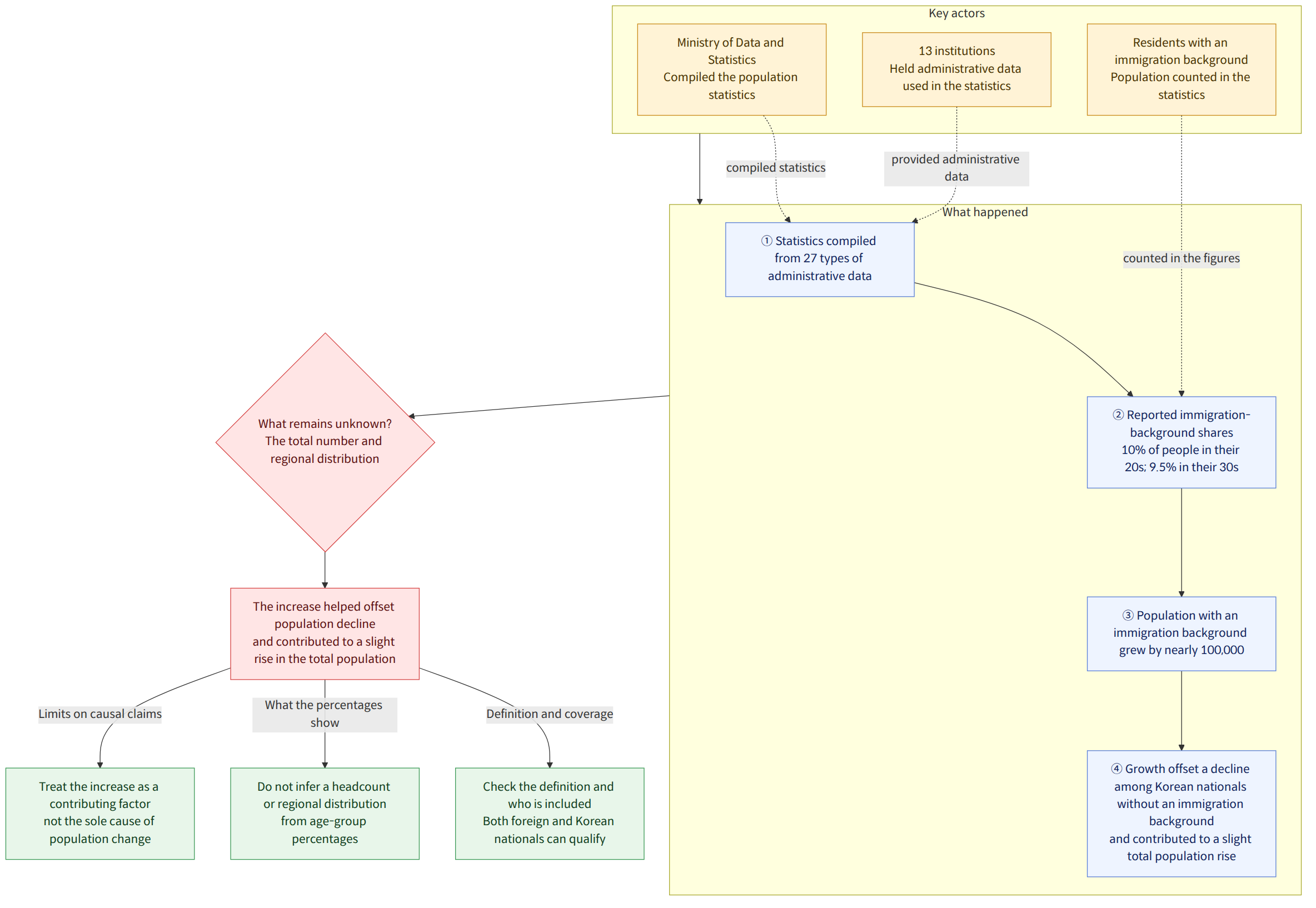
Last year, 10% of residents in their 20s and 9.5% of those in their 30s in South Korea had an immigration background. That is according to the Ministry of Data and Statistics (데이터통계부)’s 2025 population statistics. The population with an immigration background grew by nearly 100,000, offsetting the decline in Korean nationals without an immigration background and helping bring about a slight rise in the total population.
The statistics show that an immigration background is not uncommon among young adults, and that the increase in this population also affected overall population change. However, the proportions for these two age groups alone do not show the total number of residents with an immigration background or how they are distributed across regions.
Background and context
In the statistics, “residents with an immigration background” means people who are immigrants themselves or have at least one parent with an immigration background. This criterion therefore does not classify people based solely on whether they are foreign nationals. Both foreign nationals and Korean nationals are included.
Among Korean nationals, the category also includes people who acquired citizenship through naturalization or the legal recognition of a parent-child relationship, second-generation immigrants, North Korean defectors and their children. Therefore, interpreting “population with an immigration background” as synonymous with the foreign population would give an overly narrow understanding of who is covered by the statistics.
The statistics were compiled using 27 types of administrative data held by 13 institutions. Administrative data (information collected and managed by institutions in the course of their work) included resident registration, foreigner registration and records of citizenship acquisition. The fact that these statistics were compiled from multiple sources is important when considering the criteria and data on which the figures are based.
What this means
The figures of 10% for residents in their 20s and 9.5% for those in their 30s are proportions of all residents in those age groups. These figures alone cannot tell us an individual’s nationality or immigration experience, since Korean nationals with an immigration background are also included.
The increase in the population with an immigration background also emerged as a factor that partly offset the decline in another population group. However, what the statistics say is that the increase in the population with an immigration background “contributed” to a slight rise in the total population. There is no basis here for interpreting it as the sole cause of the overall population increase.
For example, the 20s figure can be read as meaning that “10% of residents in their 20s meet the criteria for having an immigration background.” It should not be read as meaning that “10% of people in their 20s are foreign nationals.” The criteria are broader than nationality alone.
What is confirmed and what remains unknown
Confirmed facts
- Residents with an immigration background accounted for 10% of all people in their 20s and 9.5% of those in their 30s.
- The population with an immigration background grew by nearly 100,000.
- That increase offset the decline in Korean nationals without an immigration background and contributed to a slight rise in the total population.
- The statistics include both foreign nationals and Korean nationals, and were compiled using 27 types of administrative data from 13 institutions.
What remains unknown
- How many residents with an immigration background are there in total?
- How are residents with an immigration background distributed by age group and region?
What readers should check
- When looking at related statistics, readers should first check the definition of “residents with an immigration background” and which nationalities are included.
- The proportion by age group and the total number of people are different kinds of information. It is best not to extend a percentage to infer a headcount or regional distribution.
- When considering the causes of population change, readers should distinguish between the confirmed contribution of the increase in the population with an immigration background and other factors not identified by the statistics.

















