



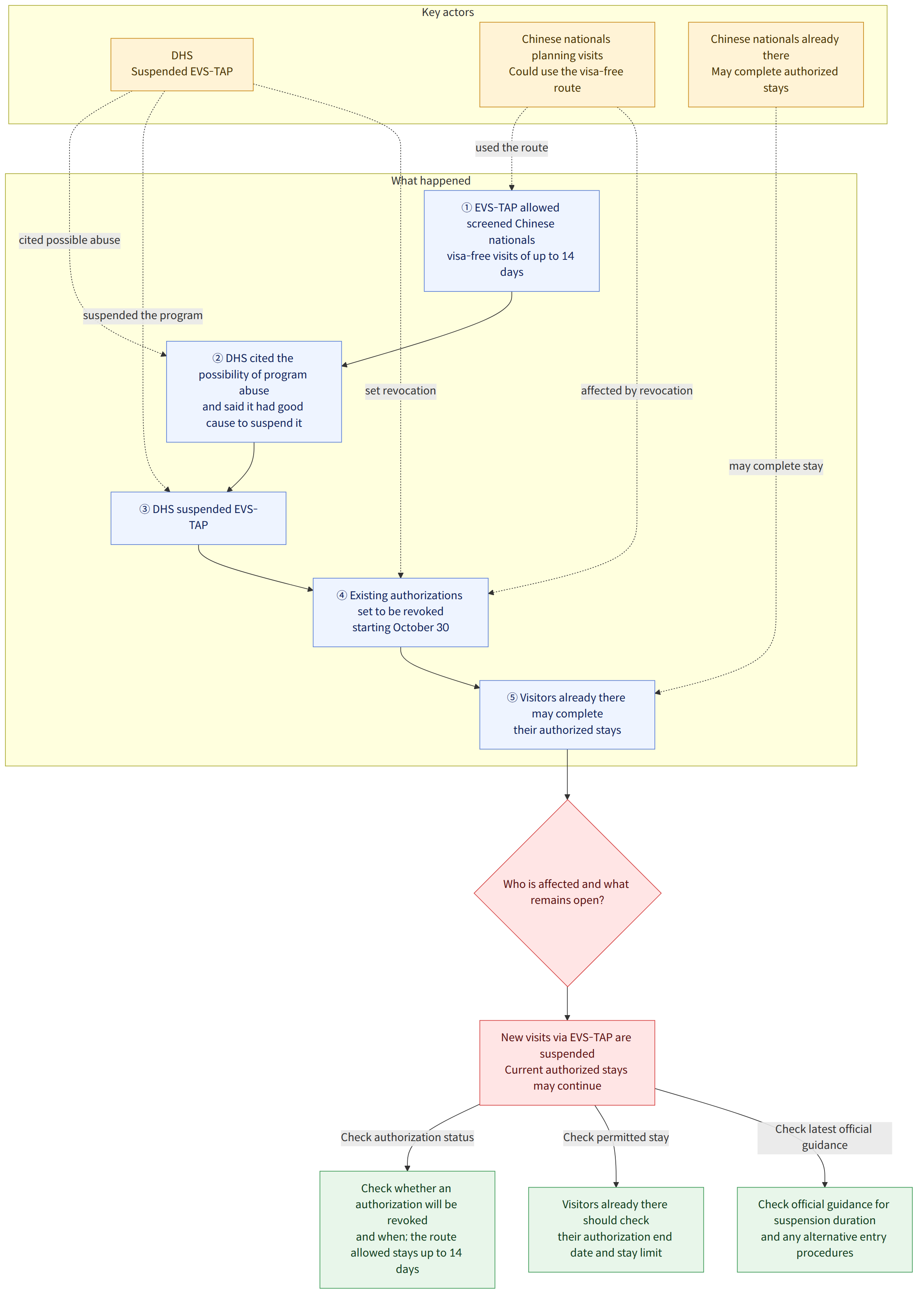
The U.S. Department of Homeland Security (미국 국토안보부; DHS) has suspended the Economic Vitality and Security Travel Authorization Program (경제활력·안보 여행허가 프로그램; EVS-TAP), which allowed Chinese nationals visiting the Northern Mariana Islands to enter without a visa. Existing authorizations will be revoked starting October 30, but Chinese nationals already there may complete their authorized stays.
Background and context
EVS-TAP allowed Chinese nationals who had undergone advance screening to visit the Northern Mariana Islands for up to 14 days without a U.S. visa. The Northern Mariana Islands is a U.S. territory in the Pacific, and this action concerns the visa-free entry route for Chinese nationals visiting there.
DHS said there was “almost certainly” a possibility that nationals of China (PRC) were abusing EVS-TAP, and that it had “good cause” to suspend the program. Reports cited allegations of birth tourism and human smuggling as the background to the suspension, but did not provide specific evidence DHS used to determine that the program was being abused or details of the allegations.
Reports also included figures on program use. More than 3,000 Chinese nationals entered using EVS-TAP in fiscal year 2025. That figure alone, however, does not show how many cases among those users were connected to the allegations.
What this news means
The most direct change is that Chinese nationals will no longer be able to use EVS-TAP to visit the Northern Mariana Islands. Existing authorizations are also set to be revoked starting October 30, so people who planned to travel or received an authorization cannot proceed on the assumption that it remains valid. The reports do not establish what entry methods or separate procedures might be available as an alternative to this route.
By contrast, Chinese nationals already there may complete their authorized stays. For example, if a Chinese national has already arrived in the Northern Mariana Islands and still has time remaining on their EVS-TAP-authorized stay, this decision alone does not immediately end that period. This means the suspension of the route for new visits and the treatment of people currently staying there are different.
U.S. Senator Mike Lee called the program a “Biden-era Chinese birth tourism loophole” on social media and welcomed the action, saying the Trump administration had “shut down” the route. This is Senator Lee’s assessment and reaction and should be distinguished from specific evidence presented by DHS.
What is confirmed and what is not yet known
Confirmed facts
- DHS announced the suspension of EVS-TAP in the Northern Mariana Islands.
- The program allowed Chinese nationals who had undergone advance screening to visit for up to 14 days without a U.S. visa.
- Existing authorizations will be revoked starting October 30, while people already there may complete their authorized stays.
- DHS cited the possibility that Chinese nationals were abusing the program as the reason for the suspension.
- More than 3,000 Chinese nationals entered using the program in fiscal year 2025.
What is not yet known
- What specific evidence did DHS rely on in assessing the possibility of abuse?
- How long will the program suspension remain in effect?
- What are the specific details of the birth tourism and human smuggling allegations?
- Are there other entry routes available to Chinese nationals following the suspension of EVS-TAP?
What readers should check
- Chinese nationals planning to visit the Northern Mariana Islands should check whether their EVS-TAP authorization is subject to revocation and when it will be revoked.
- Visitors already there should check the end date stated on their authorization and their permitted length of stay.
- The reports provided do not establish how long the program will be suspended or what alternative entry procedures may apply, so travelers should check the latest official guidance before making travel decisions.

















