


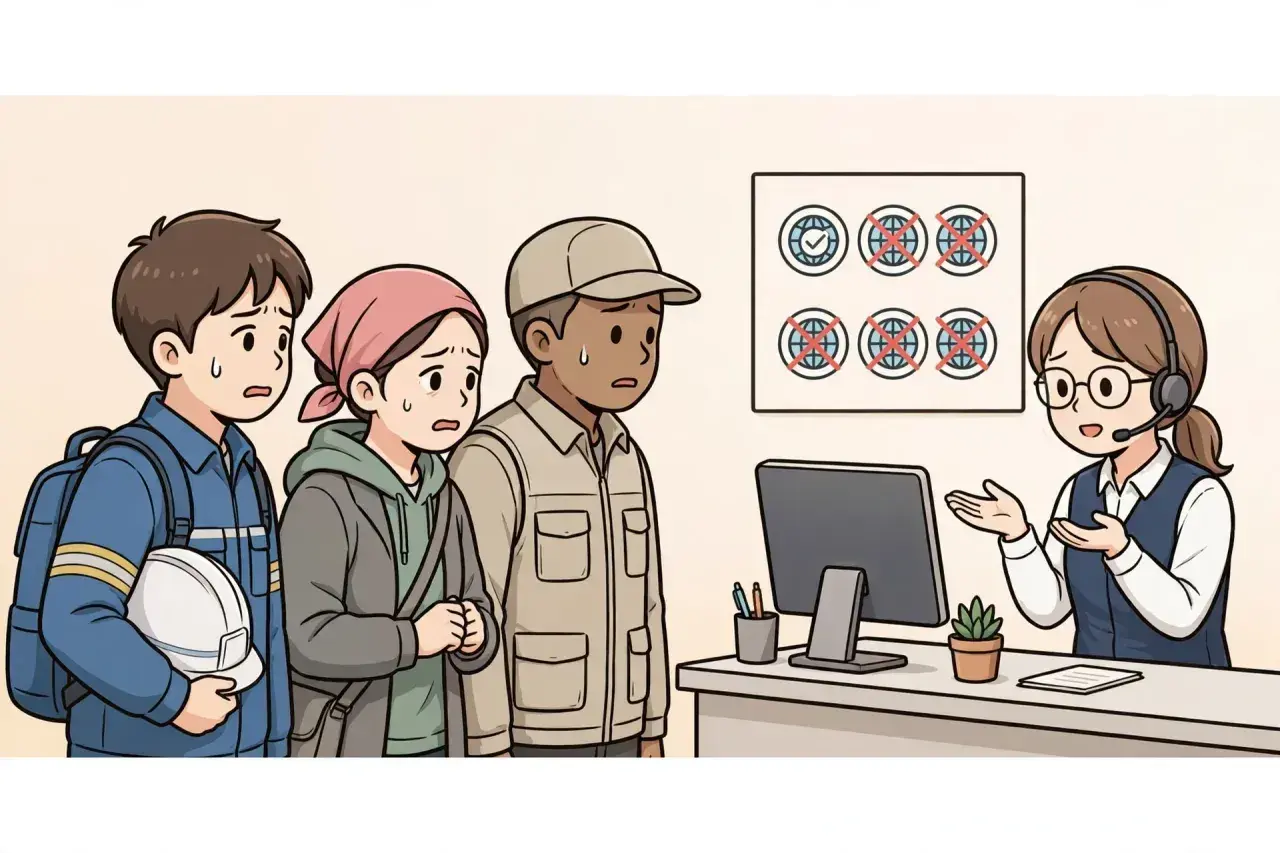
The number of foreign nationals visiting local labor offices (지방노동관서) in South Korea is rising. But language barriers and a shortage of multilingual counselors can make it difficult for migrant workers to file complaints, check on the progress of their cases, or receive responses. Since the process of seeking help can itself be blocked for workers who have experienced unpaid wages or assault, interpretation support is not merely a convenience—it is closely tied to the ability to exercise one’s rights.
Background and context
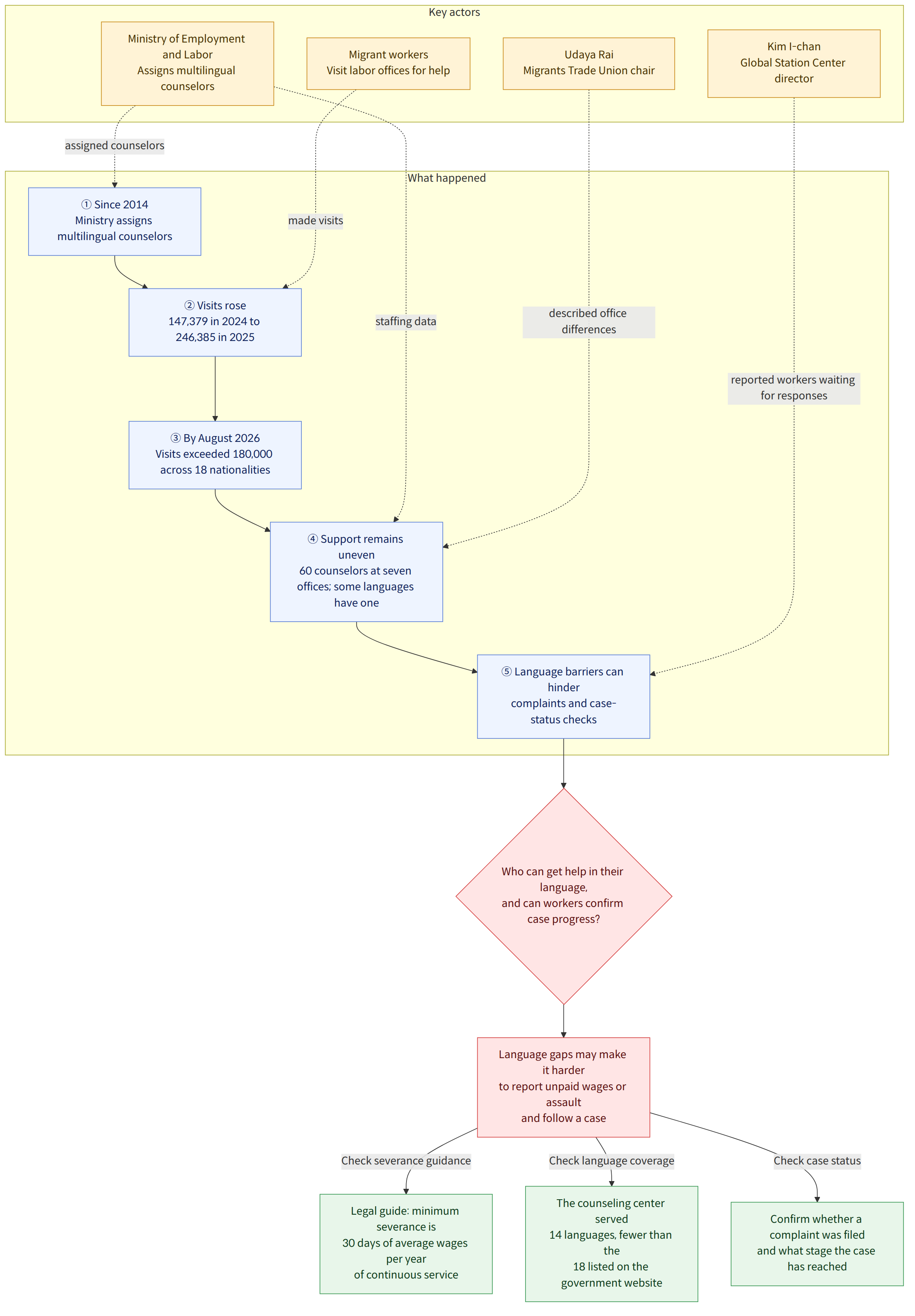
Kim I-chan, director of the Global Station Center (글로벌스테이션센터), said that some workers do not file complaints because they cannot understand the basic information provided by labor offices. He said he had seen cases in which workers believed they had filed complaints and waited for a response, only to wait as long as two years. If workers cannot confirm whether a complaint was actually filed or what stage a case has reached, the time they spend waiting for a resolution can be prolonged.
The number of visits is growing. In 2025, foreign nationals made 246,385 visits to local labor offices, up from 147,379 in 2024. According to data released by Lee Hak-young, a lawmaker from the Democratic Party of Korea (더불어민주당), the number of visitors had already exceeded 180,000 by August 2026, and they represented 18 nationalities. From January through August this year, 14,888 Cambodian nationals visited local labor offices across the country.
The Ministry of Employment and Labor (고용노동부) has assigned multilingual counselors to labor offices since 2014, but the current number of support staff and the languages they cover do not evenly meet demand. There are 60 multilingual counselors working at seven local labor offices nationwide. As of August, there were nine Khmer-language counselors and 10 Nepali-language counselors, while there was only one counselor each for Mongolian, Bengali, Kyrgyz, and Tetum. There were two counselors each for Thai, Filipino, and Pakistani services.
Udaya Rai, chair of the Migrants’ Trade Union (이주민노동조합), said that some labor offices offer services in Nepali while others do not. He said some offices strictly require an interpreter to accompany the worker in person, and that if workers cannot bring one, staff may try to communicate through gestures or explain things in Korean without checking whether the worker understands. In other words, even workers who speak the same language may receive different forms of assistance depending on which office they visit.
The shortage of counseling staff is also evident at help desks outside labor offices. Of the 35 foreign-language counselors at the Migrant Worker Foreign Language Counseling Center (이주노동자 외국어상담센터), as of August there were none who spoke Bengali, Urdu, Kyrgyz, or Tetum. The center provided services in only 14 languages, fewer than the 18 listed on the government website, and received 1,540 requests for Bengali-language counseling over the past three years. The Ministry of Employment and Labor said it has difficulty recruiting qualified interpreters for less common languages because there are few of them and they often live far from the institutions that need them.
What this news means
When counseling staff are in short supply, workers may struggle not only to explain what happened to them but also to understand whether their complaint has been filed and what steps come next. If workers must find and bring an interpreter themselves, those seeking help after suffering harm may face an additional burden just to access support. Lawmaker Lee Hak-young said that telling migrant workers who have experienced unpaid wages or assault to bring someone to interpret places the burden of seeking justice on the victims.
For example, a worker who believes they have not been paid may visit a labor office but, if they do not fully understand the information provided, may be unable to confirm whether a complaint has been filed or may miss an explanation about the case’s progress. This is a hypothetical example; the original article does not state how many complaints in total have gone unfiled or been delayed because of language problems.
Relevant systems and support information
Readers seeking advice about unpaid wages or severance pay may find it helpful to gather documents showing their working conditions and pay history. According to an in-house legal guide, when a severance pay system has been established, the statutory minimum is 30 days’ worth of average wages for each year of continuous service. Average wages are calculated by dividing the total wages paid during the three months before the event requiring the calculation, such as retirement, by the total number of days in that period. This is why it is important to review contracts and pay records together.
An agreement that a monthly or annual salary includes an amount designated as severance pay does not, by itself, eliminate the obligation to pay severance. However, whether severance pay applies and which period is included in the calculation may depend on factors such as the length of continuous service, the number of prescribed working hours per week, the size of the workplace, and the timing of when the rules apply. Night, overtime, and holiday-work premiums also depend on workplace size, the type of work, and the terms of the contract, so workers should compare their actual hours and duties with their contracts and pay records.
The in-house legal guide gives a period of three years from the date of resignation for severance pay claims, and a three-year period for wage claims related to overtime pay. The specific rules may vary depending on the case, so it is advisable not to delay checking your rights.
What is confirmed and what remains unknown
Confirmed facts
- Foreign nationals made 246,385 visits to local labor offices in 2025, up from 147,379 in 2024.
- By August 2026, the number of foreign visitors had exceeded 180,000, representing 18 nationalities.
- Sixty multilingual counselors work at seven local labor offices nationwide, and staffing levels vary by language.
- The Migrant Worker Foreign Language Counseling Center provided services in 14 languages, fewer than the 18 listed on the government website.
What remains unknown
- The article does not state how many complaints in total have gone unfiled or been delayed because of language problems.
- It is not known when the government will expand multilingual counseling staff or which languages it will prioritize.
- The article does not say whether alternatives such as real-time interpretation services are planned.
What readers should check
- Before visiting a labor office, check whether counseling is available in your language and whether the office requires an interpreter to accompany you in person. It has been reported that services may differ from one office to another.
- If you have an unpaid-wage or severance-pay issue, organize your employment contract, pay records, and documents showing your working hours and duties. The substance of your wages and the nature of the employment relationship may affect the assessment of your rights.
- Do not delay making a claim; check which deadlines apply to your case. In particular, time limits related to severance pay and overtime premiums may vary by case, so it is helpful to provide your resignation date and pay records when seeking advice.
If you are dealing with a similar issue, attorney Ji-sun Ahn of Ijun Law Firm can review your employment contract, records of the incidents or complaints, and any requests for interpretation or other assistance with you. These details can help clarify which options apply to your situation.

















