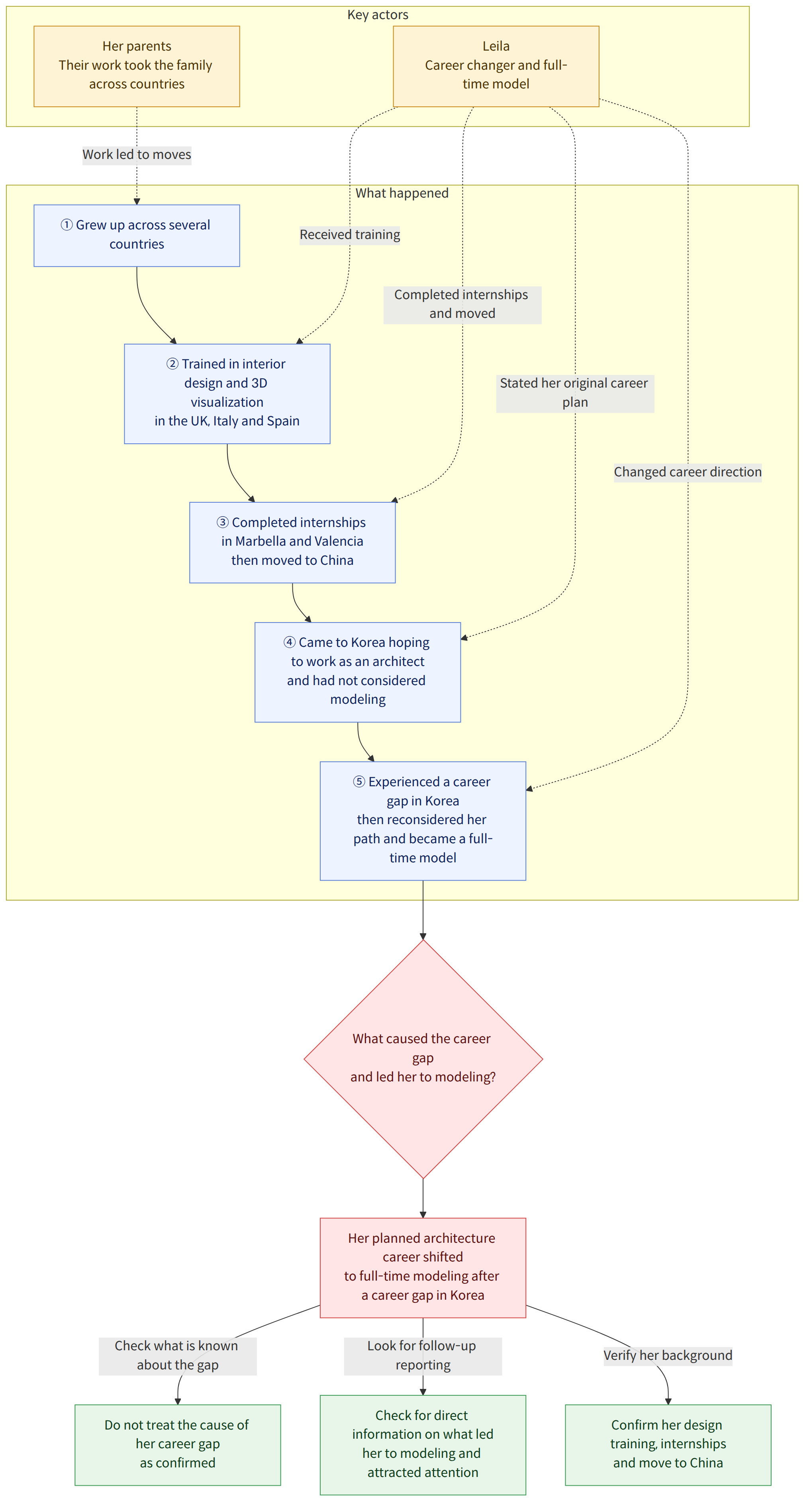
Tanoe Akuba Leila Olivia said that when she came to Korea, she wanted to work as an architect and had not considered modeling. However, after experiencing a career gap in Korea, she reconsidered her path and eventually became a full-time model. Her experience pursuing a career in design and her change of direction in Korea intersect in her story.
Background and context
Leila was born in Côte d’Ivoire to an Ivorian father and a Malian mother. Because of the nature of her parents’ work, she lived in several countries during her childhood. Drawing on that experience, she saw herself as “un enfant du monde,” French for “a child of the world.”
The childhood scenes she remembers include Manchester’s bright streets, Spain’s old streets and Italy’s busy roads. She also said she remembers enjoying Nigerian food and exploring the historic, colorful streets of Togo and Senegal. Living in several countries provides context for her upbringing, but the original article does not explain exactly how that experience directly influenced her switch to modeling.
Leila received professional training in interior design and 3D visualization (the process of representing a space or object as a three-dimensional image) in the UK, Italy and Spain. After completing internships in Marbella and Valencia, she moved to China.
What this story means
The change evident in this case is not simply the fact that she changed jobs. However, the original article does not explain the specific circumstances of her career gap or what prompted her to change direction, so it cannot be attributed definitively to a particular barrier or choice.
For example, if someone who received professional training in another country comes to Korea and experiences a career gap in their original field, Leila’s case can be read as one example of how a career may not proceed as planned. That does not mean everyone with a migration background has a similar experience or turns to modeling as an alternative. More information is needed to establish what steps Leila actually took to become a model.
What is confirmed and what remains unknown
Confirmed facts
- Leila said that when she came to Korea, she wanted to work as an architect and had not considered modeling.
- She received professional training in interior design and 3D visualization in the UK, Italy and Spain.
- After experiencing a career gap in Korea, she reconsidered her path and became a full-time model.
- She was born in Côte d’Ivoire to an Ivorian father and a Malian mother, and lived in several countries during her childhood.
- She moved to China after completing internships in Marbella and Valencia.
What remains unknown
- What were the specific circumstances of the career gap Leila experienced in Korea?
- What led Leila to attract attention as a model in Korea?
- What specific choices and steps led her to become a full-time model?
What readers should check
- When citing or referring to this story, it is important to distinguish the fact that she “experienced a career gap in Korea” from its cause. The original article does not give a specific reason for the gap.
- The reason for her switch to modeling and how she attracted attention in Korea cannot be treated as confirmed facts. To learn more, readers should check whether follow-up material is available that directly explains what happened.
- When reviewing Leila’s background, it is useful to distinguish which details are confirmed in the original article: her education in interior design and 3D visualization, her internships in Marbella and Valencia, her move to China, and her career gap in Korea.