
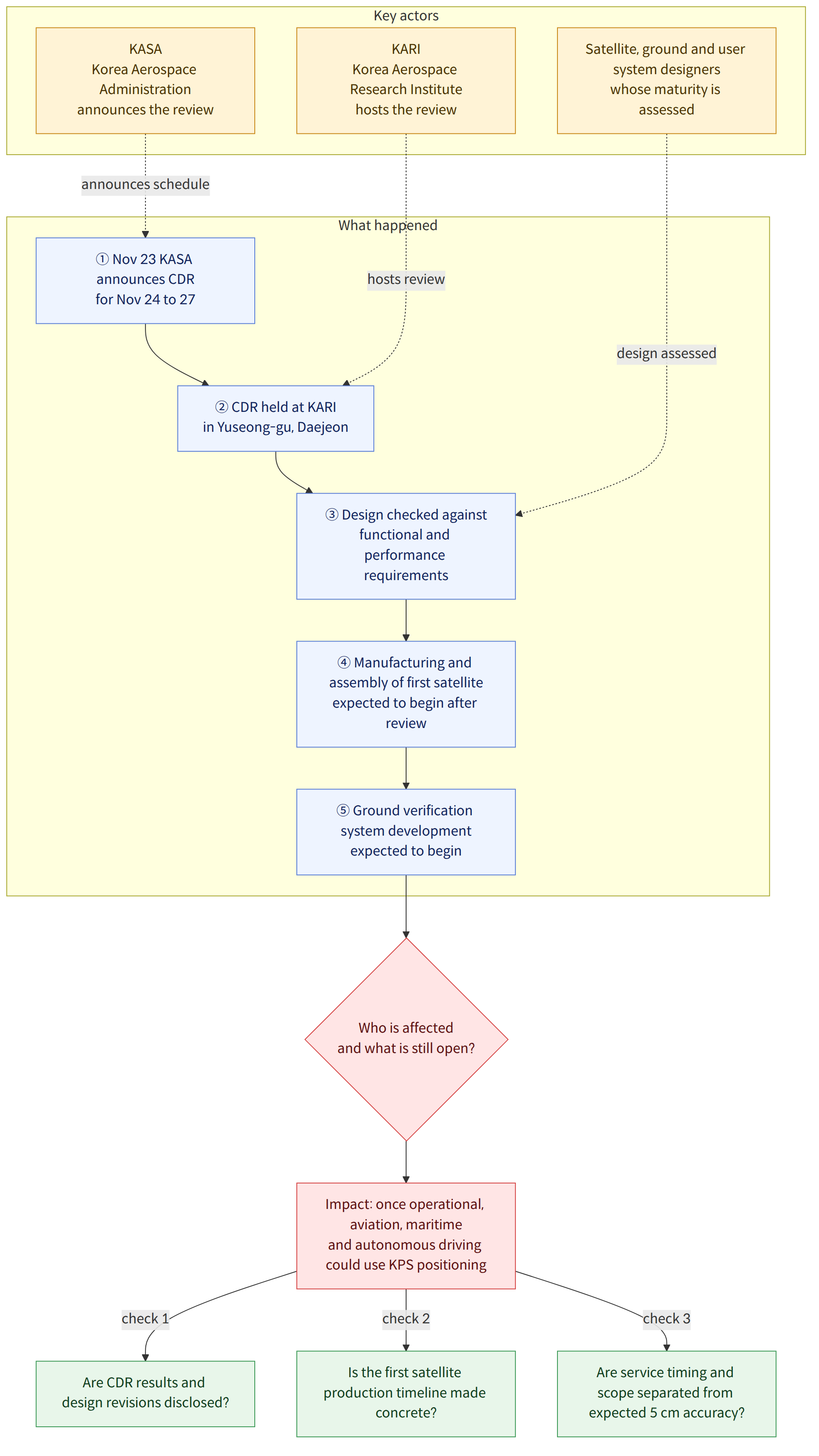
The Korea Aerospace Administration (우주항공청, KASA) announced on November 23 that it will hold a critical design review (CDR) from November 24 to 27 at the Korea Aerospace Research Institute (한국항공우주연구원) in Yuseong-gu, Daejeon. After the review, manufacturing and assembly of the first KPS satellite and development of ground systems for verification are expected to begin.
Background and Context
The CDR is the final checkpoint performed before production of the flight model (the satellite model that will actually be deployed for the mission), confirming whether the design meets the mission's functional and performance requirements. Because the KPS is not a system made up of satellites alone, this review will comprehensively assess how mature the designs of the satellite, ground and user systems are, and whether they can be linked with one another.
The KPS plans to provide high-precision positioning, navigation and timing information to the Korean Peninsula and surrounding regions. A project to deploy eight satellites by 2035 will receive 3.72 trillion won in public funding. The first satellite is scheduled for launch in September 2029, with a launch mass of 3.7 tons and a mission lifespan of 13 years and 3 months.
What This News Means
The CDR is notable as a gateway that must be passed before moving from design review to the production stage. If the review is completed on schedule and follow-on development proceeds, the KPS could move beyond design documents toward preparing for actual operation through satellite production and verification of ground systems. However, what this announcement contains is the review schedule and future plans; the review results and the specific timelines for manufacturing and assembly have not been confirmed.
Once the KPS is fully operational, Korea will become the seventh country to have its own satellite navigation system, following the United States, Russia, the European Union, China, India and Japan. The KPS is expected to provide high-precision position data with an error margin of 5 cm, and it could be used to improve the operational safety of aircraft, self-driving cars and drones. In autonomous shipping and smart ports, it is expected to support the adoption of artificial intelligence and digital transformation, and to help with maritime search and rescue operations.
For example, if the KPS is built as planned and related services are provided, operators of autonomous ships or smart ports could use high-precision position information to set up their operating systems. This describes expected potential uses and does not mean that any specific service is currently being provided in each sector.
Confirmed Facts and Unknowns
Confirmed facts
- The KASA announced that it will hold the KPS critical design review from November 24 to 27.
- The CDR is a procedure for checking whether the design meets the functional and performance requirements before flight model production.
- After the review, manufacturing and assembly of the first satellite and development of ground systems for verification are scheduled to begin.
- A public investment of 3.72 trillion won is planned for deploying eight satellites by 2035.
Unknowns
- It is not confirmed how the design was evaluated at the CDR or whether any supplementary items were identified.
- The specific start date for manufacturing and assembly of the first satellite has not been given.
- Based on this material alone, it is not possible to know the exact schedule and method by which KPS services will actually be provided to users.
What Readers Should Check
- Whether follow-up announcements disclose the CDR results and any design revisions.
- Whether the timeline for manufacturing and assembling the first satellite and the development plan for ground verification systems become more concrete.
- Because the 5 cm position error and industry-specific uses are expected performance and effects, check whether the timing and scope of actual service provision are presented separately.